
In what could be a watershed moment in Monterey County health care, members of the state’s Office of Health Care Affordability Board signaled they are interested in reigning in high costs at the three main hospitals—Community Hospital of the Monterey Peninsula, Salinas Valley Health and Natividad—during a daylong meeting that took place in Seaside on Wednesday, Aug. 28.
The meeting included emotional stories from people impacted by high hospital costs, as well as testimony with hard data outlining just how expensive the county’s hospitals are presented by OHCA staff, Covered California, CalPERS and a university professor. By the end of the day, it was clear those hospitals will remain under scrutiny of the regulatory agency and could face strict spending limits in the future.
Some board members raised the specter of forwarding any further data they find to the California Attorney General’s Office to investigate whether there had been any antitrust activity among hospitals resulting in higher prices.
The OCHA board was created just two years ago by the California Legislature and only began meeting 14 months ago. They have been working on a timeline to have a structure in place to begin regulating specific sectors of the state’s health care system, including geographic regions, by 2028. During the Aug. 28 meeting, board members asked if they could jump ahead of that process and begin scrutinizing Monterey County sooner.
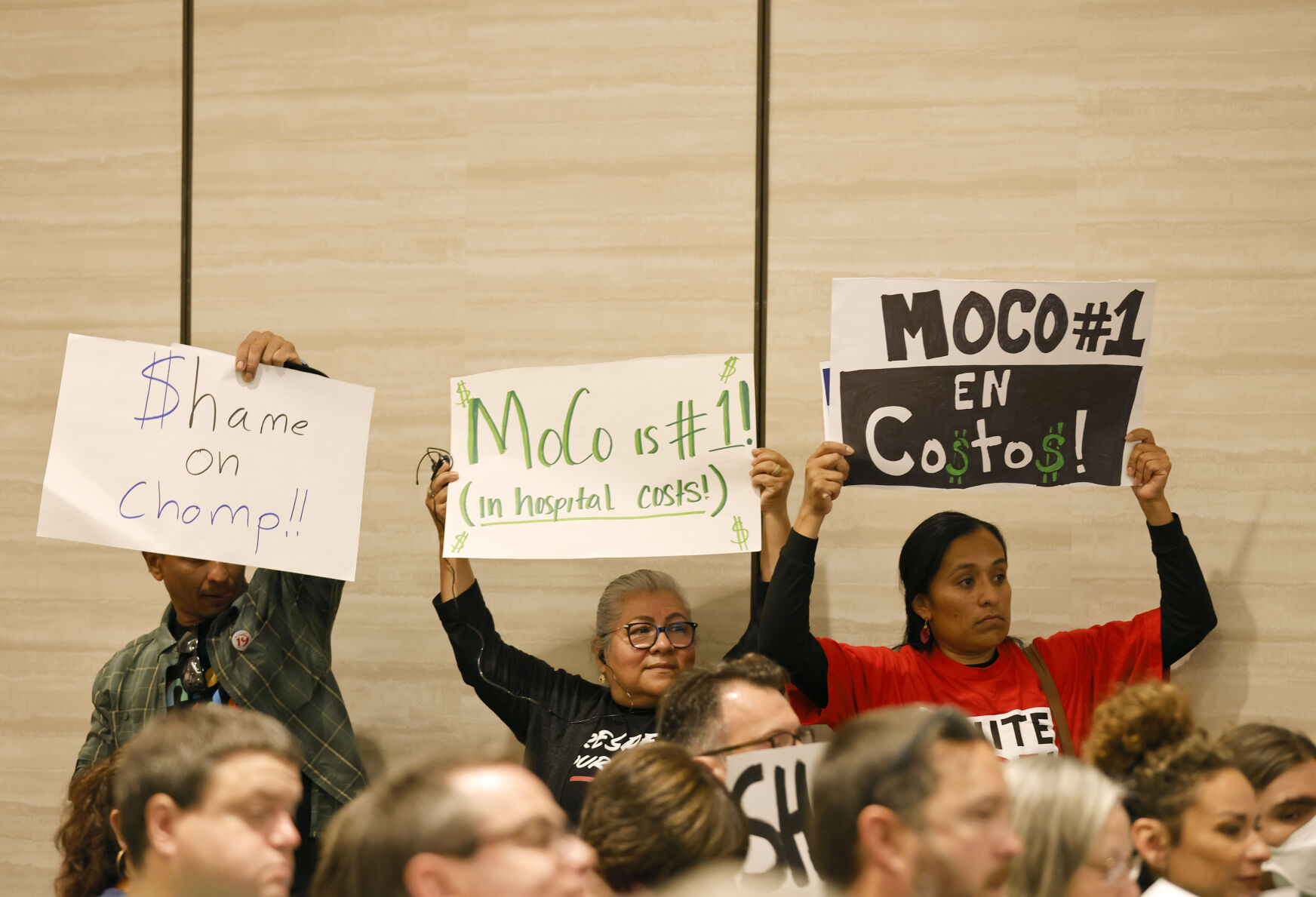
Some of the data collected by OHCA staff stunned the audience of dozens of people who filled a meeting room at the Embassy Suites Hotel in Seaside, the first time the board had met outside of Sacramento, motivated by workers who had trekked to the capital to speak at earlier meetings since last year. On Wednesday, union workers lined the walls holding signs that declared “Mo Co hospital rates are making us sick,” “Mo Co #1 en Costos!” (Spanish for “#1 in costs.”)
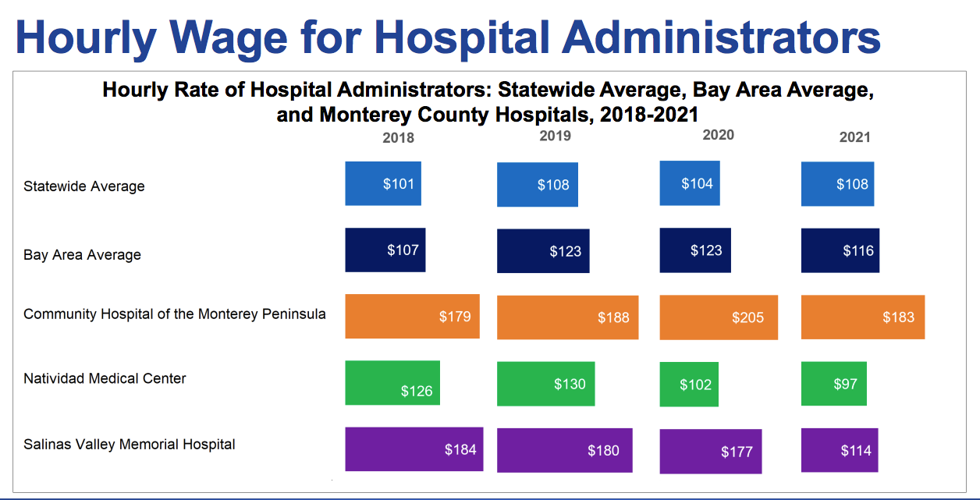
The audience was taken aback by hospital administrator salaries, which were found to be higher than those in the San Francisco Bay Area between 2018 and 2021, in particular at CHOMP. Multiple members of the audience could be heard uttering “wow” when a slide came up showing CHOMP administrators being paid $183 an hour in 2021, in comparison to the Bay Area average of $116 and the statewide average of $108. (Natividad’s hourly average for administrators was $97 in 2021; SVH’s was $114.)

From the OHCA staff presentation on hospital costs in Monterey County.
One OHCA board member later pointed out that executive salaries are probably a small percentage of the budget. However, some board members were incredulous at data presented that showed the three hospitals have positive operating margins, which indicates higher profitability, according to the staff report. Between 2018 and 2022, CHOMP and SVH had “significantly higher” operating margins than the statewide average, according to OHCA staff’s report.
All three hospitals provide less charity care—defined as the difference between the cost to the hospital for services provided to patients who cannot pay or for all or part of their bills and the amount paid for on behalf of the patient—than the statewide average.
“Where does the money go?” asked board member Ian Lewis, policy director for Unite Here Local 2, representing hospitality workers in the Bay Area. “I’m not asking that facetiously.”
The answer offered by staff and others was that it probably goes into reserves and endowments. Later, Lewis added a comment that the money goes into those reserves and endowments “after executive salaries get paid.”
Christopher Whaley of Brown University School of Public Health, who did his own study of the region’s hospital prices, suggested that it was the “market power and market concentration” by the three hospitals that was creating a high-price atmosphere, and that hospitals could charge their prices because they know they can collect them. He rejected hospital officials' arguments that they have to make up for the low rates paid by Medicare and Medi-Cal, as well as making up for uninsured patients who cannot pay.
Throughout the country, premiums and deductibles have outpaced worker wages since 2000, he said, with inflation rising by 167 percent, wages by 178 percent, contrasted to premiums at 355 percent and deductibles at 473 percent. He said that means less in workers’ paychecks for other living expenses.
He compared Monterey County hospitals to Bay Area markets and found that while the average for all California hospitals is that prices are 287 percent of what Medicare pays, the Bay Area average is 320 percent, SVH is 340 percent, Natividad is 420 percent and CHOMP is 466 percent above Medicare. Inpatient prices were significantly higher; outpatient prices were higher, but not as much.
Whaley also presented data that showed a cap on spending used in Oregon, at 200 percent of Medicare for public employees and teachers, led to a 25-percent reduction in outpatient prices per procedure and a 3-percent reduction in inpatient prices per admission. The state saved $54 million a year as a result. He estimated a similar policy in California could save $983 million a year.
In June the OHCA Board voted 6-1 to enact a phased-in 3-percent cap on spending increases for hospitals and medical facilities, beginning in 2025 with a 3.5-percent cap that year and in 2026, then lowered to 3.2 percent in 2027 and 2028, and finally 3 percent in 2029 and beyond.
Under the OHCA board’s regulatory authority, it could require a specific sector of the market—like the Monterey region—to have an even lower spending cap if it’s found that “market failure” exists. It’s possible the region could meet the legal definition of market failure, which would give the board authority to act.
Beth Capell of Health Access California, a 501(c)(4) organization that lobbies for better access to health care, said she believes Monterey County hospitals meet the standards for investigation of market failure. “We don’t usually talk about greed…but we have a health system here that has billion-dollar reserves,” she said.
OHCA would have to do more data collection before it could declare market failure and act to regulate the hospitals.
“I do think it would be useful—not to keep us from doing something—but useful to have a better understanding of, other than higher operating margins and higher pay for hospital administrators, what does account for the higher costs at CHOMP than the statewide average?” said board member Richard Kronick, a professor at UC San Diego and a former member of the Obama administration who worked toward the implementation of the Affordable Care Act.
“We know that costs are higher at CHOMP and my question though, is, at an accounting level…what parts of costs are higher?” he asked.
OCHA Chair Dr. Mark Ghaly, who is also secretary of the California Health and Human Services, agreed there was an “opportunity to dig a little bit more. Today has been terrific in terms of the presentations but by no stretch exhaustive. The next layer of the proverbial onion could be peeled away and some questions asked,” he said.
No local hospital representatives spoke during the meeting, but they released statements to the press during the day that indicate administrators are now well aware they are on OHCA’s radar and will have to make changes to lower costs.
Dr. Allen Radner, president and CEO of SVH, said the system takes the issue of health care affordability seriously. He said they had participated in a call earlier in the week with leadership at the California Health and Human Services Agency and were looking forward to working with OHCA, patients and community partners on the issue.
Montage Health, parent company of CHOMP, the focus of numerous comments throughout the day because of its status as the highest priced hospital in the region, released the most detailed statement.
“Montage Health is committed to lowering the costs of providing high-quality health care for the people living and working in Monterey County,” said Mindy Maschmeyer, director of marketing and communications. “We recognize that health care costs are too high.”
The first of three steps she said they are taking is a “Community Affordability Initiative,” to target $50 million in cost reductions over the next 24 months “which will allow us to lower our expenses and return those dollars to the community via lower rates. This is a priority for senior leaders in the organization and our frontline medical staff alike.”
She said that all 3,000 Montage Health employees “are actively looking at ways to reduce costs, increase efficiencies, and maintain excellent levels of care.”
Updates of the initiative would be provided “next month” to the community, Maschmeyer said.
The second step, she said, involves working with large employer groups and unions. She said Montage had reached an agreement with “the largest hospitality employer on the Peninsula,” which can access services at in-network rates. She said they had made the same offer to the local Unite Here union chapter.
Maschmeyer said Montage had made an offer to the Municipalities, Colleges, Schools Insurance Group that insures local teachers and other public employees, and the offer “would have substantially reduced the amounts paid to CHOMP by their 27 member agencies, including school districts like Monterey Peninsula Unified, as well as the City of Seaside. Unfortunately, as of today that offer has not been accepted. But we’re going to keep trying.”
The third point she made was that Montage Health’s price increase was 5 percent in 2023 and 4 percent in 2024. She said they are working on adjustments to meet OHCA targets.
A Natividad spokesperson provided a statement with the hospital’s mission statement and basic fact sheet about the hospital.
The complete OHCA staff presentation can be found here.


(2) comments
I attended Wednesday's OHCA board meeting and can attest that Pam's article accurately describes what went down. The torrent of data and related commentary depicted, as reported by Pam, "market failure" in this region, resulting in the highest hospital charges in the state. The question is whether and how soon the board will act on this information.
I attended most of the hearing, albeit remotely. Persons who are interested in this issue should read the charts/graphs provided by Pam Marino at the bottom of her article. My general overall impression, based on the hearing and the charts/graphs, is that the three main hospitals (Natividad, SVH, CHOMP) provided great service, better than statewide average, and accordingly their overall costs/patient are somewhat higher as well. I don't believe we should be lowering the standards to lower the costs.
My comment at the hearing was based on my experience producing Medicare all across the country. Regions with lots of insurance carriers tend to have better insurance costs for the patient. Currently, the three hospitals have an effective monopoly on Medicare Advantage plans. If the hospitals were to allow other carriers to enter Monterey County on a reasonable basis, the competition should lower costs somewhat for that particular demographic. I suspect the new State board will begin reviewing the non-Medicare side of the insurance carriers, to insure arms-length bargaining to keep the costs low.
One major factor for higher costs in Monterey County is the greater obesity of the population. Doctors should be encouraged to promote healthier lifestyles of diet and light exercise. Perhaps re-introduction of the old JFK program of the 50-mile-club in the secondary schools, and emphasis again on physical education, would work towards a healthier population to reduce costs. These are long-term goals, but they should be implemented anyway, if we wish to effectively reduce our costs in the long-term.
Welcome to the discussion.
Log In
Keep it Clean. Please avoid obscene, vulgar, lewd, racist or sexually-oriented language.
PLEASE TURN OFF YOUR CAPS LOCK.
Don't Threaten. Threats of harming another person will not be tolerated.
Be Truthful. Don't knowingly lie about anyone or anything.
Be Nice. No racism, sexism or any sort of -ism that is degrading to another person.
Be Proactive. Use the 'Report' link on each comment to let us know of abusive posts.
Share with Us. We'd love to hear eyewitness accounts, the history behind an article.