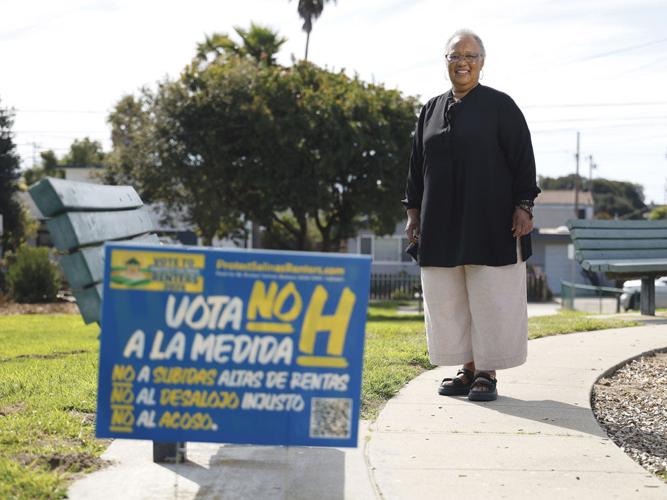


Gaye Freedman, 76, worries that she and her husband might be priced out of their Salinas apartment if rent stabilization and other housing-related ordinances are repealed at the polls.
Salinas is a city of renters; more than half, 52 percent, do not own their homes…
And over the past five years, those renters have become an increasingly visible political constituency. Former councilmember Anthony Rocha, who represented District 6 from 2000-2024, spearheaded an effort to implement rent stabilization and tenant protections. The council approved a mandatory registry for rental units in 2022, then in 2024, followed with approvals for three more ordinances that impose stronger tenant protections from evictions and harassment by landlords than those provided by state law, and set a maximum 2.75-percent annual rent increase (or 75 percent of the consumer price index, whichever is lower), on qualifying units.
It made Salinas the first city in Monterey County to implement rent stabilization, on buildings constructed pre-1995, citywide. And the policy discussion ignited a fierce political debate about housing with two defined factions crystallizing in defense of or opposition to the four ordinances.
The policies became a defining issue in the 2024 election season, which saw a whole new council swept into power, with three incumbents unseated and replaced by members who opposed the rent stabilization ordinances. (They won alongside other candidates aligned on the issue. Those members are Mayor Dennis Donohue; Gloria De La Rosa, who ousted Orlando Osornio; José Luis Barajas; Margaret D’Arrigo, who unseated Jesus Valenzuela; and Aurelio Salazar Jr., who took Rocha’s seat. Only two councilmembers in support of rent stabilziation – Andrew Sandoval and Tony Barrera, both up for reelection this Nov. 3 – remained.)
The new council voted 5-2 to repeal those four ordinances, with Sandoval and Barrera casting the two dissenting votes.
Two days later, Donohue convened a meeting in City Hall to announce an alternate plan to solve the city’s housing crisis. He appointed an ad hoc committee of himself, Barajas and De La Rosa to address the issue. Their task was to develop a $1 million-plus rental assistance program to help keep people housed; enhance tenant-mediation services; and expand outreach and education on tenant rights and resources. (Residents can apply for rental assistance via the Monterey County Office of Education or the nonprofit Echo Housing Program.)
“The ordinances that were put in place, which were well intended, would have exacerbated the problem,” Donohue said in his remarks on Thursday, June 5, 2025. “The real solution is to build more housing… Salinas has a long history of coming together to directly address tough problems.”
DONOHUE’S ANNOUNCEMENT came just about 36 hours after the repeal, but another initiative was already underway. Even before the 5-2 vote to make it official, on April 22, 2025, council voted to proceed in the direction of a repeal. After the vote, supporters of the policies started booing and shouting “disgraceful!” and “shameful!” in the council chambers.
Then they gathered outside and started talking about next steps.
On June 3, after the official vote, the group Protect Salinas Renters began collecting petition signatures for a referendum. They gathered over 10,000, more than the 6,998 required, leaving council with options: rescind their repeal ordinance, or let voters decide. The council chose the latter, and voters will decide on Measure H this Nov. 3. (Pending the election outcome, the repeal was temporarily suspended, meaning the four original ordinances are currently in effect.)
If Measure H succeeds, the council’s repeal will again take effect. If Measure H loses, the four renter-protection ordinances, including rent stabilization, will stay on the books. That would not, however, prevent a future council from amending those ordinances again.
Rosa Gonzalez became a volunteer with Protect Salinas Renters in its early days, before ordinances were inked and approved. “I got involved because I could see working families gouged by high rents,” she says.
“We know from talking to residents that negligent landlords are a problem, and people being afraid to ask for repairs because the rent will be increased – they are afraid to ask for anything from their landlords.”
For that reason, advocates pushed for multiple ordinances: the cap on rent increases, and protections to keep tenants housed.
At the time, Rocha, the policies’ champion on council, said, “The purpose of this is to make sure that people remain housed and to make sure that people who are living in unsafe living conditions fully understand their rights, and that they have greater protection under the law from abuse in the housing market.”

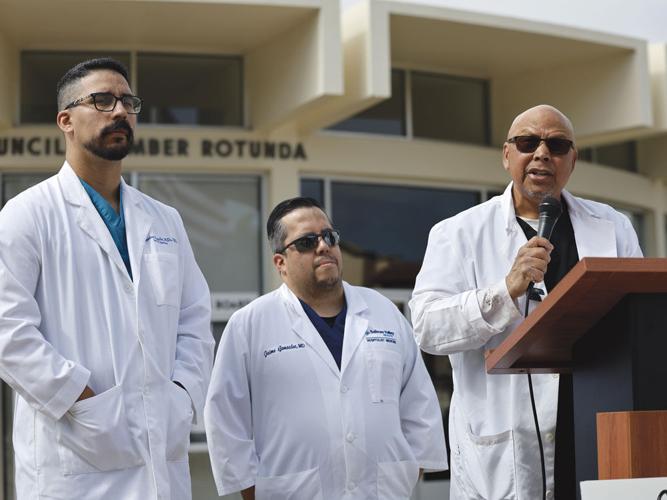
Rent stabilization and related policies have for years been a political lightning rod in Salinas. At top, a group of physicians speak about housing stability as a health issue during a press conference in April 2025 hosted by the group Protect Salinas Renters. “I was disappointed that all that hard work was erased for ideological moneyed interests,” says Dr. John Silva, at the microphone.
THE YES ON H GROUP, called Protect Salinas Residents, supports reinstating Ordinance No. 2687 (the repeal), citing impacts on local landlords and arguing the state already has adequate legislation to aid renters.
“These local ordinances go far beyond that, adding layers of bureaucracy, public registry requirements, and financial burdens that serve politics far more than they serve people,” Ignacio Fregoso, who is campaign committee chair for Protect Salinas Residents, said on the group’s website.
“Affordability is the issue of our time in Salinas,” according to the group’s argument in favor of Measure H. “The rental registry took effect May 4, 2023, with three more ordinances following after. Rents are still high.”
Since the coalition succeeded in getting the four ordinances overturned, they have also been building a campaign for Yes on Measure H and fundraising extensively. Campaign finance reports show Protect Salinas Residents has raised at least $272,925 since 2025.
Most donors are involved in the real estate industry; the largest donor is UDR Inc., which contributed $78,250. UDR is a publicly traded real estate investment trust based in Colorado that owns, develops and manages apartments nationwide. Next is the California Association of Realtors Issues Mobilization PAC, based in Los Angeles, with $60,000.
Outfundraised by about 4-to-1, Protect Salinas Residents has collected at least $68,770. Its largest donation is $10,000 from nonprofit AIDS Healthcare Foundation Inc. based in Los Angeles, followed by Jaime Gonzalez, a physician at Salinas Valley Heath, with $5,485.
GAYE FREEDMAN, 76, is a semi-retired Salinas resident who has lived with her husband in an apartment complex near Lucky supermarket on Blanco Road since 2017.
“It’s really hard to survive in Salinas and not have two full incomes,” Freedman says. “Even though I retired, I went back to working part-time.”
Their rent is $1,850/month for a one-bedroom apartment. “When we moved in it was $1,200. If it hadn’t been for rent stabilization, our rent right now would be over $2,100,” Freedman says, noting their unit hasn’t had any upgrades since they moved in.
If Measure H passes, Freedman says they might need to move, especially since food and gas prices keep spiking. At her age, she says, “it’s a massive ordeal to move again… If we [owned] a house, our mortgage wouldn’t go up like this every year.”
Freedman isn’t alone. Cost-burdened renters, households that spend more than 30 percent of their pretax income on rent and utilities, increased to 50 percent nationwide in 2022; that’s up by 3.2 percent compared to 2019, according to a 2024 report from Harvard Joint Center for Housing Studies.
As of Sept. 6 the average rent for a one-bedroom apartment in Salinas is $2,100 according to Zillow.
Freedman says she and her husband applied for affordable housing in Marina at Terracina at The Dunes, but their combined income was a few thousand dollars above the threshold to qualify.
“We are right now at the limit of what we could possibly afford,” she says.

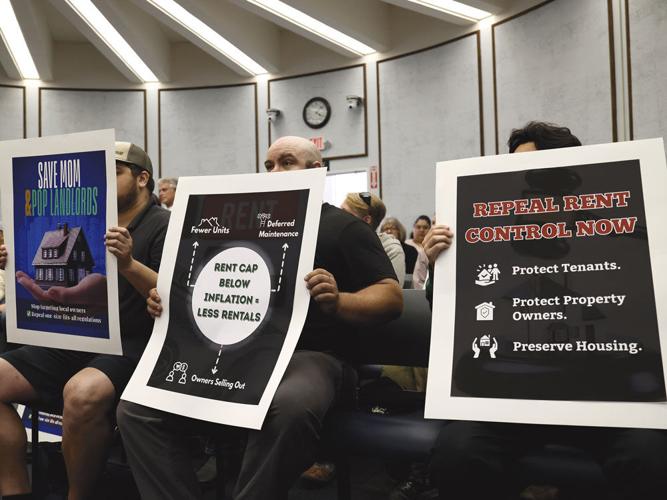
Property owners urged Salinas City Council to overturn a 2.75-percent annual cap on rent increases, which a new council agreed to do in 2025. “Good policy has to work over the course of time. In my mind, it was clear this was not a sustainable policy,” Mayor Dennis Donohue said.
WHAT IS NOT UP FOR DEBATE is that Salinas has a housing crisis. “There’s been so much emotion in this, from the renter community and the landlord community. I think everybody can agree we just have to build more units,” City Manager René Mendez says.
The last time the city had a major housing development was two decades ago. The city is making progress in increasing its housing stock but isn’t growing as fast as demand. According to Salinas’ housing dashboard, the city issued 544 permits from 2023-2026, and 323 are ready to use; all are for units at or above moderate-income housing.
According to a quarterly update produced by the Salinas Community Development Department in May, 8,376 units, or 27 percent of the total, were registered in the rental registry. In the first trimester of 2026, the city collected $754,568 in associated fees.
During that time period, city staff handled three rent increases and four rent reductions and there are five pending petitions. (Salinas’ communications department did not respond to repeated requests for additional information for this story.)
Since implementing the rental registry, fees have been adjusted. Landlords currently pay $29 annually per unit that is not covered under the rent stabilization ordinance; for those that are subject to the ordinance, meaning they are in multifamily dwellings constructed before Feb. 1, 1995, the fee is $112 per unit a year. The revenues go toward implementing other elements of the housing program.
Meanwhile, Mendez says, the issue of housing in Salinas has become a polarized one. “We struggle to have these conversations here because of the need of our community which is very real and which we have to address, we absolutely have to address it,” he says. “Now those conversations have become even harder.”
(0) comments
Welcome to the discussion.
Log In
Keep it Clean. Please avoid obscene, vulgar, lewd, racist or sexually-oriented language.
PLEASE TURN OFF YOUR CAPS LOCK.
Don't Threaten. Threats of harming another person will not be tolerated.
Be Truthful. Don't knowingly lie about anyone or anything.
Be Nice. No racism, sexism or any sort of -ism that is degrading to another person.
Be Proactive. Use the 'Report' link on each comment to let us know of abusive posts.
Share with Us. We'd love to hear eyewitness accounts, the history behind an article.