




Clementina Gonzalez, a hotel housekeeper from Marina, stood in a Sacramento conference room on May 23, 2023, before a committee of physicians, policymakers and industry experts. She spoke in Spanish, her daughter by her side serving as translator.
“Good afternoon. My name is Clementina Gonzalez and I made a three-hour trip here to tell you about my experience with a very expensive hospital in Monterey County,” she said, detailing how 10 years earlier she was hospitalized at Community Hospital of the Monterey Peninsula for a blood ailment requiring transfusions and other procedures.
“With even the health insurance that I had, I had to pay over $10,000. And I don’t have that,” Gonzalez said.
She and her family tried their best to repay the debt on time, but it went to collections, ruining her credit. Worse, the illness came back, landing Gonzalez back at CHOMP, facing more bills she couldn’t pay.
“My family and I are very stressed and depressed and had to cut back on other needs just to pay these bills back,” she said, then added: “Please do what you can to help people just like me.”
The floodgates were opened. For the first time, workers like Gonzalez had a powerful public platform before a regulatory board willing to hear their long-held grievances about the high cost of health care in Monterey County. Their stories included exorbitant hospital bills they couldn’t pay, along with shrinking paychecks due to ever-increasing health insurance premiums. In the months following Gonzalez’s remarks, more workers either made the trip to Sacramento or appeared online to testify remotely, mostly from unions representing employees from hospitality, agriculture and education.
They were flocking to the newly formed Health Care Affordability Board, part of the Office of Health Care Affordability, created by the California Legislature in 2022. The OHCA board, led by the secretary of the California Health and Human Services Agency, convened an organizational meeting on March 21, 2023. Its charge: To curb the spiraling health care costs in California, while ensuring quality care and equitable access, similar to eight other states in the country that have placed caps on growth in healthcare costs.
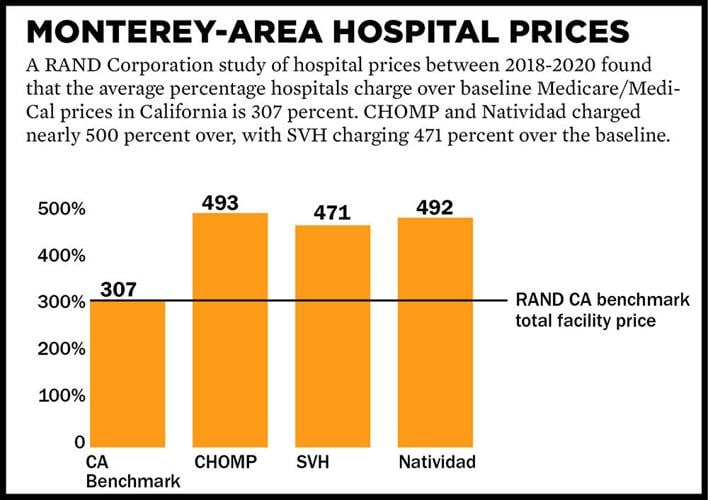
No doubt health care in California is expensive, but Monterey County is an outlier. Data from the RAND Corporation shows that two of the largest hospitals, CHOMP and Natividad, are in the top 10 percent of the most expensive hospitals in the state, and Salinas Valley Health is in the top 15 percent.
Why are hospital prices so expensive in Monterey County? Hospital leaders point fingers at insurance companies, low reimbursement rates for Medi-Cal and Medicare patients, drug costs and the high cost of living that requires higher salaries for staff. Union leaders point to a lack of competition, high administrative salaries, burgeoning reserves and investments.
When the OHCA board next meets on Wednesday, June 26 in Sacramento, it is expected to codify a cap on annual spending increases by hospitals and other medical facilities over the next five years. The plan, initially approved by a vote of 6-1 on April 24, will phase in the annual increases, with a 3.5-percent cap in 2025 and 2026, then lowered to 3.2 percent in 2027 and 2028, and then finally 3 percent in 2029 and beyond.
It’s potentially good news for the state. But for Monterey County, the fact remains, it’s a 3-percent cap on spending increases on top of prices that were already some of the highest in California.
IT’S EASY TO ASSIGN BLAME FOR HIGH COSTS IN THE HEALTH CARE INDUSTRY, because there are so many middlemen making money. Many entities besides the provider – like drug makers and device makers, pharmacy benefit managers and insurance companies – are profiting in between the patient-provider relationship.

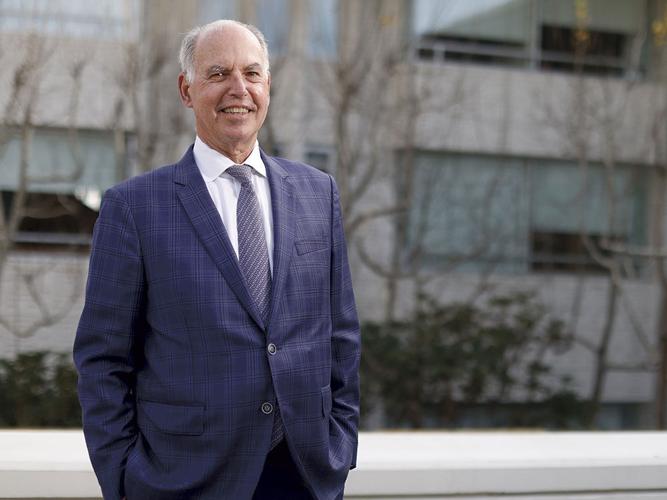
Dr. Steven Packer, Montage Health’s president/CEO who started as a pulmonologist, announced on June 10 that he’s retiring in 2025. He became CEO of CHOMP in 1999, when it was a 150-bed hospital; today it has 250 beds. The organization has grown from 1,200 employees to 2,800.
Even though regular people (patients) are the ones paying medical bills, they are rarely what medical administrators refer to as “payers.” That term describes the entities – usually insurers – that pay hospitals.
Those insurers come primarily in two buckets: government payers (Medicare, Medi-Cal and the military’s Tricare) or private payers (commercial insurance, like Anthem, Blue Shield or United Healthcare). When it comes to private payers, doctors and insurance companies negotiate behind the scenes (more on that later). When it comes to the former, medical providers are stuck with what they get from entities like Medicare and Medi-Cal. (Medicare is the federal program that insures elderly people ages 65 and up. Medicaid is the federal health insurance program for low-income people; California’s version of Medicaid is called Medi-Cal, financed in equal parts by the state and the federal government.)
The problem for local hospitals is that what Medicare and Medi-Cal pay is lower than the actual cost of care.
While Montage officials were not available for interviews for this story, in January, Montage/CHOMP’s CEO, Dr. Steven Packer, said this issue is the thing that keeps him awake at night as the biggest challenge his system is facing: “It’s the increasing gap between the expenses we incur to provide care and what Medi-Cal pays us and Medicare pays us. It’s continued inadequate government reimbursement.”
While there’s behind-the-scenes negotiation with private insurance companies, there’s no equivalent for these government payers; instead, payments are set through rulemaking processes established by the U.S. Centers for Medicare & Medicaid Services (CMS). Local providers are essentially powerless to change these payment formulas. (“The public can comment on proposed payment rates and policies, and CMS encourages public feedback as it works to finalize the payment rates and policies,” a spokesperson for CMS offers.)
“Those government plans do not reimburse at a rate that covers the actual costs of providing care to the patients,” Salinas Valley Health’s Chief Administrative Officer Gary Ray says in an emailed statement.
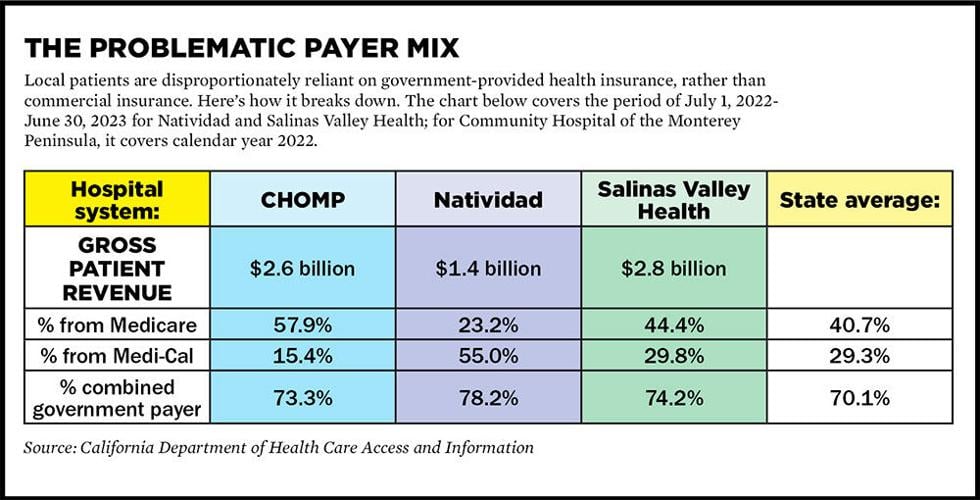
The problem comes when a significant portion of patients are government-insured, rather than privately insured – that means the so-called “payer mix,” that blend of the two buckets, skews heavily toward the lower-value payers.
“Seventy-five percent of the patients receiving care at Salinas Valley Health are government-insured, meaning they have Medicare or Medicaid,” Ray adds. “Creating equitable solutions in this healthcare environment is extremely challenging. Fewer than 25 percent of the patients in Monterey County have commercial insurance. When there is such an enormous imbalance in the payer-mix, commercial rates are driven higher and nowhere is that more evident than in Monterey County.
“When you look at the common drivers of health care costs, inflation, high cost of living and payer mix, Monterey County is unique. Even similar high cost-of-living areas such as the Bay Area and Southern California have a more balanced payer mix. The facts in this situation are frustrating to all of us.”
THE RESULT OF THAT PAYER MIX (see chart) is that local providers are especially reliant on the commercial payers to keep their business model working. That means patients with commercial insurance effectively subsidize those with government insurance, and local hospitals need to negotiate terms with private insurance companies that make the math work out.

Editor's note: This chart has been corrected to reflect the accurate state averages, which are much closer to local Monterey County hospitals than previously calculated. The combined government payer revenue is 70.1 percent, not 34.9 percent as originally reported.
Those negotiations happen mostly behind the scenes, out of the public eye. But once in a while, they come into clear view.
That happens with relative frequency in Monterey County Superior Court, where CHOMP takes insurance providers to court, claiming that insurers are improperly denying payments.
An even more public insurance negotiation happened last year when Salinas Valley Health officials decided to announce publicly that they’d reached a stalemate with Anthem Blue Cross.
On July 27, 2023, then-SVH CEO Pete Delgado wrote a letter to patients explaining that after five months of negotiations with the insurance company, they could not reach an agreement. With no new contract, thousands of Anthem-insured patients were set to go out of network on Aug. 1.
“For months, Anthem, which is among the largest and most profitable insurance companies in the country, has refused to pay us fairly for the services we provide, using its size and power to insist that we accept an unfair contract,” Delgado wrote. “To minimize impact to our community, we offered to extend our current agreement through the end of the year. Anthem flatly refused. Anthem’s action demonstrates that it continues to put its own interests first, at the expense of its members.”
Delgado went so far as to suggest patients switch insurance companies.
An Anthem Blue Cross spokesperson at the time deflected it back onto SVH: “It’s disappointing that Salinas Valley Health would threaten to terminate its contract with us unless we agree to significantly increase local health care costs for our members, employers and families in Monterey County,” the spokesperson said. “The increases being sought by Salinas Valley Health are unsustainable and will lead to significant cost increases and result in higher premiums, deductibles and copays for local health care consumers.”
The standoff was high stakes. About 11,000 Anthem Blue Cross patients had visited SVH or affiliated Salinas Valley Health Clinics the year prior.
County Supervisor Luis Alejo, writing on behalf of the Monterey County Board of Supervisors, wrote to Anthem: “Where are the increased premium dollars going if not to the health systems providing care to those paying the premiums?” At the time, Covered California – the state’s health care exchange established by the Affordable Care Act, which allows people to purchase subsidized insurance plans – reported that Anthem’s premiums were rising by 11 percent.
Eventually, four months later, Anthem and SVH reached an agreement. Anthem patients would remain in-network, just as the open enrollment period for 2024 was set to begin.
And then early in 2024, SVH would find itself in highly public negotiations with another insurance provider.
MCSIG STANDS FOR MUNICIPALITIES, COLLEGES, SCHOOLS INSURANCE GROUP, which started in 1982 as a joint powers authority, composed of various government entities that pooled into a collective insurance group. Today, it insures 11,070 subscribers (and their family members) employed by 28 member agencies. The list includes local school districts such as Monterey Peninsula Unified, Carmel Unified, Salinas City Elementary and Salinas High School Unified, as well as the City of Seaside and some more far-flung members, like the El Dorado County Office of Education (in the Lake Tahoe area).
It costs about $15,912 to insure one employee/patient per year. Each employee has different options for plan configuration through their employer, but the cost, determined by an actuary, is immovable.
The most popular plans, unsurprisingly, are the cheapest for the insured, in which they pay a lower premium. The rule of thumb is that higher premiums pay for better coverage, and the same goes here. Until March 1, 2024, members of MCSIG’s lowest-premium plan – the PPO Select, also the most popular plan – had insurance cards that conveyed a strong message in all-capital letters: “NO MONTEREY COUNTY HOSPITALS ARE COVERED UNDER THIS PLAN.”
The actual business of insurance and claims is managed by Blue Shield, but MCSIG leadership negotiates the plans. And MCSIG members have been a regular presence at OHCA meetings in Sacramento, and an increasingly vocal presence locally when it comes to health care expenses.
They’ve been unable to reach agreements with Natividad and CHOMP, but as of March 1, SVH began accepting PPO patients insured through MCSIG. (Patients with different plan configurations were covered at local hospitals prior to the agreement.)
Organizers and SVH administrators trumpeted the agreement as a breakthrough.
“Salinas Valley Health recognized that many teachers and other educators in our area were falling through the cracks of unaffordable commercial health insurance plans and low cost government healthcare programs,” SVH CEO Allen Radner said in a statement. “The situation was unacceptable. We listened to concerns and diligently worked with MCSIG to provide educators with local, quality care at no additional cost to them.”
Steve McDougall is a longtime teachers union rep, now serving as president of the California Federation of Teachers early childhood through grade 12 Division Council of Locals. He also serves on the MCSIG board, and spearheaded the effort to get PPO-insured patients in-network at a local hospital.
“Our members win. They have an in-network hospital,” McDougall said at the time. “Good on [SVH] for working with us on this. Maybe we can get similar things done with other hospitals.”
McDOUGALL IS FIRST AND FOREMOST AN OLD-SCHOOL UNION ORGANIZER, but he’s gotten a crash course in health care and now that is a major focus.

The Natividad Board of Directors (shown on June 14) governs the public hospital, owned and operated by the County of Monterey. Board members are appointed by the Monterey County Board of Supervisors. In January 2015, the hospital became a Level II trauma center after a competitive process versus SVH.
He is now ready to advocate for MCSIG members to boycott two of Monterey County’s three major medical systems. “If I had things my way, we would steer all our business to SVH, and starve Natividad and CHOMP until they do something akin to what SVH has done,” he says.
(In a nod to the challenging landscape for educators, Montage announced in March it was donating $5 million to create the Montage Health Fund for Teachers at the Community Foundation for Monterey County, with the funds intended to go to teachers as cash that might be used to offset medical costs. McDougall, along with other teachers, received a $1,000 check at the end of the 2023-24 school year but says he won’t cash it: “I call that a prop. It was to make the folks rattling cages with Montage look like fools.”)
Union members have regularly spoken up at OHCA meetings. For Hector Azpilcueta of Unite Here Local 19, representing hospitality workers in the region (like Gonzalez who is struggling with medical debt), the creation of the OHCA board was “the light at the end of tunnel,” an opportunity to finally shine the light on Monterey County’s high hospital prices. Alongside a coalition of representatives from other local unions, they’re working with OHCA to bring the board to Monterey County later this summer for a public meeting where workers and anyone else concerned about high prices can share their stories.
The union coalition is also working on gathering more allies to their cause, including politicians. “At the end of the day, all the politicians locally have a stake in it,” Azpilcueta says. “They need to work with us on finding solutions on how to control these crazy prices in Monterey County.”
At the next OHCA meeting (at 10am Wednesday, June 26), the board is expected to formalize its April decision to impose a spending growth cap on hospitals and other medical facilities, beginning with 3.5 percent in 2025 and 2026, landing on 3 percent in 2029. It is open to the public, instructions on how to participate online are available at hcai.ca.gov/public-meetings.
The first year is a test run, with no penalties for hospitals that spend over the limit. Beginning in 2026, OHCA will have enforcement power – the penalties are yet to be determined.
ACCORDING TO MONTAGE HEALTH CHIEF DEVELOPMENT OFFICER KEVIN CAUSEY, the system’s net increase in spending for 2023 was at “a very reasonable 3.8 percent,” he said in an email statement, taking into account all health care provided by Montage throughout the county. Montage Chief Financial Officer Matt Morgan states the nonprofit health care organization operates in compliance with all state and federal regulations, including the spending target mandates. “Montage Health has a history of passing along financial savings to our community directly, and we intend to do just that as a result of our current efforts to reduce costs,” he says.
Natividad officials declined to speak in specifics about the 3-percent cap, but CEO Chad Harris says: “At the end of the day, for us, it’s about the services and continuing to provide these services and be sustainable in the long run. We have been here for 138 years, and we want to be here for 138 more.”
At SVH, Radner agrees that ensuring the sustainability of the system is critical, but also that the cost of care is too high. “There is no question the cost of commercial health care is too expensive nationwide and in Monterey County,” he says in an email. “We have worked diligently over many years to expand access to affordable quality care to everyone in our community regardless of their insurance provider.”
These hospitals provide care to anyone regardless of insurance. Under California law, hospitals must make “charity care,” or discounted care to low-income uninsured patients or low-income patients with high medical bills.

RUNNING A HOSPITAL IS UNQUESTIONABLY EXPENSIVE. According to CHOMP’s nonprofit Form 990 filed with the IRS, in 2022 its total expenses were just over $1 billion and revenue was $828.4 million, resulting in a loss of $188.7 million. (CHOMP’s total assets were listed at $217.5 million.) Expenses include $415.2 million in salaries, other compensation and employee benefits. Labor union representatives argue that salaries include millions for CEO pay at local hospitals. Packer made over $2.5 million in 2022, up from $1.5 million in 2018. Even so, the combined salaries of Packer and all other Montage vice presidents are around 2 percent of all salaries and benefits.
At Natividad, Harris earned a little over $455,000 in 2022, according to State Controller records. Radner was appointed on June 6 by the SVH board as CEO after serving for six months as interim CEO; the board is set to approve a contract and salary on June 27. His predecessor, Pete Delgado, earned $1.35 million in 2022.
Insurance companies are already dealing with a different kind of cap, thanks to the Affordable Care Act of 2010, which sought to rein in profits. The so-called 80/20 rule means that insurance companies must spend at least 80 percent of revenue from premiums on medical care and quality. If they spend less than that, they must rebate customers to get to 80/20.
As to whether the 3-percent cap imposed by OHCA on providers will make a difference for regular patients, McDougall is skeptical. “Three percent on top of a lot, compounded annually, is still a lot,” he says. “Monterey County is still going to suffer this anomalous situation until the hospitals change their business practices.
“For the whole state, this reining in the total expenditures at least slows this runaway train in the state of California.”
(0) comments
Welcome to the discussion.
Log In
Keep it Clean. Please avoid obscene, vulgar, lewd, racist or sexually-oriented language.
PLEASE TURN OFF YOUR CAPS LOCK.
Don't Threaten. Threats of harming another person will not be tolerated.
Be Truthful. Don't knowingly lie about anyone or anything.
Be Nice. No racism, sexism or any sort of -ism that is degrading to another person.
Be Proactive. Use the 'Report' link on each comment to let us know of abusive posts.
Share with Us. We'd love to hear eyewitness accounts, the history behind an article.