
Just like there is a season for certain crops, there is a season for certain parasites.
Roughly two-and-a-half months after the start of cyclospora season, which typically begins May 1, U.S. Secretary of Health and Human Services Robert F. Kennedy Jr. famously said in a July press briefing, “We have the outbreak under control.” His department oversees the Food and Drug Administration and the Centers for Disease Control, two federal agencies responsible for working with state public agencies on detecting the outbreak and investigating potential food sources linked to the parasite.

Although no product from California was linked to this summer’s cyclospora outbreak, lettuce operations of all sizes were affected across the region.
Since May 1, nearly 19,600 people have been sickened by the food-borne illness across 49 states, with 1,043 hospitalizations and two deaths recorded. This year’s cyclospora outbreak is the worst of its kind on record, according to an analysis by the consumer watchdog group U.S. PIRG Education Fund, and the third-largest foodborne illness outbreak behind two salmonella outbreaks, one in 1994 and the other in 1985.
“There are certainly less human resources and capabilities because of the changes to both the CDC and FDA,” says Trevor Suslow, a UC Davis professor who serves as a technical adviser to the Center for Produce Safety. “They’ve lost quite a number of their experienced senior people in the divisions that dealt with this before, and they’ve also changed the requirements for reporting within their sentinel systems.”
In 2025, the FDA lost 21 percent of its staff. The CDC lost 15 percent of its staff. The layoffs were part of HHS’ “transformation to Make America Healthy Again” in accordance with President Donald Trump’s executive order, “Implementing the President’s ‘Department of Government Efficiency’ Workforce Optimization Initiative.”
In April of this year, the U.S. Department of Agriculture announced it would decommission its Beltsville Agricultural Research Center, impacting ongoing experiments that generate data on how these pathogens behave and how to control them. Since, according to news reports, two of three food safety research projects dedicated to study the parasite have been cut.
The outbreak has nonetheless put a massive spotlight on the food safety system for produce. While the response and tracing has been spotty – the FDA and CDC are investigating at least six other clusters, as of Aug. 31, for which sources have not yet been confirmed – many experts argue the food-safety standards and regulations are generally robust but not perfect, while prevention research can and should be improved.
“Every program can be reviewed for optimization and best use of resources and to refine projects,” Suslow says. “But to just say the whole thing goes away is a loss for science and the public.”
CYCLOSPORA IS NOTORIOUSLY DIFFICULT to detect environmentally and study in the laboratory. Unlike E. coli and salmonella, bacteria that can be cultured and multiplied in a lab setting, cyclospora can’t. Researchers are therefore left trying to find a tiny number of oocysts (microscopic parasite structures) in a given sample of water, soil or produce.

Both biological and regulatory reasons have made the parasite particularly difficult to track and contain its spread. Cyclospora, a microscopic parasite which causes a diarrheal illness, is difficult to study in a laboratory setting. Its only known host is the human intestine, where its lifecycle is completed.
Across an entire field, or in the vast quantities of water used in farming, contamination is extremely patchy which makes standard sampling plans underpowered to catch something so sparse.
“It’s a needle in a haystack,” says Joelle Mosso, associate vice president of science programs with Western Growers Association. She adds that testing is only as good as the sampling, and with water or produce, very large volumes are needed to find a sample of the parasite, which is likely very diluted.
“We need to step back and say, ‘We want the test to teach us something such that we can be better in the future,’ and that may require a very different approach to how we look at testing and technology.”
The FDA’s main preventative food-safety system is known as the Produce Safety Rule, under the Food Safety Modernization Act, which provides a framework for evaluating farms that grow produce that is generally eaten raw or receives little processing. The FDA has inspectors that visit farms in person – they do things like walk the fields, interview workers and examine records and practices. Federal regulators also work with state regulatory agencies to conduct inspections.
But it was California and Arizona’s Leafy Greens Marketing Agreements (LGMA), which formed a decade before FSMA, that shaped the federal produce safety framework. The E. coli outbreak in 2006 linked to contaminated spinach prompted industry leaders and state regulators to create stricter standards.
LGMA built a highly prescriptive code of conduct, requiring farmers to look at things like water quality and worker hygiene, land uses and soil amendments, a model which continues to serve as a template from which the FDA seeks to learn. In August, LGMA staff hosted an educational farm tour in the Salinas Valley for FDA fresh produce safety staff, where attendees learned how LGMA works to minimize risk related to agricultural water.
“It’s important to remember that although there is no acceptable number of outbreaks, the industry really does work very hard day in and day out to try to keep food safe,” says Jennifer McEntire, founder of Food Safety Strategy, a food safety consulting firm based near Washington, D.C. “I fear that sometimes with these outbreaks there’s a perception that it’s all about profits.”
In California and Arizona, cyclospora hasn’t been as much of a risk historically, Mosso says, emphasizing that when it comes to risk management, risk is dynamic, and isn’t the same everywhere. While the parasite has been less of a risk in California, the LGMA protocols may have an indirect impact on reducing the potential pathways for cyclospora.
Active surveillance is needed, according to leading experts, and a critical part of that is long-term research.
“There are very few people in the world who are experts in this organism,” Mosso says. “It’s not as simple as just moving a lab and having new people do the work. It takes decades to learn and become an expert in something.
“Longer term, we need to look really holistically about our food system and how we want it designed. Do we want to design it such that we just chase outbreaks, or do we design it such that we identify ways to prevent them?”
ON THE FIRST OF JULY, the Michigan Department of Health and Human Services announced it was actively investigating a large and growing outbreak of cyclosporiasis, a diarrheal illness.
“As of Tuesday, June 30, more than 170 cases have been reported,” the announcement said. “Typically, Michigan only identifies around 50 cyclosporiasis cases per year.”
Just over two weeks later, that number had grown to 7,000 cases, spreading to multiple states. It was through media scoops that the public was first alerted to the fact federal officials were investigating Taco Bell and its lettuce supplier, Taylor Farms, as a likely contamination source.
What followed was an incredibly rocky beginning to how public health communications should typically run. On July 17, the U.S. Food and Drug Administration linked Taylor Farms de Mexico to the outbreak as the supplier of “shredded iceberg lettuce used by Taco Bell locations where sick people ate before becoming ill.”
Two days later, the FDA retracted a separate test result, saying the finding was a false positive, but still linked Taylor Farms to the outbreak. Taylor Farms responded, saying “Today, FDA apologized to us,” to which the FDA publicly denied. Taylor Farms later deleted its post regarding the apology.
Confusion swirled. “This false-positive lab sample DOES NOT change the basis for FDA’s ongoing outbreak investigation or the overwhelming epidemiological data supporting the current voluntary recall by Taylor Farms,” the FDA announced. Meanwhile, state health officials in North Carolina began to say parsley and cilantro appeared to be potentially linked to cases in the state. No announcement has yet been made from the FDA on this link.
“We maintain best-in-class cyclospora prevention protocols and invest more than $200 million annually into our independently audited and verified food safety protocols,” a Taylor Fresh Foods spokesperson wrote in a statement to the Weekly. The company says it had temporarily suspended production of all products on July 18, and commissioned independent experts to conduct “top-to-bottom review of food safety processes and protocols in our central Mexico facility.”
The Weekly filed a Freedom of Information Act request with the FDA seeking all communications and records related to their test results, notifications and findings regarding Taylor Farms and its role in the outbreak. On Aug. 25, the FDA responded: “We are denying your entire request.”
The basis for the denial is that the agency is allowed to withhold records “compiled for law enforcement purposes when disclosure could reasonably be expected to interfere with enforcement proceedings.”
Both biological and regulatory reasons have made the parasite particularly difficult to track and contain its spread, according to the John Hopkins Bloomberg School of Public Health. In addition to cuts to staffing and funding for inspections, they argue more of the system is left dependent on voluntary industry participation.
Programs like FoodNet, a joint CDC-FDA-USDA-EPA active surveillance system helped with this, building a detailed picture of foodborne illness trends across 10 sentinel sites, covering 16 percent of the national population. In July 2025, reporting cyclospora, along with five other pathogens, became optional. While the CDC still works with local and state agencies to receive reports of disease data, experts argue that reducing FoodNet’s reporting requirements weakens our depth and understanding of trends for cyclospora and other pathogens.
An article published in the journal The Lancet Microbe in August took a hard look at gaps in knowledge about the parasite, and also the failures of the system that did not catch it.
“The philosophical question posed by this outbreak is fundamental. The greatest victories of public health are invisible: the outbreaks that do not occur and the cases that are never counted,” the authors wrote. “Active surveillance constitutes the foundation upon which this invisible success is built; it is the constant, unglamorous, and costly work of observation that enables intervention at the margins and averts catastrophe.”
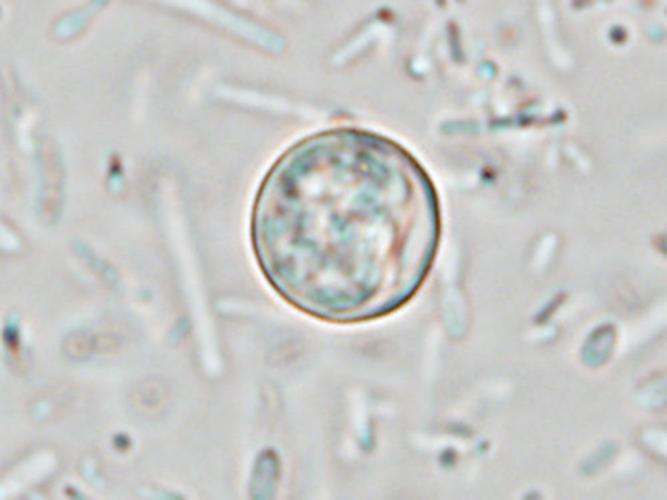
THE OOCYST OF CYCLOSPORA CAYETANENSIS, a single-celled protozoa, is about 8-10 microns in diameter, or 8 thousandths of a millimeter.
Its only known host is the human intestine, where its lifecycle is completed, and an infected person’s poop contains oocysts.
The parasite does not spread person to person; that human feces is non-infectious. It might take a week or more outside of the human host for those oocysts to undergo another biological step, sporulation, which occurs only outside of the body. From there, if those sporulated oocysts come in contact with food and are consumed by others, the cycle of infection continues. As the CDC puts it: “Cyclospora spreads when people eat food or drink water that is contaminated with human feces (poop).”
It requires a human host to go through its complete lifecycle, and with current research capabilities, scientists cannot replicate it in a test tube. But not only is it hard to study, the protozoa’s thick walls make it resistant to tools like disinfectant. (Cooking does kill it, which is unhelpful for lettuce, berries and other produce eaten raw.)
There is a seasonality to cyclosporiasis illnesses, generally May through August. Environmental conditions, notably warmer weather, are favorable for the parasite to grow outside the body, not to mention much of the produce implicated by the organism is harvested during the same months.
In June, David Ott of Texas was in Youngstown, Ohio. Twice, on June 18 and 20, he purchased Taco Supremes from Taco Bell store number 027999. By the morning of June 22, he was ill – “excruciating abdominal pain, horrible gas, diarrhea, a constant urge to vomit, low-grade fever, dizziness, nausea and headaches,” according to a lawsuit filed in July.
He was hospitalized for two days then sent home with an antibiotic. He tested positive for cyclospora.
While the parasite is only very rarely deadly, it is nasty, as Ott’s example – one of thousands – reveals.
The 27-year Army veteran is believed to be the first plaintiff of more than a thousand, and counting. Attorney Ron Simon of Ron Simon & Associates based in Texas is representing Ott and another 1,200 plaintiffs in 29 states so far. Ott is suing Taco Bell and Taylor Farms.
Simon anticipates the companies implicated will eventually pay out hundreds of millions of dollars in settlements to thousands of plaintiffs. “This is the largest outbreak in American history,” he says. (Simon does not file class-action cases, calling that approach “lazy.” “Each of these clients has different medical bills, different amount of time they were sick, and a different story,” he adds. “It is my job to make sure they are heard.”)
There is also at least one federal class-action case already filed against Taylor Farms and Taco Bell. The focus is economic losses, rather than personal injury from food poisoning. Lead plaintiff Lawrence Null of West Virginia bought three cheesy bean-and-rice burritos with iceberg lettuce at a Taco Bell on June 29. “Plaintiff would not have purchased the products, or would not have paid the price he paid, had he known the lettuce was contaminated and could not lawfully be sold for human consumption,” according to the case.
Simon expects that we might learn the most about what happened through the litigation. Meanwhile, investigators in Mexico continue looking into what happened. “The CDC is trying to track all of this down, they are doing a pretty good job, but they were behind the curve,” he says. “A big part of the problem is this administration, no matter which side of the aisle you fall on. They’ve made major cuts and there’s just not enough people to investigate.
“As a result, this outbreak happened, and it happened at a much bigger scale. It’s like trying to solve a problem with your hands behind your back. They are working their asses off, I feel sorry for them.
“Of all places to cut costs, you are going to cut our food system?”
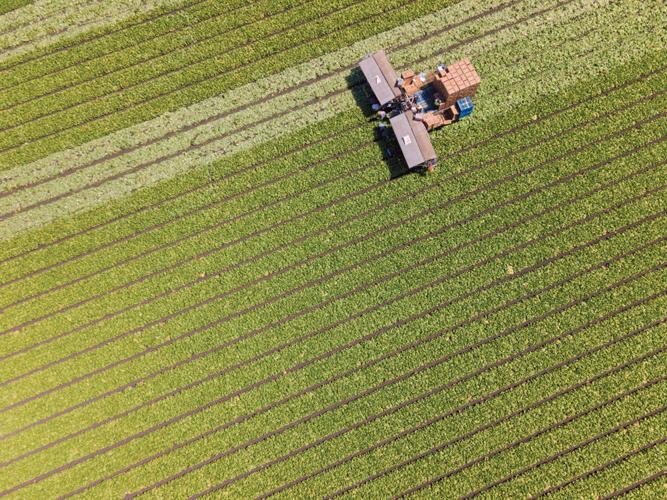
DRIVE THROUGH THE SALINAS VALLEY at the end of July and one would likely encounter fields of lettuce being destroyed.
In the early days of the cyclospora outbreak, and in the mess of the FDA’s communication alerting the public to findings of their investigation, consumers grew fearful of eating fresh produce. Internet speculation began linking Taylor Farms as the supplier even before the FDA’s official announcement July 17, which was quickly followed by Taylor Farms de Mexico initiating a voluntary recall of iceberg lettuce sourced from central Mexico.

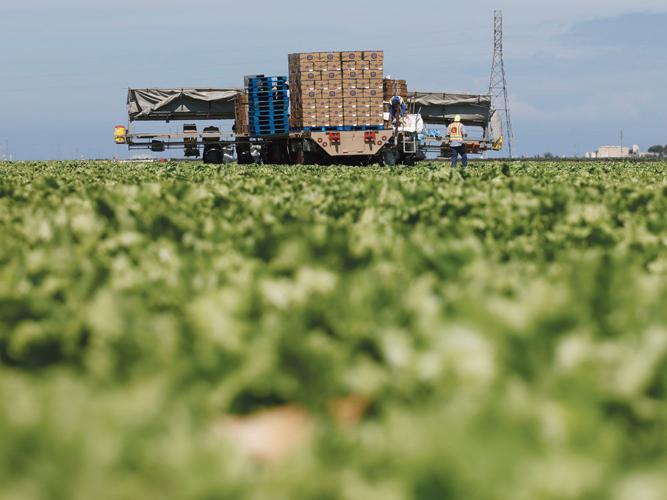
Growers at Boutonnet Farms harvest lettuce in the Salinas Valley. Roughly 46 percent of the company’s crops are lettuce. In July, about halfway through a typical lettuce season, the company discarded roughly 50,000 cartons of head lettuce, along with another 25,000 cartons of romaine.
Taylor Farms and various trade associations were quick to send out statements seeking to assure consumers that lettuce grown here was safe, but consumer confidence was shaken.
“An economic impact was felt here even though the product was not from the U.S., California or this region,” says Christopher Valadez, president/CEO of the Grower-Shipper Association of Central California. “We saw that all operations, regardless of size and scale, were impacted. As for processing facilities, they too were impacted.”
Iceberg lettuce prices saw a 16.4-percent plunge in July, according to Consumer Price Index reports. Consumer skepticism rippled across the country, impacting lettuce growers in Monterey County, where roughly 56 percent of the nation’s head lettuce and 61 percent of leaf lettuce is grown.
“I haven’t totaled everything up, but on head lettuce, I think it was right around 50,000 cartons, which would be 50 to 60 acres of head lettuce and about half of that worth of romaine,” says Ryan Kelly of Boutonnet Farms. He explains that many growers across the Salinas Valley have disced their fields, a practice by which farmers destroy the crop by mechanically processing it into the ground.
With roughly 46 percent of its acreage devoted to lettuce, Boutonnet Farms, like other growers in the region, faced a significant downturn following news of the outbreak. The company typically farms between 4,600 and 4,800 crop acres per year and sells through a mix of contract arrangements with retailers and profit-sharing agreements.
Kelly says some of those contracts helped shield the farm from bearing the full loss; in other words, growers weren’t the only ones absorbing the financial impact of the decline in lettuce consumption. The outbreak was announced in the middle of the traditional Salinas Valley growing season, which typically runs from spring through fall and wraps up near the end of October.
Before the outbreak, yields and pricing for lettuce had been strong, and had been Boutonnet Farms’ best-performing crop of the year.
“We’ve still got a few months here before the season winds up and determines how the season was as a whole,” Kelly says. “Even though these last couple months have been pretty brutal, it still might wind up – and I’m hoping here – that it’ll turn out positive.”
Local leaders say market signals are supporting a rebound, and that consumer demand for vegetables is fairly resilient. Kelly points to past E. coli outbreaks, where demand came back roughly two to six months after. Market prices, he says, are still not quite to where they should be, but are recovering slowly.
“When all of a sudden fields are being disced, or people are only getting work for half a day, I do worry about the impact,” Salinas Mayor Dennis Donohue says. “There’s the human side of all this, which I’m really aware of. And then as a practical matter, we have sales tax as part of our budget projections, and so you know we’ll probably have to stress test those a little bit and see if there was an impact.”
Whether there is any impact on rebuilding investment in federal agencies tasked with regulating and monitoring food safety remains to be seen.
(1) comment
To Ms. Rodriguez and Ms. Rubin: Allow me to express my profound gratitude for this genuinely splendid piece of journalism.
In an era overwhelmed by the superficial, your deft synthesis of microscopic biology, agricultural economics, and regulatory maneuvering elevates this into an exceptional piece of investigative reporting.
Welcome to the discussion.
Log In
Keep it Clean. Please avoid obscene, vulgar, lewd, racist or sexually-oriented language.
PLEASE TURN OFF YOUR CAPS LOCK.
Don't Threaten. Threats of harming another person will not be tolerated.
Be Truthful. Don't knowingly lie about anyone or anything.
Be Nice. No racism, sexism or any sort of -ism that is degrading to another person.
Be Proactive. Use the 'Report' link on each comment to let us know of abusive posts.
Share with Us. We'd love to hear eyewitness accounts, the history behind an article.