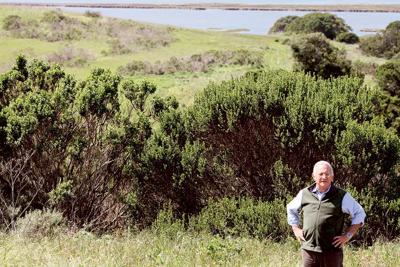

In 1980, the National Oceanic and Atmospheric Administration and California Department of Fish and Wildlife established the Elkhorn Slough National Estuarine Research Reserve. Two years later, a nonprofit, the Elkhorn Slough Foundation, launched to support the 1,700-acre reserve.
In the 45 years since, conserved land has grown, research projects have expanded and various species rebounds of both flora and fauna have been observed.
Mark Silberstein has led the foundation since 1983, and on Nov. 20, announced his retirement.
"Mark’s dedication and collaborative spirit have been truly transformative for the Elkhorn Slough Foundation," board president Susan Matcham-Hernandez said in a statement.
"It sort of astonishes me that the little Elkhorn Slough Foundation now employs 40 people, doing amazing work, helping to acquire land, to manage and restore it, opening it up to the community for recreation and education," Silberstein says. "And I think it’s on lots of people’s radar.”
Originally trained as a marine zoologist, Silberstein led the direction of the ESF not just to support the reserve and public outreach, but also to operate as a land trust, acquiring land and entering into easements for conservation. It has had the effect of expanding the footprint of the protected areas of the slough significantly, to about 6,700 acres total.
As of 2015, the foundation had acquired 3,291 acres on 30-plus properties and held easements to 294 acres on 13 properties, in addition to having helped transfer another 315 acres to other agencies. Silberstein has previously described the approach as a "puzzle," piecing together deals on what might be small-acreage parcels to have a bigger impact.
In past interviews, Silberstein noted how the whole ecosystem is connected, and ESF and Reserve staff have observed ecological functions be restored.
On former agricultural lands, Silberstein said he watched as wildlife came back and the property was transformed. Where land was disked annually for farming, ESF might acquire what looked like a path of bare dirt, prone to weeds. A change in practices—the end of farming and annual disking of the earth—could make the land into wetlands in a decade, drawing over 100 bird species.
"Wetlands serve as scrubbing filters for runoff. Water coming off of some of these lands [upstream] can be very high in nitrate," he said of acquisitions along Moro Cojo, a tributary to Elkhorn Slough. "As it moves through biological scrubbing machines, nutrients are trapped and transformed."
In 2013, Silberstein was recognized by Environmental Law Institute as its Community Wetlands Leader for the year.
"I’ve always viewed Elkhorn Slough as a window on the larger natural world and, through our work here, have learned how critical wetlands are to the functioning of both the natural and the human economy," Silberstein stated at the time. "To be included with national leaders in wetland conservation and research is very humbling and inspiring for a mud-lover like me.”
The board of the foundation has established a transition committee to find a new executive director, and has hired the firm Potrero Group to lead recruitment.
Silberstein will stay on until a successor is hired, and plans to then continue in an advisory role on special projects associated with the recently completed fundraising campaign called "Elkhorn Forever" that brought in $13 million for the acquisition of new lands and continued stewardship of existing property.
Asked to describe a standout wildlife sighting in his 40-plus years at the foundation, Silberstein declines to answer the question directly— "I have identical twin sons and that’s like asking me which one I like best," he says.
He does, however, offer a vivid description of a scene he says still sparks wonder.
He loves fall because it's migratory bird season, and shorebirds stop in Elkhorn Slough to feed at low tide as they make their way south. Western sand pipers, which have brown backs and white bellies, travel in large flocks. Silberstein describes the magic of looking down on the mud flats at the birds: "They'll be almost invisible because brown backs are facing you. Then in unison, 1,000 of these little animals turn, and there’s this flash of white, and then they turn and disappear again. It's never failed to stop me in my tracks," he says.


(1) comment
Thank you for your exceptional career! My heart still breaks over the battery fire that started in January. Impossible not to mention. How can we forget? But know that I am so grateful for all the work you did! Again, what a wonderful achievement!
Welcome to the discussion.
Log In
Keep it Clean. Please avoid obscene, vulgar, lewd, racist or sexually-oriented language.
PLEASE TURN OFF YOUR CAPS LOCK.
Don't Threaten. Threats of harming another person will not be tolerated.
Be Truthful. Don't knowingly lie about anyone or anything.
Be Nice. No racism, sexism or any sort of -ism that is degrading to another person.
Be Proactive. Use the 'Report' link on each comment to let us know of abusive posts.
Share with Us. We'd love to hear eyewitness accounts, the history behind an article.