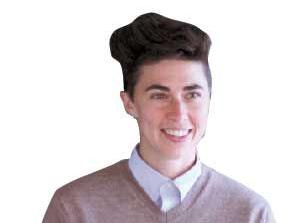

Death was never a gnawing topic for Katrina Spade, especially not the thought of her own demise. But one day, she says, while watching one of her children play in the backyard, she realized her children would eventually grow old and she would one day die.
That thought set her in motion to pioneer a new option for human death rites, aiming to answer a question: Can humans grow new life after they die?
The Urban Death Project is a compost system for human bodies, designed to also offer space for ritual and symbolism mourners are seeking. Human bodies would be laid to rest in wood chips and sawdust, and after a couple weeks begin to decompose, eventually becoming soil.
Spade’s nonprofit continues to gain funding and support from scientists and environmentalists throughout the country. At the age of 38, her goal for now is to make people see death care as a human right, as cremation and overcrowding in city cemeteries increasingly become problems for environmentally conscious individuals.
Spade presents on her project at CSU Monterey Bay on Oct. 2. She spoke to the Weekly from her home in Seattle in advance of her talk.
Weekly: How do you envision the first facility?
Spade: I am proposing neighborhood-scale buildings in our cities, where both composting the deceased and creating new soil become a place of memorial, a place we can come to, like we would to stroll through a cemetery. We would come to this building and take in the wonderful process taking place inside. We would think about loved ones we’ve lost, think about our mortality.
Can you describe how it works and where the bodies would be placed?
The bodies are placed by families onto the top of the core, into one of the beds. On the day of the memorial, friends and family would bring the body up to the top, say goodbye and there would be only one bed open.
Then friends and staff would cover the body with wood chips, and that bed is closed. That body is now at the top of the three-story core and over the next several weeks, it will decompose. As [fully processed compost] is taken out of the bottom, the body will settle into the core.
There’s this very beautiful process of using the living’s energy to carry the body onto the top of this core, to set in motion this transformation over time as the body transforms into something else. You are no longer human at the end of this process.
Is cremation problematic?
Before, I assumed it was a pretty eco-friendly form of disposition, but when I researched it I found that in the U.S., cremation emissions total about 600 million pounds of carbon dioxide per year. I ran the numbers, and it’s the equivalent to 70,000 cars driving the road for an entire year. I know a lot of people would prefer an option more connected to nature.
In what parts of the world, or the country, have you seen support to get this project going?
There is a lot of support in the U.S. and lots of people in Canada have reached out. Sometimes it’s hard to know if it is just because the press has picked it up, but oddly enough, I’ve gotten [inquiries from] several people from South Africa, the U.K., the Netherlands.
I’ve spoken to some politicians here in Seattle, but I haven’t yet heard from city officials elsewhere. It’s all been individuals who feel this is a meaningful and worthwhile idea.
Is religion or spirituality a challenge for the project?
There are plenty of religions where the way we care for our dead is not prescribed. Christianity broadly doesn’t say what to do with our bodies. But if you are Hindu, you are cremated and that is part of the faith. So there are some religions that tell us what to do with our bodies, and others that don’t.
I don’t think religion will be the worst challenge. The biggest challenge is to get people to talk frankly about their mortality, which is what we should all be doing.


(0) comments
Welcome to the discussion.
Log In
Keep it Clean. Please avoid obscene, vulgar, lewd, racist or sexually-oriented language.
PLEASE TURN OFF YOUR CAPS LOCK.
Don't Threaten. Threats of harming another person will not be tolerated.
Be Truthful. Don't knowingly lie about anyone or anything.
Be Nice. No racism, sexism or any sort of -ism that is degrading to another person.
Be Proactive. Use the 'Report' link on each comment to let us know of abusive posts.
Share with Us. We'd love to hear eyewitness accounts, the history behind an article.