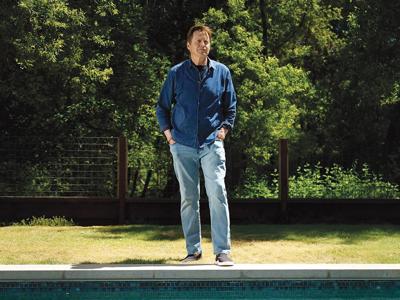

The latest book in Dwight Holing’s Nick Drake mystery series, The Thunder Head, has plenty of fast-paced, thriller-type moments. There’s dynamite thrown out of airplanes, shots – many of them – are fired, and the eventual body count is high. But it starts in a more cerebral way, with one dead body belonging to an environmental analyst who was hired to survey a sprawling ranch in rural eastern Oregon on behalf of an East Coast developer in the 1970s.
To call it a land-use mystery oversimplifies the story, but that is a big part of it; the main character, Nick Drake, is a ranger with Fish and Wildlife. The story also investigates questions of what brought various people together, and the indigenous story of the region, which revolves around fitting themes of vengeance and justice. As Holing says, it’s as much a “whydunnit” as a “whodunnit.”
Holing has been publishing fiction since 2012, and he left a career in journalism to pursue mystery writing. He’s since self-published 13 novels in his Jack McCoul and Nick Drake series, and says it’s been a successful business.
He and his wife, Ann Notthoff, moved to Carmel Valley in 2019 from the East Bay. Holing works generally 9-5 on his writing. Although his books are set in the Pacific Northwest (where he and Notthoff met as students at University of Oregon), Holing also draws inspiration from local settings, such as horses he sees daily heading to Garland Ranch Regional Park.
Weekly: I was surprised to read in your bio that your journalism career was not covering cops and crime, but travel and ecology. How did you learn to write the police procedural part?
Holing: You can research anything online. I am really glad I started off as a journalist. It taught me the skills of a writer, and research. Journalism definitely gave me discipline; I set deadlines for myself.
Why Harney County in rural Oregon as a setting?
Most people don’t get it – they think it’s just an endless sea of sage, but when you’re in it, there is a lot to be found there. Not only geology and geography, but deep, rich indigenous history.
Indigenous cultures factor prominently into your latest book. What’s the feedback been like?
When I set out to write the Nick Drake mysteries, I really didn’t know I would populate all the books with strong native cultures. But look who’s living in Harney County: I can’t write about the ranchers, and the federal workers at agencies like BLM, and not the Paitue people.
I was very concerned about cultural appropriation. I have a friend who is a member of the Cherokee Nation and asked him about it. He said, we need more people to be aware of the rich history [of indigenous people]. As long as you’re doing it with respect and accuracy, daylight the hardships and discrimination, but also daylight the culture and the way we see the world.
Your setting is the 1970s. Why then?
I grew up during that period and if you’re looking back for a time of real social and political change, not unlike what’s happening right now – it’s just a very vibrant time to write about.
Another reason is technology wasn’t really around yet. Now [police work] is checking cameras and monitoring phone calls; [my characters] have to be on the ground.
Do you have more to write in this series?
Are there more stories I can tell about Nick Drake? Yes. Am I going to do it tomorrow? No. I am going to take a little time off.
When I first started writing these, I was writing and publishing them every nine months or so. I used to say it’s like pregnancy. I joke the next will be like an elephant pregnancy, two years. But I like to get a book out a year.
There is a lot of change for the main character from the beginning to the end of this book.
In every Nick Drake book, he is changing. He’s not married at the beginning of the series, he doesn’t have children. All the characters are growing, they’re all changing, and as the world changes around them. I’m sure you’re different than you were 10, 15 years ago – I know I am. I also want to show how the land is changing. That’s the only constant in life is change.
What advice would you give to a writer who is just starting out?
Don’t rule yourself out. There are plenty of people who will tell you that you are wasting your time. If you have a story to tell, tell it – and then figure out what to do. Worrying about publishing is almost secondary. You can always indie publish it.


(0) comments
Welcome to the discussion.
Log In
Keep it Clean. Please avoid obscene, vulgar, lewd, racist or sexually-oriented language.
PLEASE TURN OFF YOUR CAPS LOCK.
Don't Threaten. Threats of harming another person will not be tolerated.
Be Truthful. Don't knowingly lie about anyone or anything.
Be Nice. No racism, sexism or any sort of -ism that is degrading to another person.
Be Proactive. Use the 'Report' link on each comment to let us know of abusive posts.
Share with Us. We'd love to hear eyewitness accounts, the history behind an article.