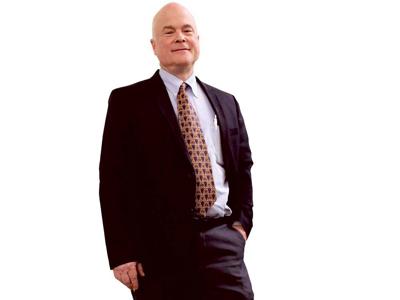

Slightly stocky and on the shorter side, with a bald head rimmed with white hair, one might assume Elliott Robinson’s main hobbies would be golf or fly fishing. But the 52-year-old director of the Monterey County Department of Social Services has a preference for the wild, and has a big-wall climbing and high-altitude mountaineering resume to prove it.
On any given weekday evening, Robinson can be found at Sanctuary Rock Gym in Sand City. Most wear T-shirts, tank tops and shorts exposing muscles toned from supporting their body weight by their fingertips. Robinson, on the other hand, enters the gym wearing a suit. He removes his blazer and tie, swaps out dress shoes for climbing shoes and begins working on advanced bouldering problems in slacks and a button-down Oxford.
He’s chatty and friendly and often finds himself surrounded by a half-dozen people half his age talking about climbing and life. While Robinson enjoys the community found indoors at gyms like Sanctuary and appreciates the accessibility it brings to the pursuit, he still holds onto the principles instilled in him as a “dirtbag” climber eating the scraps left on the plates by tourists in Yosemite Valley dining halls in the early ’80s.
“I got to the valley just before things really began to change. The 1980s were a fight between the last vestiges of trad [traditional] climbing and sport climbing [using pre-placed bolts]. It was also the diminishing of any vestige of John Muir’s idea of the wild.”
His pursuit of the wild brought Robinson to the most challenging walls in the Sierra Nevada and to the high peaks of Kazakhstan and Kyrgyzstan in Central Asia.
He met up with the Weekly for a post-climb beer at Post No Bills in Sand City.
Weekly: Being from the Midwest [Cleveland, Ohio], what got you into climbing?
Robinson: I started to impress a girl. I didn’t get the girl, but ended up falling in love with climbing. When it came time for college in 1982, I had been accepted to both Harvard and Stanford. The choice was easy: At Stanford I could spend every weekend at Yosemite.
Did you find many at Stanford who shared your passion?
Definitely. There’s great climbing on the university buildings. [He pulls out his smartphone to show pictures of him and his friends scaling Stanford’s iconic buildings.] It’s called “buildering,” as opposed to bouldering. That’s how we spent all of our free time on campus. Then my senior year, I was called into the provost’s office. He said they had identified me as the leader of the group and he put an end to our activities.
Of all the international mountaineering destinations, how did you connect with Central Asia?
A group of climbers from Kazakhstan came to Berkeley in 1989. I struck up a friendship with Anatoli Boukreev [a renowned mountaineer whose heroics were documented by Jon Krakauer in the book Into Thin Air]. I took him to Yosemite where we climbed El Capitan. Then in 1991, I flew to Kazakhstan with my wife to climb with Anatoli – it was actually our honeymoon. I went back again in 1994 to climb Khan Tengri on the border of Kyrgyzstan and China.
Before the fall of the Soviet Union there was no homelessness, but really bad food. After, the food was much better, but there was homelessness.
How did Anatoli Boukreev’s death in 1997 affect you?
Anatoli was the baddest climber in the world at the time. But high-altitude climbers don’t live that long. After he died, and a few other world-class mountaineers died in avalanches and other accidents, I had to stop. My kids really saved my life because I could have easily gone the way of others who were much better than me. I couldn’t justify continuing to take those risks while having a family to care for. I didn’t climb or touch a rope for a decade.
What did you do to touch the wild after that?
Big Sur is wild, complex and challenging. Going off-trail in the Ventana Wilderness presents many difficulties. It’s unbearably hot in the summer and you have miles of chaparral ripping at your skin and clothes whether you try to crawl underneath or walk on top of it.
I couldn’t find the trail to get out a few years ago after I went up to Ventana Double Cone. I spent an extra 24 hours in the backcountry. By the time I got cell reception I had calls from the sheriff and [County Admininistrative Officer] Lew Bauman asking me where the hell I was and if I was OK.


(0) comments
Welcome to the discussion.
Log In
Keep it Clean. Please avoid obscene, vulgar, lewd, racist or sexually-oriented language.
PLEASE TURN OFF YOUR CAPS LOCK.
Don't Threaten. Threats of harming another person will not be tolerated.
Be Truthful. Don't knowingly lie about anyone or anything.
Be Nice. No racism, sexism or any sort of -ism that is degrading to another person.
Be Proactive. Use the 'Report' link on each comment to let us know of abusive posts.
Share with Us. We'd love to hear eyewitness accounts, the history behind an article.