
In the U.S. military, the term “stand down” refers to a temporary stop in fighting, maybe for a truce. Retired Army colonel and mental health counselor Tom Griffin lived another interpretation.
“Way back in Vietnam,” he writes by email, “it was when we came in from [combat in] the jungle to a safe area and got hot food, haircuts, medical, dental. We got to stand down.”
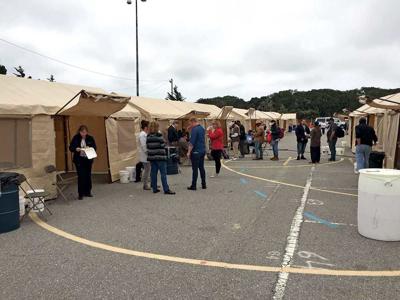
It has another meaning. The National Coalition for Homeless Veterans applies it to “a grassroots, community-based intervention program designed to help the nation’s estimated 107,000 homeless veterans.” It usually happens in an outdoor area, populated by tents or other shelter, where homeless veterans can come get services – including dental, medical, clothes, food, showers, legal help, haircuts – to “combat” the ravages of homelessness.
A group of Vietnam War veterans founded the first Stand Down in San Diego in 1988; now there are 190 nationwide. The Veterans Transition Center (with the United Veterans Council of Monterey County) is the lead agency for the Monterey County Stand Down, and Griffin, who was VTC’s founding chairperson 18 years ago, has been its coordinator.
Their first Stand Down was at the rodeo grounds in Salinas in 2012. But the ground was soft, so wheelchair-bound veterans had to be hoisted and carried, and strong winds hampered food prep. So for 2014 and 2016 they moved to a motor pool on former Fort Ord. In 2016 it looked like a tent city had sprung up on a vast tarmac tucked between 7th Avenue and the edge of an oak forest
There were no building structures so everything had to be housed in more than 100 frame tents staked to water barrels, which took immense work. It cost $9,000 to set up a mobile kitchen. And unwanted visitors lived there.
“There were yellow jackets,” Griffin says. “When human beings come and eat, they want to partake.”
Griffin is grateful for the generosity and courtesy of both previous venues, but the 2018 Stand Down is setting up camp at the Monterey County Fairgrounds for its three days. There, volunteers will occupy existing buildings and will only need 20 tents.
In Monterey County’s 2017 homeless census, 110 homeless veterans were counted. “Anecdotally, we believe the actual number of homeless veterans in Monterey County to be closer to 250,” says Jack Murphy, an Army retiree who works at the VTC. Griffin says there are so many in California because the weather is more favorable than other states, and links overall veteran homelessness to not enough transitional help from the military, PTSD and trauma, meager job prospects, insufficient mental health facilities and services.
There are 32 bus stops between Menlo Park and King City where homeless veterans will be picked up on Friday, brought to the Stand Down, and returned on Sunday. There are no ins-and-outs to avoid drug and alcohol use, or the selling of supplies. If a veteran does not have discharge papers, volunteers can look them up.
They’ll get clothes and sleeping bags. The Salvation Army is providing coffee and donuts. Some 24 dentists will do cleanings, extractions, fillings and even bridge work. Doctors and podiatrists will be available, beauticians and barbers for grooming, chaplins to aid their spiritual lives. Organizations are setting up 300 bunks for men, women and children, monitored by veterans groups. The SPCA for Monterey County will provide kennels, food, microchips, shots and check-ups for pets.
One of the most appreciated services is legal work. Seven judges, under the leadership of Judge Sam Lavorato Jr., will help absolve veterans of debilitating fines and misdemeanors so they can work, drive and get housing again.
“With winter coming, we hope to make life a little easier for those who have already served and sacrificed for us,” Murphy says. “In a larger sense, we want to provide resources and a pathway to end veteran homelessness.”
It costs $140,000 to organize each Stand Down, and there isn’t enough money or manpower to do it every year. In the past, the VTC has been left with tens of thousands in bills to cover. (Donations of money and supplies, and volunteer labor, are welcome.)
When Griffin sees the veterans leaving the Stand Down on Sunday afternoon, he says it’s a bittersweet sight.
“They walk away crying because they can get their driver’s licenses, they no longer have rotten teeth, they leave with a bunch of food, new clothes, compassion and support,” he says. “They think, ‘Hey, I am worthy.’”


(0) comments
Welcome to the discussion.
Log In
Keep it Clean. Please avoid obscene, vulgar, lewd, racist or sexually-oriented language.
PLEASE TURN OFF YOUR CAPS LOCK.
Don't Threaten. Threats of harming another person will not be tolerated.
Be Truthful. Don't knowingly lie about anyone or anything.
Be Nice. No racism, sexism or any sort of -ism that is degrading to another person.
Be Proactive. Use the 'Report' link on each comment to let us know of abusive posts.
Share with Us. We'd love to hear eyewitness accounts, the history behind an article.