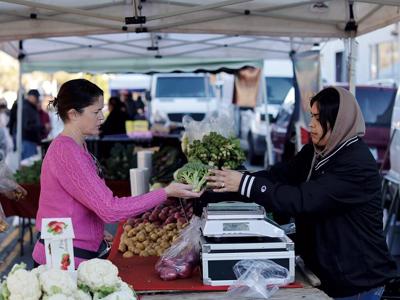

Since launching its Fresh Rx program in 2014, the Monterey-based nonprofit Everyone’s Harvest has been at the forefront of a popular trend in health and wellness: The belief that diet should play a larger role in health care.
In a society plagued by economic inequality, which begets food insecurity, which begets poor dietary choices that lead to obesity, diabetes and other chronic diseases, the thinking goes that better nutrition is the first step toward a healthier population – one that places greater emphasis on “preventive” health care rather than relying on costly traditional medical and pharmaceutical treatments after the fact.
Everyone’s Harvest, which operates five farmers markets across Salinas, Marina and Pacific Grove, has played a pivotal role in bringing that philosophy to Monterey County’s most vulnerable communities – its Fresh Rx program sees doctors “prescribe” patients vouchers for up to $35 worth of fresh fruits and vegetables per week at its markets.
To date, Fresh Rx has provided more than 1,000 local families with more than $630,000 worth of fresh produce “prescriptions,” including more than $135,000 to 268 families in 2022 alone. And with two new, multi-year grants totaling $700,000, Everyone’s Harvest is ready to grow the program further and team up with health care providers to better quantify the health impacts.
“It feels like both of these grants were written with us in mind,” says Executive Director Hester Parker. The larger of the grants, from the U.S. Department of Agriculture’s Gus Schumacher Nutrition Incentive Program, or GusNIP, provides the nonprofit with $500,000 over three years. On top of expanding the number of Fresh Rx patients, the grant will allow Everyone’s Harvest and its partners to survey participants over the course of months and collect biometric data like their A1C blood sugar levels.
The anonymous data will provide researchers with troves of information on the benefits of nutrition-based health care programs like Fresh Rx. The end goal, according to Parker, is “moving [health care] away from acute care to more preventative care.”
That includes incorporating players like insurance companies. “My dream is that, eventually, these types of preventative produce prescriptions will become an allowable insurance expense,” Parker says. “As we’re able to show that it’s cost-effective as far as the utilization of health care, maybe it becomes an allowable expense paid for through insurance.”
The smaller grant is for $200,000 over a two-year period from the Central California Alliance for Health. The award follows up on a previous two-year, $156,000 grant that Everyone’s Harvest received in 2019. It focuses on expanding the Fresh Rx program’s reach to Medi-Cal recipients, in particular through Clinica de Salud del Valle de Salinas and Monterey County Health Department Clinic Services. There is also an educational component: The program will look to impart nutritional knowledge and recipes to Fresh Rx patients, while also conducting focus groups evaluating the program with the help of researchers at CSU Monterey Bay.
“We want to make sure we’re covering as many people as possible between the two grants,” Parker notes. She says the GusNIP grant is budgeted for 144 patients per year over three years; the alliance award will fund 100 prescriptions per year over two years.
That will help Everyone’s Harvest get more fresh produce onto the plates of food-insecure residents like those treated at Alisal Health Center in East Salinas. “These patients often have to make decisions on whether to pay rent or buy food, and the Everyone’s Harvest program has given them the ability to do both,” says Adriana Velez, outpatient services manager at the county-run health clinic.
Velez says the Fresh Rx program has “exposed [patients] to different types of eating habits” – noting that some had “never even been to a farmers market in Salinas.” She adds that she’s heard particularly from parents.
“A lot of parents have expressed gratitude and emotion about being a part of [the program],” Velez says. “Rather than buying bulk [junk food], they’re choosing to get healthy stuff because they understand that, long term, it’s better for [their children] and will give them better health outcomes.”


(0) comments
Welcome to the discussion.
Log In
Keep it Clean. Please avoid obscene, vulgar, lewd, racist or sexually-oriented language.
PLEASE TURN OFF YOUR CAPS LOCK.
Don't Threaten. Threats of harming another person will not be tolerated.
Be Truthful. Don't knowingly lie about anyone or anything.
Be Nice. No racism, sexism or any sort of -ism that is degrading to another person.
Be Proactive. Use the 'Report' link on each comment to let us know of abusive posts.
Share with Us. We'd love to hear eyewitness accounts, the history behind an article.