
IN THE LAST MIDTERM PRIMARY ELECTION, IN 2022, ONLY 31 PERCENT OF REGISTERED VOTERS IN MONTEREY COUNTY RETURNED A BALLOT. That was despite a number of crowded races for consequential seats (six contenders for county supervisor, four for sheriff). We hope that this midterm primary election, on Tuesday, June 2, is better. Participation is critical, especially in local elections, where just a vote or two can change the outcome. Your vote matters, and your right to vote is not something to take for granted as President Donald Trump and his administration strategize about how to undermine trust and integrity of our electoral system.
We hope that’s enough of a pep talk to motivate you to return your ballot, which has never been easier.
But we hope it also motivates you to learn a little bit about the candidates seeking your vote, and some of what they represent. The Weekly editorial board interviewed candidates for several offices in person, and others via email questionnaire; we also base our assessment on the records of the candidates.
(We have not made endorsements in all state races – you’ll also see lieutenant governor, secretary of state, attorney general, state treasurer, state controller, insurance commissioner and Board of Equalization member on your ballot. We recommend consulting a voter guide from CalMatters for more information, online at calmatters.org/california-voter-guide-2026.)
In races with more than two candidates, the top two finishers will go to a runoff in November, regardless of political party.
Early voting began on May 4, and continues through Election Day. You can return your ballot by mail, no postage required, through June 2.
For a full list of polling locations and more on how to vote, visit montereycountyelections.us.
Voting is easy and fast – and it matters.
The Editorial Board comprises Weekly Founder & CEO Bradley Zeve, Publisher Erik Cushman and Editor Sara Rubin. The judgments of our editorial board are made independently of the Weekly’s news team.
State
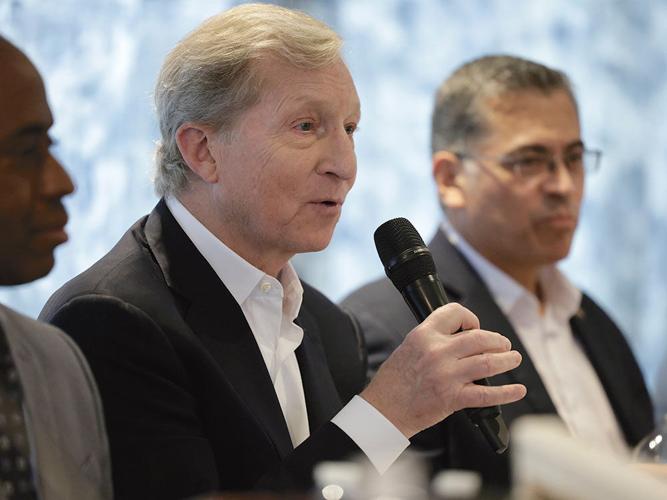
Tom Steyer for Governor
California’s economy is the fourth largest in the world ($4.25 trillion), larger than Japan’s or the United Kingdom’s. Texas and New York combined barely edge us out. There are 19 million people employed here. Our state government employs 552,000 people, compared to 458,000 in Texas, a state that brags about lean government while running nearly the same headcount with 9 million fewer residents.
We’re monstrous.
Yes, our state is iconoclastic. We’ve banned fracking and plastic straws. Our homeless problem is notorious. Our bullet train is a dud. We probably invented double oat milk cappuccinos. Meanwhile we lead in tech and the fight against climate change, we subsidize the rest of the country – in fiscal year 2024-25 sending $275 billion more to Washington than we got back – and we sit at the center of the AI investment boom, the single most consequential technological transformation of our lifetimes.

Tom Steyer was one of six leading Democratic candidates for governor who participated in a debate in Monterey in March, hosted by the Democratic Women of Monterey County. "I believe we’re going to have a fight between the oligarchs and working people who have been screwed for 45 years. That’s what I am down for," he said.
And we are about to elect a new governor with Gavin Newsom terming out. There are 61 candidates listed in your ballot, although many have dropped their campaigns. (This wildly unwieldy number comes from the ease of getting on the ballot in California, for a filing fee of $4,919 or 6,000 signatures. The result is some wacky candidates.)
With a government this big, inefficiency is to be expected. Our annual budget is over $300 billion, 3,245 registered lobbyists are pushing their special interests, public unions have gamed the retirement system. This is not a job you hand to a Fox TV host.
Governing California requires someone willing to take on entrenched interests at this critical moment – to lead, not manage – when Washington has turned hostile and the national Democratic Party offers little to inspire confidence.
That person is Tom Steyer.
Steyer is the clearest anti-Trump voice in this race, and he means it. While others are also running against Trump, Steyer spent years and hundreds of millions of his own money, mostly through philanthropy, building an actual infrastructure of resistance. He’s not hypothesizing – he put his money where his mouth is.
What seals it is who’s spending money to stop him. PG&E pumped nearly $10 million into an anti-Steyer PAC, which funneled it into a second PAC backed by the real estate and the construction industry. Two layers of corporate money, one goal: keeping Steyer out of the governor’s office. Their ads attack him for proposing commercial landlords pay property taxes on what their properties are actually worth today. Oil companies, facing his proposed windfall profits tax and his track record to fight against climate change, are part of the same anti-Steyer coalition.
These are the industries that are committed to being the masters of Sacramento. When they line up against you, you’re clearly doing something right.
Much of the work Katie Porter did in Congress was potent. In committees, she led a relentless interrogation of corporate malfeasance. She’d be a strong voice for working Californians and for women. But sharp questioning isn’t the same as results, and her pitbull style has undermined her ability to build the coalitions that governing actually requires.
Xavier Becerra is decent, experienced and now carries a number of influential endorsements, including that of Assembly Speaker Robert Rivas. Before he was appointed by former president Joe Biden to lead the Department of Health and Human Services, Becerra was California’s Attorney General and was not shy about suing the first Trump administration. But when it mattered most, when the oil companies were doing what oil companies do, he looked away. His successor, Rob Bonta, sued them. Becerra didn’t.
In debates, Becerra plays the politician, careful to the point of evasion. Who will he truly serve? We’re not sure, except he’s clearly no change agent.
Steyer has spent over $125 million of his own money campaigning – that makes us wince. His hedge fund has bad investments. But he’s beholden to no one, and may be exactly the right formula for these tumultuous times. The people spending millions to stop him are precisely the people who need strong opposition. Their efforts to defeat him speaks volumes.
Robert Rivas for Assembly | District 29
In 2023, California witnessed a youthful and ambitious assemblymember from a rural district pull off an audacious political move as Robert Rivas ascended to the position of Speaker of the Assembly in a bloodless coup.
Rivas has wielded the power of the position with particular impact. He put a $25 million stash of money aside to sue the Trump administration, which he says preserved $188 billion in federal money destined for California. He led the legislative push to draft Proposition 50, the state’s redistricting initiative to counter Trump’s Republican-friendly gerrymandering, in time for this year’s midterm elections. He capped the number of bills that can be introduced each session and has launched a legislative oversight tool so that lawmakers can assess current laws instead of drafting new legislation if it isn’t needed.
And unlike previous speakers, he has also continued to push legislation of his own, and last session authored AB 1454, a landmark literacy education bill that included $200 million for implementation. He also secured critical funding for Pajaro’s post-flood recovery.
Rivas, a Democrat, faces two Republican challengers, Dennis Sanchez (who did not respond to the Weekly’s questions) and J.W. Paine, a truck driver who believes (incorrectly) that Rivas is too focused on the state overall and not on the district.
In fact, it’s quite the opposite. As Rivas frames it, “Being Speaker keeps our local values and perspectives at the table in Sacramento. That’s something we’ve never had before, and it’s helped us make great progress.”
Dawn Addis for Assembly | District 30
Two years ago when we endorsed Dawn Addis for reelection, we commended her for having swiftly gotten up to speed on Monterey County issues in her first term representing the area. She proved to be a good listener and a strong advocate for locals. That remains the case and was on display last winter as Addis was everywhere after the Vistra battery storage fire in Moss Landing. Since that endorsement in 2024, Addis has drafted two bills to grant local authority precedence over state policies on energy infrastructure. AB 3233 was passed on the final day of the legislative session in 2024 and grants local control over oil and gas exploration. AB 303 was introduced in 2025 to give local control over the siting of battery storage facilities. (That bill died in committee.) While advocating for local control may play well at a town hall, in the wrong hands or on the wrong issue, it might look a lot more like cronyism or NIMBYism. We again endorse Addis’ reelection because of her commitment to her district, and we urge a little more restraint and perspective as far as local control goes.
Neither Republican Shannon Kessler nor Democrat Susannah Brown, who are also running for the Assembly seat, responded to the Weekly’s candidate survey.
— • —
Federal
Zoe Lofgren for Congress | District 18
Zoe Lofgren of San Jose has served in the U.S. House of Representatives since 1995, and is seeking another term, up against three challengers from both the right and the left. While Independent Chris Demers and Democrat Luis Acevedo-Arreguin of Castroville have some good ideas about foreign policy and immigration, they lack the practical how-to expertise that Lofgren brings to the job.
She’s been persistent in speaking out in defense of dignity and protecting basic government functions during both the first and second Trump administrations, and in response to the Trump-led gerrymandering initiative in Texas, Lofgren became a key architect of California’s Prop. 50, a Democratic-leaning response about which she remains unapologetic. (The result of Prop. 50 means that dark blue District 18 now includes a slice of Republican-leaning Coalinga in the Central Valley to the east, and Lofgren pledges to connect with constituents there.) “California had the unique opportunity to level the playing field and ensure a fair election, and I’m proud that we put our foot down and took a stand for our democracy,” she says.
It’s hard to get anything done as a minority Democrat in a Republican-led Congress, but Lofgren is hopeful about flipping the chamber in November and says priority number-one will be the Farm Workforce Modernization Act, which would provide a path to legal status for roughly 1.5 million farmworkers, rightly a priority for this district, which encompasses the Salinas Valley.
Jimmy Panetta for Congress | District 19
Jimmy Panetta deserves another term representing the 19th Congressional District, but with an asterisk.
A Navy veteran, a former prosecutor, and a legislator who has delivered more than two dozen bills signed into law, Panetta brings the passion, experience and institutional knowledge this moment demands. In a Congress where Republicans have abdicated their constitutional role, most recently with the war in Iran, his voice on democratic accountability, immigration reform, and health care has been increasingly clear.
He deserves another term, especially over the six challengers who lack the experience to persuade us they could achieve more than Panetta in these heavily partisan times. He’s continued to prioritize constituent case work, closing out nearly 1,800 cases and returning over $16.2 million in taxpayer dollars to constituents in 2025 alone. He’s taken to hosting regular town hall meetings by telephone, giving constituents a chance to hear from him directly (although we think less talking and more listening would give the public a needed opportunity to feel heard), and rightly describes himself as a workhorse.
We endorse him for re-election, but not without a direct challenge on the issue where his record most betrays his constituents.
On Israel, Gaza and the West Bank, we wish Panetta would do more than write letters and issue statements in support of peace, and instead be a leader in implementing a clear, humanitarian agenda.
As Panetta says, “I have come to realize that it is easy to simplify and sloganize this topic or make it binary. I have found that it is not and it should never be.”
We agree, but we are troubled by continued significant support he receives from the powerful American Israel Public Affairs Committee (AIPAC). We’d love to see him take a stand and reject those contributions – why does he need them anyway, in a safely blue district?
Panetta has voted yes on legislation that strips funding from the United Nations Relief and Works Agency (UNWRA), a critical relief agency in Gaza. He justifies voting yes on omnibus legislation because it has achieved a range of other purposes, but unless all of the poison pills are removed, we hope he will have the courage to join other Democrats in voting no on such legislation.
— • —
Monterey County
Dan Burns for Superintendent of Schools
For the first time in decades, the top job at the Monterey County Office of Education will be determined in a contested election. This year there are two qualified candidates vying for your vote. Ralph Porras is the former superintendent of Pacific Grove Unified School District and current deputy superintendent at MCOE. Dan Burns is the former superintendent at Salinas Union High School District.

Dan Burns describes his approach to leadership as built on relationships, "so that you can provide support that is needed when it is needed, and doing so without being a compliance-led position and more of a relational position."
Since 1998, the sitting superintendent has essentially hand-selected a successor who usually ran unopposed. From Bill Barr to Nancy Kotowski to Deneen Guss, the baton was passed. Not coincidentally, leadership during this time has been staid, steady and technocratic while the results at the student achievement level have been average. In an interview with our endorsement panel, both candidates gave the overall education system in the county a C grade.
Monterey County schools are confronting declining enrollments, which means shrinking budgets. Immigration enforcement has put new stressors on many schools and districts. AI in the classroom and a wave of teacher strikes throughout California are other factors that will dominate discussions in the education hierarchy.
Burns ran the largest school district in the county, one that typifies most of the challenges facing MCOE and the county’s 24 school districts. He oversaw practical solutions, including the creation of 50 units of workforce housing for employees of the district. He partnered with community colleges and industry to advance career and technical education focused on agriculture and ag tech. He wants to use those types of innovation to transform MCOE leadership from compliance-focused to more relationship-driven.
Porras is endorsed by the retiring superintendent and suggests voters elect him because a change in leadership could be difficult. He is a dedicated education administrator, but we think a change in leadership might just be the kind of spark MCOE needs.
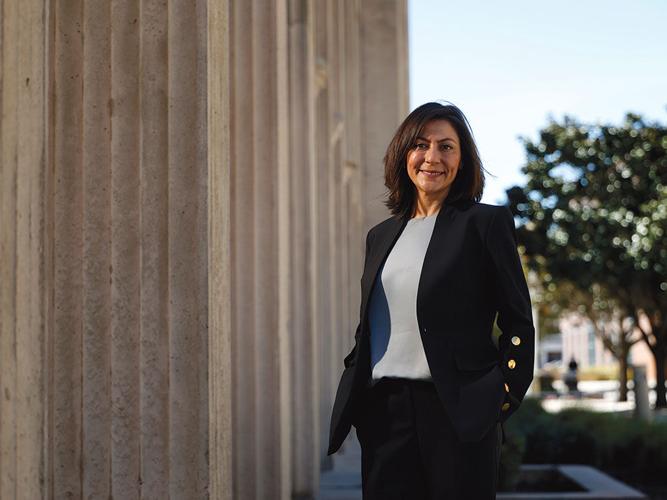
Burcu Mousa for Auditor/Controller
This is not a job that ordinarily attracts very much attention. It’s usually rough patches or errors that do, such as a mistake that had the County Auditor/Controller’s Office overcharging some property owners and undercharging others four years into a Gonzales school bond.

Burcu Mousa previously worked in the County Auditor/Controller's Office and wants to return in the top elected role. "I believe the office is on the wrong track, and I have the experience, temperament and leadership style to help turn it around," she says.
This election is not a referendum on Rupa Shah, who is not seeking re-election, nor on that Gonzales error, but it looms large in the campaign after it was revealed in 2025.
Shah has endorsed her assistant, Enedina Garcia, who was hired last June with years of experience in Fresno County. She is qualified for the job. But so is Burcu Mousa, a CPA who has similarly worked as assistant auditor/controller, so would arrive prepared to do the job on day one. But she’d now come in from the outside, bringing a needed fresh perspective. Mousa describes Shah’s leadership style as maintenance mode, rather than transformative.
She says she wants to focus on building trust, starting internally in the department, and she has specific ideas for protocols and cross-checking on how to avoid another version of the Gonzales error. She pledges that her first auditing priority would be the Auditor’s Office itself. “Given the issues that have come to light, I think we need to start by strengthening our own house,” she says.
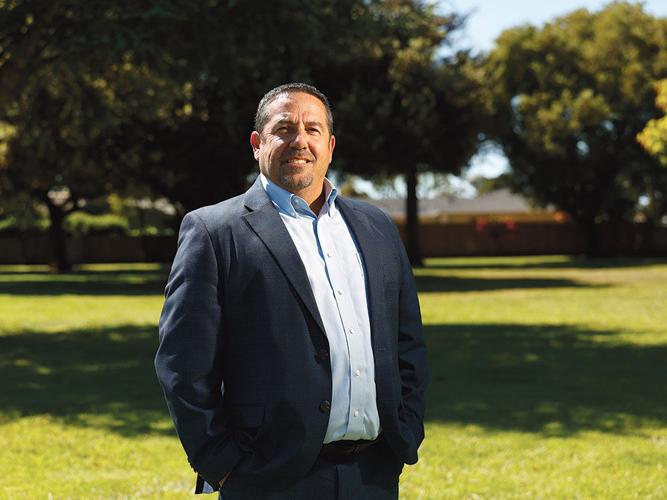
Jake Stroud for Treasurer/Tax Collector
After his predecessor, Mary Zeeb, served four four-year terms and retired last year, Jake Stroud was appointed by the Monterey County Board of Supervisors to replace her, with both the blessing of his former boss and staff members from the County Treasurer/Tax Collector’s Office. He is now running unopposed to make it official and brings with him nine years of experience locally and previously, seven years at the State of Minnesota’s Department of Revenue.

Jake Stroud was appointed by the Board of Supervisors to become County Treasurer/Tax Collector in November when his predecessor retired. He is now running unopposed for a four-year term to fill the seat.
“I grew up as a frontline tax collector,” Stroud says. He advanced in his career by deploying technology and taking on management roles before relocating with his wife and their three children to be near family in Monterey County.
He supervises a total of 49 employees in a department responsible for collecting over $1 billion in property taxes each year, plus transient-occupancy tax from hotels, cannabis taxes and court-ordered fines. They also manage and invest some $3.5 billion in county dollars. “I summarize the responsibilities of our department as collecting, protecting and investing for the future of Monterey County,” Stroud says. Those are responsibilities we are persuaded he takes quite seriously, and trust him to keep things humming.
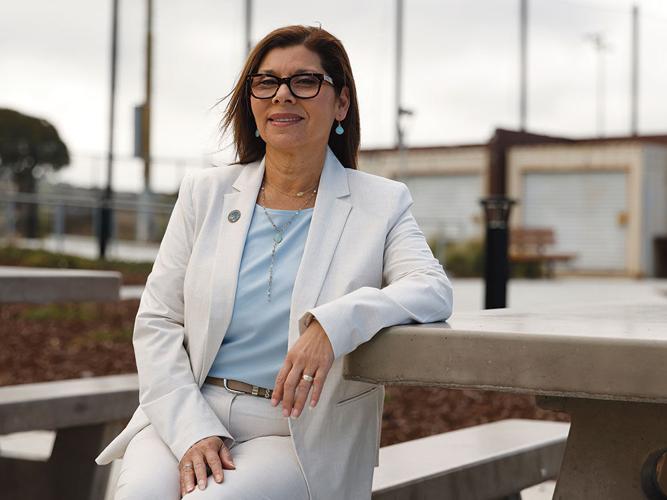
Marina Camacho for Assessor-County Clerk/Recorder
Marina Camacho ran unopposed for her first term in this elected leadership role, and is seeking a second term unopposed. She’s had four years to grow into a position she says is different despite serving 33 years previously as a staff member, absorbing more responsibility.

Monterey County Assessor-Clerk/Recorder Marina Camacho is particularly proud of starting to offer civil marriage ceremonies: "It's such a joyous occasion for people," she says. "You just see smiles as they are going through their moment."
The Office fills multiple functions, including property tax assessments, which means implementing technical state legislation such as Prop. 19, which took effect in 2021 and does a few things. It allows people age 55 or older to buy and sell a home and keep their artificially low Prop. 13 property tax bill. It also allows children who inherit a home to keep that low assessment, but only if they make it their primary residence. This has led to a range of reactions to the Assessor’s Office, Camacho says, including: “I’m not going to be able to keep my property anymore because I can’t afford it.” The result of these changes has been an increase in appeals filed. “We have to defend our position based on the law,” Camacho notes.
On the Clerk’s side of the office, which processes marriage certificates, birth certificates and death certificates, Camacho led the implementation of civil ceremonies starting in 2024. That means not just checking the paperwork box, but actually getting married onsite. It’s not just joyful, but a convenience.
Glenn Church for Supervisor | District 2
North Monterey County has had a rough few years. From the Pajaro River levee breach in 2023 to the Vistra battery storage fire in Moss Landing in 2025, it’s been catastrophe after catastrophe – on top of more run-of-the-mill challenges like persistent winter flooding in Bolsa Knolls and regular traffic backups on Highway 156.
That is to say, Glenn Church’s first four-year term on the Monterey County Board of Supervisors was a bit of trial by fire. He seemed to do best during the fires (literal and figurative), holding community meetings and advancing the free flow of information to the public. He often serves a role as the middle-of-the-road vote on the board’s most controversial matters, reluctant to give strong opinions on things like a civilian oversight committee to review the sheriff or the sheriff’s relationship with ICE. While we hope he finds more conviction in a second term, he’s likely to remain in a more tepid middle ground. “You find majorities that are changeable,” he says. “This isn’t a 3-2 bloc, this isn’t like the U.S. Congress. Things are very fluid.” (True, and Church found himself recently on the 4-1 losing end of a proposal to put a moratorium on new battery energy storage facilities.)
Ramon Gomez is a planning commissioner and North County Fire Protection District board member with a long history of public and community service, including as an athletic coach and volunteer on projects like a pandemic food pantry. But he has struggled to differentiate himself from Church, echoing many of the same policy ideas.
We think Church has proven himself up to the job and deserves another four years to finish the projects he started, hopefully with less disasters to respond to.
Chris Lopez for Supervisor | District 3
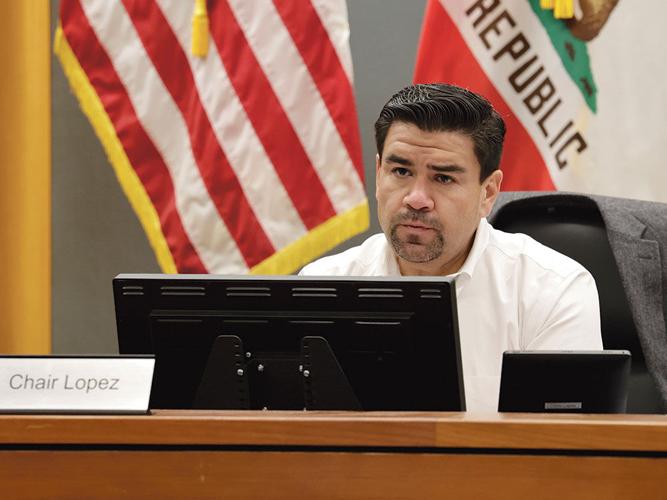
We favor contested elections because they require candidates to defend their policies publicly and it sharpens their positions. Chris Lopez has proven to be an effective leader representing South Monterey County. He is thoughtful, well prepared and when he disagrees with other supervisors, he does so with civility.

Chris Lopez was first elected to represent South County's District 3 on the Monterey County Board of Supervisors in 2018. He ran unopposed for a second term in 2022, and is headed to a third term with another unopposed campaign this year.
That combination of attributes – plus a formidable campaign war chest of north of $151,000 – make this his second uncontested bid for reelection.
His district is where the majority of new housing developments are getting approved and built in the county, and notably also the most low-income and affordable housing units. The county does not control development within the cities, but a can-do attitude permeates the activities from South County.
With his appointment to the California Coastal Commission, Lopez recently held a first-of-its kind meeting in Gonzales, an inland farm town, to allow his constituents access to the body, as well as to showcase rural communities to fellow commissioners.
— • —
Local Measures
Yes on Measure A (Soledad)
Soledad is a growing city, and that means the number of 911 calls is growing, too; the volume of calls has doubled in the past decade. To help cover emergency response costs, city leaders are asking voters to approve a parcel tax – of $233/year for a single-family home and $174 for a multi-unit home – that would generate about $1 million a year exclusively for emergency medical and fire response. Residents expect 911 calls will generate a swift and meaningful response. To get that, we need to agree to tax ourselves to pay for the services we expect.
Yes on Measure B (Gonzales)
Very similar to Soledad’s needs in a growing, rural city, Gonzales leaders are asking voters to approve an annual parcel tax of $349 for single-family homes and $262 for multi-family homes. The roughly $665,000 per year in revenue would go toward emergency fire and medical responses in a city where the number of 911 calls has risen by 35 percent in the past 20 years, and the population continues growing.
Yes on Measure C (Pacific Grove)
We are constantly amazed by people who run for local office – these are essentially volunteer positions that come with a lot of scrutiny from the public, take a lot of time and receive just a little stipend. In the case of Pacific Grove City Council, compensation for the mayor is $700/month and for other members of council, $420/month, numbers that have not changed since 1998.
If approved, Measure C would bump those amounts to $1,645/month for mayor and $987 for council, amounts they hope might entice a more diverse slate of candidates to run. “Public service should be open to anyone who wants to contribute to this community, not just those fortunate enough to absorb the financial hit without a second thought,” supporters wrote in their ballot argument.
We agree.
It would also help make P.G. better aligned with neighboring cities. Marina recently increased council compensation to $2,000/month; Seaside to $2,400; and Sand City to $950.
Yes on Measure D (Monterey)
The City of Monterey is staring down a $10 million structural deficit and needs to find solutions, fast. The tougher side of that equation is cutting spending, but the mayor, council and city staff are working on that – with more work to do as they seek to minimize the pain.
The other side of that equation is raising revenue, something that can be politically challenging because it requires support from a majority of voters. We encourage voters to approve this 0.375-percent sales tax increase, estimated to generate about $4.5 million annually. A sales tax is shared not just by residents but also visitors who shop in the city, and who would pay just an additional $0.38 on a $100 purchase.
(4) comments
So glad to see the endorsement for Yes on Measure C in Pacific Grove. Our councilmembers come forward to do a job few of us would want. They invest energy and emotional courage to run a campaign, then serve diligently and with graceful patience in a contentious role. While all cities have perennial challenges, PG seems to be navigating them as well as any city in our area. It's time to move beyond the disciples of obstruction and delay and adjust the salaries of our council to a fair level. So many cities have been able to do that without the local drama.
I've never been more disappointed than seeing this endorsement for Steyer. To endorse a billionaire candidate with ZERO experience in public service to run the fourth largest economy in the world is the height of carelessness. Becerra has had DECADES of experience. Becerra over the billionaire every day of the week.
Thank you for joining the Monterey County Democrats, the PG Progressives, and the DSA, Central Coast in endorsing Yes on Measure C. It is sensible, overdue, and modest compared to what neighboring cities already implemented (without a vote).
Pacific Grove council pay has not changed since 1998. In the 28 years since, the cost of living has more than doubled, and the demands of serving on council have only grown. Leaving compensation frozen for nearly three decades is not fiscal responsibility. It is a choice to keep public service inaccessible.
A city council should reflect the whole community: working people, parents, renters, and small business owners, not just those who can afford to serve at a financial loss. Measure C makes serving possible.
Vote Yes on Measure C.
Monterey County now is obviously a highly bias leftist rag. There is no logical reasoning in most of those endorsements - just political bias.
Welcome to the discussion.
Log In
Keep it Clean. Please avoid obscene, vulgar, lewd, racist or sexually-oriented language.
PLEASE TURN OFF YOUR CAPS LOCK.
Don't Threaten. Threats of harming another person will not be tolerated.
Be Truthful. Don't knowingly lie about anyone or anything.
Be Nice. No racism, sexism or any sort of -ism that is degrading to another person.
Be Proactive. Use the 'Report' link on each comment to let us know of abusive posts.
Share with Us. We'd love to hear eyewitness accounts, the history behind an article.