
With a short window to tackle a high-stakes problem – water – things are getting serious, fast.
Members of the Salinas Valley Basin Groundwater Sustainability Agency’s (SVBGSA) advisory committee met on Thursday, April 16 to talk about potential solutions, and the consequences if deadlines are missed.
The goal, under California’s Sustainable Groundwater Management Act, is to develop projects and management actions to bring basins to sustainability by 2040 or 2042. If local groundwater sustainability agencies cannot come up with effective solutions, control could shift to the State Water Resources Control Board, which has the authority to impose pumping restrictions. That could result in fallowing farmland, impacting the county’s top economic driver.
“We are asking you to develop a recommendation to the board,” SVBGSA Executive Director Piret Harmon told committee members. She said potential projects would need to be finalized by early fall. “We need a suite, a portfolio of projects. Not any single one, because it doesn’t get us there. It really comes together to be the most optimal.”
The timeline came as a surprise. “That was a yikes,” Committee Chair Curtis Weeks said.
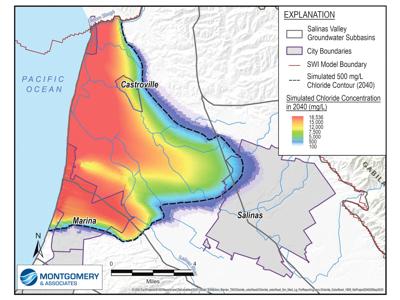
The 180/400-foot aquifer, underlying areas from Castroville to Gonzales, was deemed critically overdrafted by the state in 2014 due to decades of overpumping, and is at risk of being contaminated by seawater intrusion.
In 2022, the state Department of Water Resources determined that the plans submitted by SVBGSA for this critically overdrafted basin were incomplete, requiring stronger evidence to show how sustainability would be achieved. In December, the state asked for more refinement to the plan for this basin; local agencies have until April 30 to respond, showing how their groundwater plans relating to seawater intrusion in the 180/400 subbasin will actually work.
For the whole region, several projects are on the table, and will continue to be discussed at the next advisory committee meeting on Wednesday, April 29. The largest is a brackish groundwater restoration project, which would extract salty groundwater before it spreads inland, then treat it before delivering that treated water back to farms or back into the aquifer. That project – the highest-cost option – is estimated to cost around $1 billion.
One feasibility study discussed at the April 16 meeting was for aquifer storage and recovery, which would involve capturing excess surface water from the Salinas River and diverting that water to be stored in the aquifer for later use. The estimated capital cost would be $278 million-$383 million.
Another concept includes upgrading the existing Castroville Seawater Intrusion Project to reduce groundwater pumping. That project would cost an estimated $60 million.
Weeks stressed the need to come together to find a solution and maintain local control.
“There’s no way today to know who is going to face these cuts,” he said. “ And there’s no way to say that [the state] won’t go into certain areas. We don’t want to have the fight, so let’s figure it out.”


(2) comments
I appreciated the article’s effort to convey the urgency of the April 16 SVBGSA Advisory Committee meeting. The urgency was real. Staff did make clear that the timeline is short, that no single project appears sufficient, and that the agency is under pressure to assemble a portfolio of projects quickly. But after reading the packet and transcript alongside the archived meeting record, I think a fuller account would help readers understand what actually happened.
The meeting record shows that the main disagreement was not whether the groundwater problem is serious. It is serious. The disagreement was over how the problem was framed, especially on three points:
(1) what the “No Action Alternative” really means,
(2) whether likely state intervention should be described as broad and valley-wide or more targeted and basin-specific, and
(3) whether project cost can be discussed responsibly without also discussing cost apportionment — in plain English, who pays.
That nuance matters.
The article leaves the impression that the committee was essentially presented with a clear choice: put together a suite of projects quickly or risk state-imposed pumping restrictions across the region. That is directionally understandable, but it leaves out several important parts of the record.
First, the “No Action Alternative” was not accepted at the meeting as a neutral or uncontested baseline. I argued that if the no-action case is being presented as neutral, it cannot be built on assumptions that “load the deck from the start.” I said a proper no-action case should show what happens without the project, not “smuggle in broad, valley-wide assumptions” that then make later projects appear more necessary than they may be. I specifically asked staff to show where reductions occur, where benefits occur, and whether inland areas actually change the result.¹ That is not a side point. It goes to the credibility of the comparison framework itself.
Second, Thomas Virsik raised a similar concern in more legal and structural terms. On the earlier roadmap item, he said one of the slides contained “misrepresentations” and urged “crystal clarity” and full credibility in how the agency explains the process and the stakes.² Then, on the No Action Alternative, he stated that the no-action study as written was based on a “grotesque mischaracterization” of SGMA and said the committee still needed a much more realistic explanation of what state intervention in the 180/400 subbasin would actually look like. He also noted an important institutional point: the State Water Resources Control Board is the enforcement body, not DWR.³ Whether one agrees with every word or not, those are serious objections that go directly to the public record.
Third, Nancy Isakson provided what I thought was one of the most grounded comments of the day. She explained earlier in the meeting that changing minimum thresholds is not some simple switch you flip; it would require the GSA to bring forward a project or project set, modeling, engineering, financial and economic support, and a showing that beneficial users would not be harmed.⁴ Later, during the no-action discussion, she said the economics being presented looked like a “worst-case scenario” and stressed that if state action did occur, it would more likely be targeted “not to the whole of the valley, but to individual basins,” specifically mentioning the 180/400 and Eastside areas.⁵ Chair Weeks then responded that the information presented “probably does paint a worst-case scenario” and that perhaps the agency would not see basin-wide cuts. He went further and suggested staff refine the economics to produce a more realistic picture.⁶ That is a major part of the meeting record, and it substantially qualifies the broader fear frame that readers might take away from the article.
Fourth, John Farrow made a point that should not get lost because it may end up being decisive later: total project cost is not the same as cost allocation. He told the committee that “who pays is just as important as how much it’s going to cost,” and that without some framework for cost apportionment, the committee cannot really know whether any suite of projects is workable. He warned that it would make little sense to wait until a later Proposition 218 process and then discover the affected parties will not support the financial structure.⁷ That is not a technical footnote. It is a central governance issue.
There was also a meaningful disagreement in the room about whether the basin should be viewed “holistically” or basin by basin. A committee member argued openly for a holistic valley-wide approach.⁸ But that view was directly countered by public comments arguing that the process should remain basin by basin, fact by fact, and that broad valley-wide packaging risks blurring real hydrogeologic differences and real benefit differences between subareas.⁹ That distinction is especially important because some of the projects under discussion are plainly more coastal in their function and benefit than others.
None of this means the article was wrong to note the compressed timeline, the seriousness of the problem, or the existence of state risk if local agencies fail. Those points are real. But the public record was more contested and more careful than the article suggests. The meeting was not simply a straight line from “deadline” to “state cuts” to “build projects now.” It also included substantial public comment saying, in effect: slow down just enough to be precise. Be honest about what the no-action case is and is not. Distinguish basin-specific impacts from valley-wide rhetoric. And do not treat cost as a mere headline number when the real question may be who is being asked to pay for what.
That fuller picture matters because it is exactly the kind of nuance the public needs right now. The meeting record is available, and anyone who takes the time to review the archived materials can see that the April 16 discussion was not just about urgency. It was also about credibility, realism, and whether the agency’s framing is keeping faith with the actual structure of the basin and the law.
The article captured the pressure. It did not fully capture the cautions. And on a subject this consequential, those cautions deserve to travel with the urgency.
Notes / record references
1. Bill Lipe, public comment on Item 4.2, argued that the No Action Alternative should not be treated as neutral if it builds in broad valley-wide assumptions; asked staff to show where reductions occur, where benefits occur, and whether inland areas actually change the result.
2. Thomas Virsik, public comment on Item 4.1, said slide 8 contained “misrepresentations” and urged “crystal clarity” and full credibility in the agency’s explanation of the process.
3. Thomas Virsik, public comment on Item 4.2, said the no-action study was based on a “grotesque mischaracterization” of SGMA and noted that the State Water Resources Control Board, not DWR, is the enforcement body.
4. Nancy Isakson, public comment on Item 4.1, described the process for changing minimum thresholds as requiring GSA action, modeling, engineering, financial support, and a showing of no harm to beneficial users.
5. Nancy Isakson, public comment on Item 4.2, said the no-action economics looked like a worst-case scenario and that likely state action would be targeted to individual basins, not the whole valley.
6. Chair Weeks responded that the information presented “probably does paint a worst-case scenario,” that perhaps there would not be basin-wide cuts, and suggested refining the economics for a more realistic picture.
7. John Farrow, public comment on Item 4.1, said cost apportionment is critical, that “who pays is just as important as how much it’s going to cost,” and that a framework for that question is missing from the work plan.
8. Christopher Bunn argued the valley has to be looked at holistically and said “we don’t have the luxury of ignoring the entirety of the water portfolio in this valley”.
9. Bill Lipe, public comment on Item 4.1, asked the committee to keep the process “basin by basin, fact by fact,” and not let the roadmap get ahead of the science or the law.
Capturing the Salinas River runoff, whic currently flows into the ocean and completely lost, sounds like an ideal solution. The infrastructure cost would be high, but once in place, it should have relatively low maintenance, such as replacement of injection well motors on occasion, etc. Otherwise, we will find ourselves in a situation where the farmers of the lower valley will be unable to irrigate, with reduced crop types that can be planted.
Welcome to the discussion.
Log In
Keep it Clean. Please avoid obscene, vulgar, lewd, racist or sexually-oriented language.
PLEASE TURN OFF YOUR CAPS LOCK.
Don't Threaten. Threats of harming another person will not be tolerated.
Be Truthful. Don't knowingly lie about anyone or anything.
Be Nice. No racism, sexism or any sort of -ism that is degrading to another person.
Be Proactive. Use the 'Report' link on each comment to let us know of abusive posts.
Share with Us. We'd love to hear eyewitness accounts, the history behind an article.