Do you trust the media?
Sara Rubin here to acknowledge this is probably an unfair question (“the media” is unwieldy and vast, and I hope all of us distrust some of the media) and it’s an unfair group to pose it to. You’re part of a self-selecting bunch—if you’re reading this newsletter, you’ve already signaled that you at least would like to have a relationship with Monterey County Now, one entity that falls under the broad umbrella of The Media.
We at Monterey County Now/Monterey County Weekly are a member of the Monterey County Media Literacy Coalition, a group whose initiatives we have covered extensively, and whose mission broadly is to help the public make sense of a shifting and complicated media landscape and how to discern fact from fiction.
We have covered panel discussions and spoken on panel discussions, and published some guidance for readers. I sometimes find myself wondering: Are we just communicating in an echo chamber? Or is the message from journalists getting to those who need to hear it most?
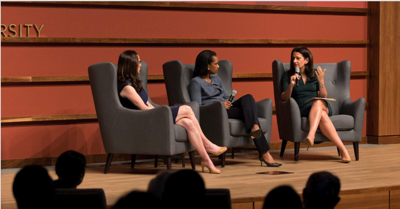
Janine Zacharia, a journalist and communications professor at Stanford, is wondering the same thing. She will speak this Saturday, April 25, as the Media Literacy Coalition’s next guest.
“I am trying to reach people who don’t trust the media anymore,” she says. Acknowledging that those who read about the talk and are inclined to attend might not be that audience, she is prepared with a follow-up: “My hope is that they share this with someone who no longer trusts the media and drag them to the talk.”
That’s all by way of introduction, and to suggest that you drag someone along with you. Zacharia’s talk is entitled “Truth in the Crossfire: Journalism in an Age of Noise and Conflict.”
As a veteran journalist who lived in Jerusalem for seven years and covered facets of the Middle East for Reuters, Washington Post, Jerusalem Post and other outlets, she is well acquainted with noise and conflict, but acknowledges this moment is particularly noisy. “It’s a complete cacophony right now,” she says.
There’s propaganda and fiction coming from all corners, she notes. The IDF blocked international journalists from entering Gaza, and videos taken from people inside the enclave told a story, at times incredibly revealing, at times misleading. In Iran, there’s an absence of international press—and also an internet blackout, making credible information from the ground incredibly difficult to access. And the renamed U.S. Department of War has waged its own war on the press, with Secretary Pete Hegseth “going beyond spin, sometimes just outright fabrications, trying to put the best face on the war that he can.”
Zacharia will talk about how to get through all of this cacophony. She’ll review some basics, like the differences between journalists and influencers. And she’ll ask some questions that might prompt you to reflect honestly on your own news diet: “What are they consuming and how are they consuming it? Are they scrolling, just reading what comes up, or are they making a deliberate decision to subscribe to quality news outlets?” she says.
The talk is free to attend and takes place at 1-2:30pm this Saturday, April 25 at the Unitarian Universalist Church in Carmel.


(1) comment
I use GROUND as a way to check the bias of a story.
Welcome to the discussion.
Log In
Keep it Clean. Please avoid obscene, vulgar, lewd, racist or sexually-oriented language.
PLEASE TURN OFF YOUR CAPS LOCK.
Don't Threaten. Threats of harming another person will not be tolerated.
Be Truthful. Don't knowingly lie about anyone or anything.
Be Nice. No racism, sexism or any sort of -ism that is degrading to another person.
Be Proactive. Use the 'Report' link on each comment to let us know of abusive posts.
Share with Us. We'd love to hear eyewitness accounts, the history behind an article.