
A civil grand jury report released May 1 found that challenging terrain, funding limitations, and delayed adoption of new technology have led to inadequate radio communications for fire districts serving unincorporated areas of Monterey County.
As a result, residents and first responders risk communication failures during life- and property-saving emergencies. This puts the County—where 80 percent of its land is categorized by Cal Fire as high, very high, or extreme fire threat —in a tricky situation.
The report found that the county’s unique terrain, spanning more than 2 million acres, creates radio dead zones and areas with weak or limited coverage—gaps that could be reduced with advances in cell phone technology, low-orbit satellites and modern radios.
Approximately 42 percent of the County lacks reliable radio coverage, and 18 percent lacks usable analog coverage, leaving some areas where first responders cannot reliably communicate during emergencies.
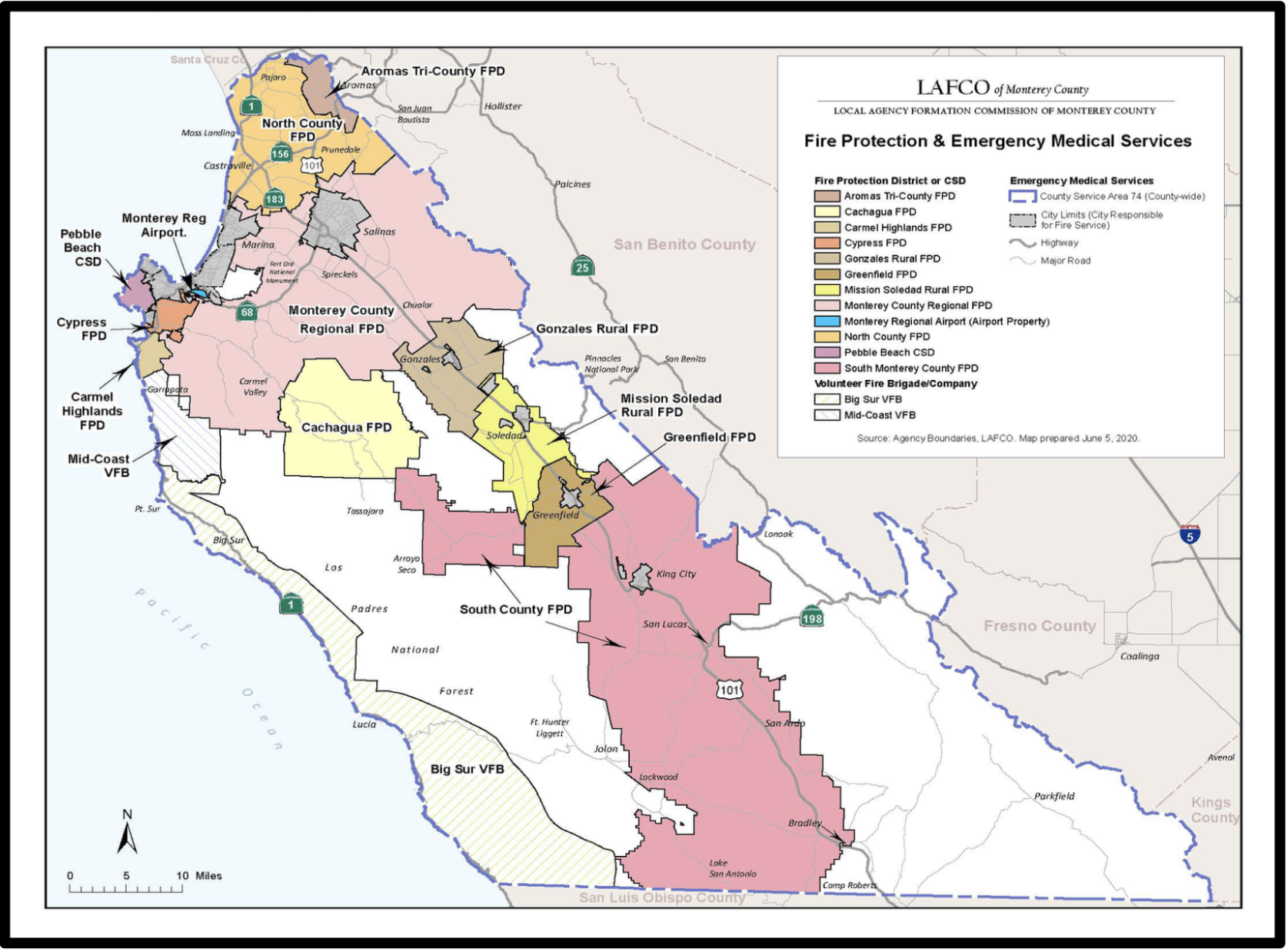
There are 11 fire districts covering unincorporated Monterey County and the Monterey Regional Airport. While most cities operate their own fire departments, two volunteer-based fire districts—Mid-Coast and Big Sur Brigades—also provide service.
Parts of the County also receive fire protection services from federal and state agencies. In total, there are 18 fire suppression agencies that serve 31 communities and participate in mutual aid agreements.
The County and other public safety agencies are a part of the Next Generation Emergency Network (NGEN), a countywide radio system aimed at improving coverage. However, deploying solutions at scale remains a challenge.
The report found some fire districts lack the financial capacity to purchase and maintain radios compatible with all communication modes supported by the County’s emergency communication infrastructure, limiting their ability to coordinate with other agencies and potentially causing delays.
The report’s recommendations include directing the NGEN Executive Committee, in coordination with the County Information Technology Department, to develop a plan by Dec. 31 identifying equipment upgrades, infrastructure needs, and estimated costs to either reduce or eliminate communication dead zones. Another recommendation calls for a feasibility analysis by March 31, 2027 to support radio equipment upgrades and emergency communication infrastructure in unincorporated areas.


(0) comments
Welcome to the discussion.
Log In
Keep it Clean. Please avoid obscene, vulgar, lewd, racist or sexually-oriented language.
PLEASE TURN OFF YOUR CAPS LOCK.
Don't Threaten. Threats of harming another person will not be tolerated.
Be Truthful. Don't knowingly lie about anyone or anything.
Be Nice. No racism, sexism or any sort of -ism that is degrading to another person.
Be Proactive. Use the 'Report' link on each comment to let us know of abusive posts.
Share with Us. We'd love to hear eyewitness accounts, the history behind an article.