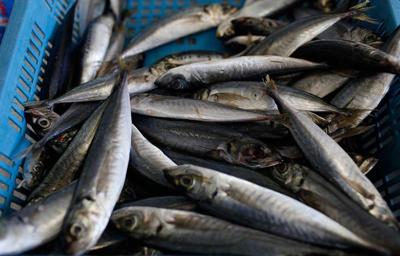

Mackerel seems to be a love-it-or-hate-it proposition, like chicken feet or the stinky Arabic cheese shanklish. It has a loyal following, but mainstream America turns up its nose.
I happen to love it. When I go out for sushi I get saba, a mildly cured mackerel nigiri (imported from Japan). At a local Korean joint, I order it grilled (imported from Norway). I recently discovered canned mackerel (imported from Tunisia) among the new products at Trader Joe’s.
Despite the distances these products travel, mackerel is native to Monterey Bay, too. Monterey Fish Company often has it whole, on ice, for about $0.75 a pound – cheap as retail seafood gets. I’ll take home a half-dozen 8-inchers and give them a clumsy run with a knife, removing the guts and tuna-like blood line that imparts the most pungent flavor.
The result is an oily fillet my husband batters and pan-fries or grills with a salt rub and lemon squeeze. There’s nothing subtle about mackerel, but my whole family has come to savor its umami essence, somewhere between tuna and sardines.
Steve Palumbi, director of Stanford’s Hopkins Marine Station in Pacific Grove, suggests it’s both an environmentally friendly and healthy choice. “There have been a lot of efforts to redirect seafood aficionados towards more sustainable species… anchovy, sardines, mackerel,” he emails. “They tend to be a bit oilier, but full of omega-3 goodness.”
His preferred preparation comes in poetry form: “smoked/ grilled on hot coals/ paired with other strong flavors/ yes!/ treated like a regular fish/ no!”
In the U.S., mackerel usually falls into the unfortunate category of “trash fish” – species caught unintentionally in the pursuit of more valuable catch.
But I predict mackerel will start trending among foodies in 2015. Monterey Fish Company President Sal Tringali says he wouldn’t be surprised if it started popping up on the menus of forward-thinking restaurants, like fresh sardines have.
“One day it will be popular,” he says. “Right now it’s just not.”
Tringali can’t think of a restaurant that buys his mackerel wholesale. But he sometimes sells it to ethnic retailers in S.F. and L.A., where he says European, Asian and Hispanic customers buy it in bulk. “They know what to do with it,” he says.
Two mackerel dishes grace the menu at Won Ju Korean Restaurant in Monterey. The go dung ae gui is grilled and served with lemon, while the go dung ae gho rim is steamed and brightened with a spicy sauce (both $21.95).
Owner Huikyong Robinson imports her mackerel; the local species just don’t appeal to her. “I don’t know how you describe it,” she says. “It tasted funny.”
The California mackerel fishery is an interesting case. Diane Pleschner-Steele, executive director of the California Wetfish Producers Association, says the population is subject to a natural cycle: retreating to its center off Mexico, where it has concentrated for the past decade, then exploding up the California coast. “We’re hoping for a resurgence,” she says.
Local mackerel species include jack (aka Spanish), silvery with rough spines, and Pacific (aka blue), dark and smooth like tiny tuna. The Pacifics are oilier and, in Tringali’s opinion, tastier.
He says the catch is more consistent near the Channel Islands, but one of his own boats brought 300 pounds in from Monterey Bay just last month. “We’re thinking this coming year we’re going to see more mackerel,” he says.
Most of it ships to canneries in Japan and China, he adds, since there’s not much demand here. “The [local] restaurants aren’t going to cook mackerel. It’s a stronger fish,” he says. “But if you know what to do with it, it’s really good.”
Mackerel caught off the California coast seems to be a bit of a blind spot in the industry. Even Monterey Bay Aquarium’s Seafood Watch omits local mackerel from it sustainability guide, listing six species (five of them “best choices), but none of them Pacific.
“Most of the Pacific mackerel caught in the U.S. are exported to Japan, the Philippines and Malta for human consumption,” SeafoodWatch spokesman Emerson Brown reports. “There is little market demand for this species for human consumption in the U.S.”
The state’s mackerel fishery is pretty meager anyway: about 5,400 metric tons of Pacific and 800 tons of jack in 2014, according to the California Department of Fish & Wildlife. Compare that with sardines and anchovies, which fishermen land in the hundreds of thousands of metric tons in abundant years.
“Pacific mackerel have even less management safeguards than sardines,” cautions Geoff Shester, California campaigns director for the nonprofit Oceana. “Until that’s fixed, I’m reluctant to support them as a sustainable alternative.”
Still, I feel pretty good about eating them. Mackerel are rich in healthy oils and generally lower in contaminants than tuna. Buying them fresh raises their value over canned, which helps local fishermen. They’re cheap, tasty and part of Monterey Bay’s seafood legacy.
They’re also kind of stinky. I like that about them. Maybe mackerel fans need a club, like the Cannery Row Sardinistas. I’ll make blue hats for members and wear mine proudly.


(0) comments
Welcome to the discussion.
Log In
Keep it Clean. Please avoid obscene, vulgar, lewd, racist or sexually-oriented language.
PLEASE TURN OFF YOUR CAPS LOCK.
Don't Threaten. Threats of harming another person will not be tolerated.
Be Truthful. Don't knowingly lie about anyone or anything.
Be Nice. No racism, sexism or any sort of -ism that is degrading to another person.
Be Proactive. Use the 'Report' link on each comment to let us know of abusive posts.
Share with Us. We'd love to hear eyewitness accounts, the history behind an article.