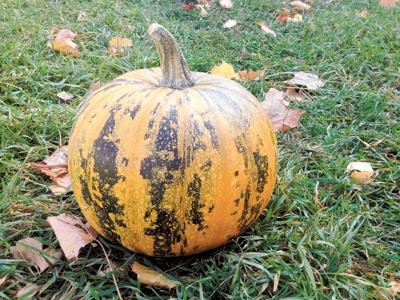
As I was leaving his farm a few weeks ago, the farmer tossed me a parting gift in the form of a large, green and orange orb.
“It’s a special variety of pumpkin, called a kakai, grown specifically for its seeds,” he told me.
It was curiously light for its size, suggesting a big air cavity inside. My wife and kids carved it into a scary face. She then came into the house and announced how good the seeds were.
“I’m not surprised,” I prepared to lecture. “It’s a special pumpkin bred for… wait, are you eating the seeds raw?”
Indeed she was. I munched on one myself, had another, and was struck not only by how delicious they were, but also how soft. They were a bit slimy, too, but that air-dried away in a few minutes. Roasted, the seeds were divine. They puffed out in the heat, into oblong chunks of seed meat bereft of the usual seed coat. Alas, there were surprisingly few seeds inside, for such a large pumpkin.
Pumpkins are a powerhouse plant, one that can produce tremendous amounts of edible material in the flowers, flesh and seeds. A Native American food, pumpkins were one of Christopher Columbus’ most valuable New World acquisitions. They were originally cultivated in Spain, but soon found their way to Austria, where they were adopted in a major way.
The province of Styria in southeast Austria became ground zero for pumpkin seed oil. By the 1700s, Styrian bureaucrats were regulating its production. In the late 1800s, a mutant came along in which the seed’s hard shell was replaced by a soft membrane, and the naked-seeded pumpkin was born. Its soft-seeded descendants became the progenitors of the finest edible and oilseed pumpkins in the world.
Today, there are about a dozen varieties of naked-seed pumpkins, all of Austrian descent, according to Jay Gilbertson of Hay River Pumpkin Seed Oil company in Prairie Farm, Wisconsin. And despite its recent tune-up in Europe, pumpkin is more American than apple pie, he says.
When they got started in 2006, Gilbertson and his partner Ken Seguine planted as many pumpkin seed varieties as they could get their hands on, and finally settled on a variety that grew well on their land. While he won’t say which variety – “it’s our only secret” – he says the seeds are considerably larger and more plentiful than those in a kakai pumpkin.
I went to the store and picked up a few bottles of pumpkin seed oil, one Austrian and one domestic, and played around with them. The domestic, Omega Nutrition brand, is lighter; the Austrian Castelmuro brand is darker and stronger. Both have a deeply toasted smell that’s almost burnt, almost smoky, but not quite. It is a nutty, oily chord, in baritone, and I could see why it’s occasionally used as a replacement for toasted sesame oil in Asian dishes.
The culinary uses of pumpkin seed oil are limited by the fact that you can’t cook with it, as it readily breaks down in heat. So it’s often added raw to dishes as a finishing touch. In Austria, pumpkin seed oil is added to various preparations of meat, like rare slices of beef, or mixed into salad dressings, often with cider vinegar. It is even added to sweets like vanilla ice cream, to which it imparts its nutty flavor.
That night I went Styrian style and put Kürbiskernöl, as they call it, on everything. I drizzled it on salad, salmon and squash, dipped tomato slices into it, and tried to follow a recipe for pumpkin seed and walnut oil mayonnaise, which failed.
The flavor of pumpkin seed oil is not for everyone. My wife finds it quite disgusting, and busts me whenever I use it.
Pumpkin seed oil is used medicinally as well, in Austria and elsewhere, usually for problems in the “down there” regions such as bladder or prostate issues. It’s also high in protein and zeaxanthin, a carotenoid that’s important for eye health. A look at some of the gushing Amazon reviews for various pumpkin seed oils supports the idea that there might be something to these health claims. And the fact that it was grown at all in centuries-ago Austria, much less in such great quantities, speaks to its value, because pumpkins are hardly the most efficient way to get oil; pumpkins placed 31st of the 48 major oilseeds, in terms of oil per acre. Today, India and China are major suppliers of cheap pumpkin seeds.
Gilbertson says it takes 20 to 40 pumpkins’ worth of seeds to make an 8-ounce bottle of oil, which seems like an extraordinary effort. The pumpkin flesh, is basically inedible, but the oil alone makes the enterprise worth it.
“If I had a million bottles, I could sell every one,” Erickson said. But the pumpkin-farming conditions in his area have not been favorable recently: “The last two years have been disastrous. Cool summers and too much moisture.”
This made me appreciate my kakai pumpkin all the more deeply. Those seeds. While they are quite edible raw, cooked they are straight-up spectacular, thick and meaty and bursting with flavor. Straight out of the oven and dressed with olive oil, salt and garlic salt, they exploded in my mouth.
I chew them up and swallow, husks and all. With all the pumpkin pie I’ll soon be eating, I could use a little extra fiber.


(0) comments
Welcome to the discussion.
Log In
Keep it Clean. Please avoid obscene, vulgar, lewd, racist or sexually-oriented language.
PLEASE TURN OFF YOUR CAPS LOCK.
Don't Threaten. Threats of harming another person will not be tolerated.
Be Truthful. Don't knowingly lie about anyone or anything.
Be Nice. No racism, sexism or any sort of -ism that is degrading to another person.
Be Proactive. Use the 'Report' link on each comment to let us know of abusive posts.
Share with Us. We'd love to hear eyewitness accounts, the history behind an article.