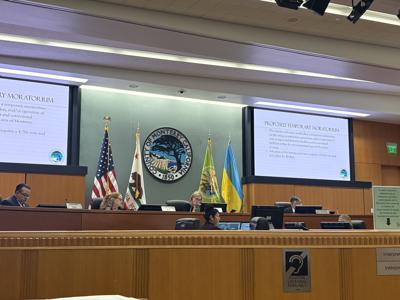

It’s not perfect, but it’s better than the alternative. That’s the sentiment among many about the County of Monterey’s updated housing element, which the Board of Supervisors is expected to pass on Tuesday, Nov. 3, after several years of work.
The alternative to delaying passage is to subject the County to more Builder’s Remedy projects after missing the state’s deadline in December 2023.
County planners have been racing to get the element completed in recent months. The Monterey County Planning Commission approved a draft with a vote of 7-0 on Oct. 14, the final step before taking it to the supervisors.
The state-mandated element includes plans for the possibility of nearly 5,900 housing units in the county (1,256 extremely low income, 939 low income, 712 moderate and 2,990 above moderate), across 56 opportunity sites. It covers a six-year period from 2023 to 2031.
Once the supervisors approve it, the element goes to the California Department of Housing and Community Development for final consideration. If HCD approves, the element will be considered to be in “substantial compliance.”
Currently the draft element is considered to be in "statutory compliance,” which is still not enough to escape Builder’s Remedy.
That law gives builders the ability to propose housing developments that go beyond regular zoning regulations as long as they contain a certain percentage of affordable units.
In the last couple of years, the County has seen multiple applications for Builder’s Remedy projects in the unincorporated areas of the county be submitted. Currently there are nine such projects on the list.
Proposals include a 100-unit project on the site of the old Carmel Hospital, 160 units at the site of a golf course in Royal Oaks, 200 units on a hilly slope on the border with the City of Monterey and more recently, a massive development of nearly 1,000 units at the intersection of Highway 68 and Laureles Grade Road. Whether any of them will actually be built is yet to be seen.
One development that was on the list a few months ago was a highly controversial project proposing 90 units in Carmel Valley Village. That project came off the list when developer Patrick Orosco removed it. He resubmitted it on Sept. 29.
Opponents of the Orosco development, including the Carmel Valley Association and the Friends of the Village Airfield, have been urging residents to write the Board, or make public comments to lobby for passage of the element.
The updated housing element includes certifying the final environmental impact report, as well as making amendments to the 2010 General Plan and specific area land use plans. For example, one amendment to the North County Land Use Plan would reclassify a housing opportunity site in Las Lomas, taking it from Residential Medium Density of one to four units per acre, to Residential High Density, five to 30 units per acre.
Changes to the Carmel Area Land Use Plan could see two sites—the old Carmel hospital site and Stevenson School in Pebble Beach—to up to five to 30 units per acre.
Another change is adding “By-Right” approvals for developments that meet specific zoning and design standards. They would only require staff review and approval, instead of going through the Planning Commission and Board of Supervisors.
The supervisors are scheduled to discuss the element during the 1:30pm session inside the chambers at 168 W. Alisal St., Salinas. Directions on how to participate via Zoom are available on the agenda. The meeting will also be carried on the County's YouTube channel.


(0) comments
Welcome to the discussion.
Log In
Keep it Clean. Please avoid obscene, vulgar, lewd, racist or sexually-oriented language.
PLEASE TURN OFF YOUR CAPS LOCK.
Don't Threaten. Threats of harming another person will not be tolerated.
Be Truthful. Don't knowingly lie about anyone or anything.
Be Nice. No racism, sexism or any sort of -ism that is degrading to another person.
Be Proactive. Use the 'Report' link on each comment to let us know of abusive posts.
Share with Us. We'd love to hear eyewitness accounts, the history behind an article.