
Much like Dorothy opening the door of her tornado-blown house and stepping into the unfamiliar landscape of Oz, when it comes to housing in California, we’re not in Kansas anymore.
Californians, whether they’ve caught on to it or not, are leaving the old ways of planning for more homes into a completely new panorama of laws and ways of planning that, if successful, will reshape how our cities, suburbs and populated regions of unincorporated Monterey County look and feel.
We are potentially stepping out of the tornado that is the housing crisis and into a new landscape that might provide what thousands of residents desperately need: affordable homes near where they work; the promise of better work/life balance and overall health for workers and their families; a consistent workforce for employers, bringing stability to the local economy. Along the way, it also promises to take thousands of cars off of highways and reduce carbon emissions that are hastening climate change.
What’s shaping this new landscape is the state’s most recent Regional Housing Number Allocations, or RHNA (pronounced by planners as ree-nah), for the period of 2023-2031, along with a collection of new laws with real teeth and a reinforced California Department of Housing and Community Development ready to flex its enforcement muscles. Cities and counties do not have to guarantee the units will be built by 2031, but they do have to rezone areas and remove barriers to developers who may take on the actual construction.
Monterey County’s RHNA target number for 2023-2031 is 20,295, almost three times the number required in the last eight-year cycle, which ran from 2014-2023. That total number is then divided between the 12 cities and the unincorporated county jurisdiction. For the entire region encompassing Monterey, Santa Cruz and San Benito counties, the number is 33,274 units.
Monterey County was asked to plan for 7,386 units in the last cycle. So far 5,187 building permits have been issued, or 70 percent of the ask, according to HCD. While that sounds promising, housing advocates point out that more than half of those permits went to market-rate homes. Only 1,200 went to low – to very low-income units.
That’s set to change this time around, as new laws means planning for affordable units in wealthier cities. Other new requirements are taking into account where jobs are, the impact of climate change and other factors when figuring out RHNA numbers. Jurisdictions will also have to make the case that their plans will work. It is a major challenge. But state officials have made it clear: Make the changes or face fines, loss of state funds and even loss of control to make planning decisions.
“It’s an exciting moment, [but] it’s definitely scary for a lot of folks too,” says Alyssa Kroeger, housing program manager for the Monterey Bay Economic Partnership, a nonprofit focused on economic development. “It’s the push that we need to really start moving forward to address these needs in a tangible way so we can hopefully see supply and demand even out, as far as housing is concerned.”
Getting there means big changes for cities and counties, and not all are going along with it easily.
SAND CITY CITY MANAGER VIBEKE NORGAARD AND CITY PLANNER CHARLES POOLER were making their case on Aug. 10 on why their city’s RHNA number – 260 – was too high. The county’s smallest city was appealing, claiming they were hemmed in by protected coastal land and other environmentally sensitive areas and could not accommodate what amounted to 141 percent of their current housing stock. Norgaard guessed 60-70 units was about all the city might be able to handle.
They were making their pitch to the board of directors of the Association of Monterey Bay Area Governments. AMBAG is the state-recognized agency responsible for regional planning, with board members appointed from all three member counties: Monterey, Santa Cruz and San Benito.
Pooler presented a map of the city, and pointed out each of the protected areas as well as the areas of existing development, including two large parcels that make up the two shopping centers that are the city’s economic lifeline. The AMBAG board, made up of elected officials from each city and county, listened before peppering Norgaard and Pooler with questions.
A few board members pointed out the two shopping centers could be rezoned for mixed use – in other words, rezoning those areas to allow buildings with stores on the bottom floor and housing units on top. It’s exactly the kind of creative thinking that HCD officials are expecting jurisdictions to engage in during this RHNA planning process, the sixth eight-year cycle.

The Monterey Bay Region is about to enter another state-mandated housing cycle for 2023 to 2…
Santa Cruz County Supervisor Manu Koenig, an AMBAG board member, said he was sympathetic to Sand City’s predicament, adding, “But of course RHNA is an intellectual exercise in terms of zoning, and to the extent that I think you would solve your problem by allowing residential in the shopping centers,” he said. “Theoretically 260 units could be built above the parking lot. Will that happen? I don’t know.”
In other words, present a plan that in theory could gain HCD approval – whether the units get built or not.
AN INTELLECTUAL EXERCISE IS WHAT RHNA HAS ESSENTIALLY BEEN for decades since the first cycle began in 1969, although it wasn’t meant to be just an exercise. It was supposed to translate into actual homes.
The process begins with California housing officials projecting how many units will be needed for the next eight-year period – as well as the current unmet need – and sharing with each region their target numbers. The designated organization of governments for each region – for the tri-county area surrounding Monterey Bay it’s AMBAG – then goes through a process to figure out what each city and county will need to plan for, based on projected population growth. The AMBAG board votes for the final RHNA numbers. Within each target number is a breakdown based on income of how many very-low, low, moderate and above-moderate homes should be planned for in each jurisdiction.
Next, cities and counties have about a year and a half to rework a part of their general plan called the housing element – a document that describes the housing needs of the jurisdiction at all income levels along with specific plans for how those needs will be met.
Both general plans and housing elements are required by state law. It’s a system that HCD says is supposed to provide opportunities for the private development sector, which makes up 85 percent of all developers, to build housing without “undue constraints.”
The problem is that the exercise translated into thousands of housing units that existed only on paper. Cities presented updated housing elements to HCD for approval, but developers who later attempted to build units were met with high hurdles to jump, including California Environmental Quality Act regulations, parking requirements, fees and a discretionary review process that required developers take projects before planning commissions, city councils and boards of supervisors seeking approvals. Those hearings often came with resolute residents fighting against those projects.
With each eight-year housing cycle, the state got itself further and further into a hole, especially when it came to multi-unit developments for low – to very-low income individuals and families. An HCD report in 2018 estimated that California would have to add 180,000 units per year – 70,000 of those affordable – through 2025 to keep up with demand.
In a state report released in 2020, entitled “The State Must Overhaul Its Approach to Affordable Housing Development to Help Relieve Millions of Californians’ Burdensome Housing Costs,” officials placed blame on the lack of construction, especially for the rise in homelessness and 3 million renter households grappling with overburdened housing costs, meaning they used over 30 percent of their income to pay for rent. Over half, or 1.6 million, carried a severe cost burden of over 50 percent.
The number of severely burdened households is worse in Monterey County. A 2021 report by the California Housing Partnership reported that 79 percent of extremely low-income households spent more than half of their income on housing. Only 3 percent of moderate-income households carried a severe cost burden. The report also found that renters in the county needed to earn $31.14 per hour, or over twice the state minimum wage, to afford the average monthly rent of $1,619. The number of low-income renters who did not have access to an affordable home: 14,553.
The RHNA process is in essence like a pressure valve, meant to alleviate the pressure of an overburdened housing market. In the next eight years, jurisdictions are faced with turning the valve even further to alleviate the overwhelming pressure of a housing crisis.

Market-rate homes in East Garrison, a development located between Marina and Salinas, are currently selling between the high $700,000s and over $1 million. In the last RHNA cycle, cities and the county did well constructing market-rate homes. The construction of low-income to very-low income units lagged behind targets.
IF RHNA HAS BEEN AN INTELLECTUAL EXERCISE IN THE PAST, THAT ERA IS NOW OVER. Sacramento signaled its end with new housing laws passed within the last few years. In 2021, Senate bills 9 and 10 made headlines – SB 9 for the possibility of split lots and multi-unit homes in traditionally single-family-home neighborhoods and SB 10 for allowing increased density in transportation corridors. But even before those landmark bills came Assembly Bill 686, the Affirmatively Furthering Fair Housing, Act passed in 2018. At the time, it was more of a reaction to the Trump Administration’s threat of repealing Obama-era AFFH regulations from federal housing law, but its impact is being felt in the current RHNA process.
Now that AFFH must be a part of the RHNA calculations, cities considered “high resource” must shoulder a larger portion of a region’s units than they have in the past. The goal is to take “meaningful actions, in addition to combating discrimination, that overcome patterns of segregation and foster inclusive communities free from barriers that restrict access to opportunity based on protected characteristics,” according to an HCD 2020 memorandum about AB 686.
A prime example of how AFFH is being implemented is in Pacific Grove, a small town of 15,000 that finds itself having to plan for 1,125 new units. Because HCD categorized P.G. as a “highest resource” area – a wealthier area with access to jobs, educational opportunities and other resources – it must plan for increased affordable housing to create a more inclusive community.
A P.G. town hall meeting to educate the public about the housing element process was attended by over 70 people on July 25. Some ideas for how to meet the new, higher number in a town many consider “built out” were presented by David Driskell of Baird+Driskell Community Planning, the consultants hired by the city to assist in the RHNA process.
Driskell laid out possibilities for adding more units, including mixed-use developments in key sites, increasing allowable densities and increasing the number of accessory dwelling units. “There are 5,600 residential properties in Pacific Grove. If you built an ADU on every one, you’d hit it out of the park,” he said.
It’s an effort that will likely be met with stiff resistance. There was considerable pushback from a portion of residents during the meeting that became contentious at times. One man asked if adding more affordable units would mean “illegals” would move in. Another man, who identified himself as a resident of 40 years, called the new effort to add more units unrealistic. “I think our best option is to vote out all the people in Sacramento and get a new administration and a new mindset,” he said. Some in the audience responded with hearty applause.
It’s not just residents who are struggling to accept change. Last spring the Pacific Grove Planning Commission asked the City Council to appeal the 1,125 number assigned by AMBAG, as Sand City did. The council declined after city staff said an appeal would likely fail.
At the AMBAG appeal hearing, some board members empathized with tiny Sand City’s plight, like Monterey City Councilmember and AMBAG board member Ed Smith, who said the RHNA process “is missing some logical effort that is not allowing for cities to come up with a number that is anywhere close to this planet. It’s out of whack with what is provided to us from HCD.”
Others were less sympathetic. All the officials knew their jurisdictions were facing stiff numbers to meet, and if Sand City’s number went down, everyone’s numbers would go up to meet the over 33,000 required for the entire region. The board voted 11-8 to deny Sand City’s appeal.
That night board members considered another appeal from Greenfield officials, who argued that so many homes had been built in their city during the fifth RHNA cycle that to create their number of 760, if they were built, would seriously strain their city’s infrastructure.
That vote, which came after a couple of board members left, was even more split. The board 9-8 in favor of the assigned RHNA number, denying Greenfield’s appeal.

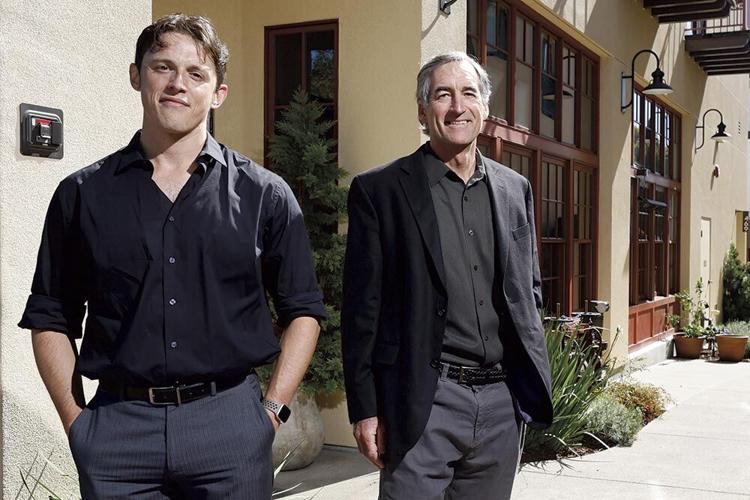
LandWatch Deputy Director Gabriel Sanders, left, and Executive Director Michael DeLapa see a unique opportunity for changes to zoning and planning that may bring more housing to the region. They want to see more people living near where they work, which would take cars off the road and lessen the impact on the climate.
“THE NARCOTIC OF NOSTALGIA” is one term LandWatch Executive Director Michael DeLapa uses to describe what drives some people to protest against more housing. That extends to opposing any kind of change from coming to their neighborhoods and downtowns, “as if anything new is bad,” he says.
The pushback against change or loss of character is what often happens during what is known as discretionary review, when a development project goes before a planning commission or city council in a public hearing where the public gets an opportunity to weigh in, pro or con. It’s where those who have come to be known as NIMBYs (Not in My Backyard), coupled with elected representatives looking ahead to reelection or higher office, have at times stymied or outright stopped the development process.
Discretionary review serves to “gum up the process,” says Gabriel Sanders, LandWatch deputy director. In a Housing Element Principles paper written explicitly for the sixth RHNA Cycle, LandWatch is recommending jurisdictions flip the process away from project-by-project discretionary review and toward public input and approval by representatives at the level of the general plan. In other words, have everyone create the standards for development at the outset – including protection of natural resources and a vision for how a city will look and feel – and then let planning staffs use those standards to approve projects. DeLapa points out it’s been successfully used in Oregon and elsewhere.
For-profit developers need to know a project will “pencil out” financially, with a net profit margin of around 5 to 7 percent. “A for-profit developer needs to talk about risk,” Sanders says. Discretionary review poses great risk, not knowing if after pouring money into planning a project if it will be approved or will be financially viable if the project is whittled down or changed significantly by planning commissioners or elected officials. It stops some developers from moving forward. “They can’t get to certainty because they can’t get a project to pencil,” Sanders says.
“The biggest issue of the discretionary process is that it is really burdensome in terms of time and money which adds to project cost, but it’s also emotionally burdensome,” says Kathryn Avila, who grew up in the family business at Avila Construction and now handles real estate entitlements, investments and special projects for the company. She believes it’s time to stop “thinking so hard” at the project level, and use that thinking and public participation at the general plan level. Essentially that time is now, as local governments have to update their housing elements by an HCD deadline of Dec. 15, 2023.
It’s not just discretionary review that serves to “gum up the works,” it also includes things like zoning, permitting, development standards and fees. HCD officials are now requiring local governments to identify anything that constrains building and then reducing or removing them. If they don’t, HCD will not certify their housing elements and that could lead to sanctions from an all-new HCD enforcement division.
“I do think it’s going to be an adjustment,” DeLapa says of what’s ahead for planning staffs, commissioners and elected officials.
“To get there politically, they’re going to have to get their heads wrapped around a new set of state laws that encourage housing production.”
WHILE SOME IN LOCAL GOVERNMENTS ARE EMBRACING THE TOUGH CHALLENGE BEFORE THEM to increase housing production, others have not caught on yet. A majority of the Pacific Grove Planning Commission in May refused to accept the city’s 1,125 RHNA requirement and asked the City Council to appeal based on concerns about the city’s infrastructure needs and lack of water.
Planning Commissioner Don Murphy voted no on the appeal. “We need housing. We need as much as we can create and we need to start now,” Murphy said. The council declined to appeal on June 1, after hearing from Housing Director Anastacia Wyatt that the appeal would likely lose.
Wyatt wasn’t just guessing about the potential to lose; she pointed to examples in other areas of the state which started their cycles earlier than the Monterey Bay region, where appeals lost more often than they won. Beyond appeals, there are also now examples of HCD making good on a promise to crack down on jurisdictions that do not comply.
San Francisco received a 17-page decision from HCD on Aug. 8 rejecting its housing element. While HCD officials applauded some of the city/county’s efforts, they told the city it had two years to shorten its notoriously lengthy permitting process. HCD also launched an investigation into the city’s housing approval process with a goal of removing further barriers to development
The decision had a ripple effect in the state. “That’s an interesting foreshadowing of what we might expect in the future,” MBEP’s Kroeger says.
Such decisions by HCD carry great weight, since the agency now has the power to take jurisdictions to court and impose fines and other penalties, including taking away a jurisdiction’s ability to make its own housing decisions. Affordable housing projects could be approved on a short deadline with no discretionary review.
“It’s really a matter of making sure we do a thorough job and make sure we understand this is no longer a planning exercise,” Kroeger says. “Folks’ feet will be held to the fire.”
THE EXTRAORDINARY OPPORTUNITY FOR CREATING REAL HOUSING afforded by this cycle of RHNA has given rise to a coalition of housing advocates in the region who are poised to help jurisdictions meet the new requirements. The coalition includes groups like LandWatch, MBEP, and the group YIMBY (Yes in My Backyard), among others. But it also includes those not normally paired with such advocacy groups, like local chambers of commerce.
Both the Monterey Peninsula Chamber of Commerce and the Salinas Valley Chamber have endorsed the creation of more housing, recognizing that businesses are having a hard time succeeding in securing employees, says Kevin Dayton, who represents both chambers as a government affairs consultant. On the Peninsula, where tourism is the number-one industry, hospitality businesses struggle recruiting and retaining employees because they cannot afford to live there, resulting in long commutes.
Similarly, he notes, Monterey Peninsula Unified School District is experiencing high staff turnover and decreasing student enrollment, leading to school closures.“The market is so distorted by the control of supply, you’ve got to look at things like the school district building their own housing,” Dayton says. It is, however, expensive, and yet somehow “we’ve got to reduce the agony” put upon people by the lack of housing supply.
“We want to see families here, we want people after they graduate to not to go away,” Dayton says of both chambers he represents. “We’re concerned about the demographic trends, which are not healthy for business or the community in general.”
DeLapa also sees this as an opportunity for furthering both equity and environmental justice. “We haven’t had this opportunity with new housing laws, the public understanding of climate change and resources,” DeLapa says. “Everyone is beginning to acknowledge that we share these goals, that they are common goals and we can work together to make them happen.”
SHOULD THE BARRIERS TO DEVELOPMENT LESSEN OR COME DOWN COMPLETELY, and should the next cycle of RHNA be successful, local communities will take on a new look. Taller, more dense buildings will rise in downtown areas and around transportation hubs. Avila expects more affordable types of housing like apartments, condos and townhomes.
Neighborhoods that were once exclusively single-family homes will include some accessory dwelling units, duplexes and fourplexes. Multi-family housing may spring up on school, college and church campuses, or on empty parking lots or above stores.
“We have no choice but to put housing where we haven’t put it before with the RHNA allocations that have been given,” Avila says.
It will also change the faces within communities, and that, advocates say, is a good thing.
“Workers can’t afford to live here but they keep the economy ticking,” Sanders says. “If you’re not considering their well-being as well as your own, what kind of community is that? Thinking longer term can only benefit yourself and the people we rely on.”
(0) comments
Welcome to the discussion.
Log In
Keep it Clean. Please avoid obscene, vulgar, lewd, racist or sexually-oriented language.
PLEASE TURN OFF YOUR CAPS LOCK.
Don't Threaten. Threats of harming another person will not be tolerated.
Be Truthful. Don't knowingly lie about anyone or anything.
Be Nice. No racism, sexism or any sort of -ism that is degrading to another person.
Be Proactive. Use the 'Report' link on each comment to let us know of abusive posts.
Share with Us. We'd love to hear eyewitness accounts, the history behind an article.