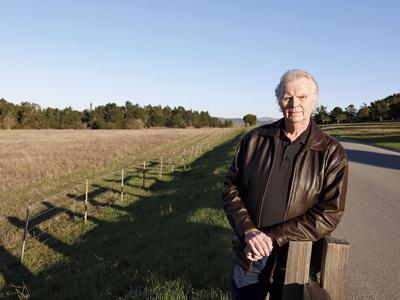

Andrew Hawryluk remembers the cows peacefully grazing in the 80-acre bucolic pasture that lies up Olmsted Road, opposite Monterey Regional Airport, part of the undeveloped land south of Highway 68 known as Tarpy Flats. One day the cows disappeared. Neighbors investigated, later discovering that the County of Monterey was eyeing the land to meet its state-mandated housing goals and a developer was considering a 350-unit project.
The Save Tarpy Flats Consortium was born, with 250 nearby households as members. With Hawryluk as president, the group successfully lobbied to have the parcel removed from the county’s housing element as a potential source of units to meet the county’s Regional Housing Needs Allocation target, arguing that the land is a natural wetlands, home to endangered flora and fauna and has cultural significance to Indigenous peoples. Its removal from the list does not mean the land cannot be developed.
In total, the county needs to plan for 3,326 units to meet its RHNA goal – nearly 2,200 in the low – to moderate-income categories – a task it was supposed to have completed by December 2023. County planners submitted a draft element in August that included a list of parcels that could potentially be developed. In November, the California Department of Housing and Community Development issued a findings letter indicating not all the parcels were viable, among other deficiencies.
Without a state-certified plan, the county is open to what’s known as “builder’s remedy,” a law that makes it easier for developers to get project approvals, even if they don’t meet zoning requirements, as long as they include 20-percent low-income units.
In the past year, 11 such projects have been submitted, including the Tarpy Flats parcel where landowner Saucito Land Company is currently proposing 80 single-family homes over 4,000 square feet each and 20 multi-family rental units that are less than 850 square feet.
While builder’s remedy may streamline the process, it’s not a guarantee that a project will be developed. It still must go through a review under the California Environmental Quality Act and can be denied if it can be proved the project will compromise public health or safety, or does not conform to state and federal laws or that the land is necessary for agriculture or resource preservation.
Hawryluk questions the wisdom of constructing 80 above-moderate-rate homes and only 20 low-income inclusionary units when the county needs more lower-income housing. He believes it would be better for the county to focus on providing affordable housing in areas closer to resources such as grocery stores and public transportation.
“For 20 units we’re going to ruin this natural preserve,” he says, overlooking the property. His group wants to purchase the land from Saucito and donate it to the nonprofit Big Sur Land Trust, which owns an adjacent property.
The housing element is scheduled to go back to the Monterey County Board of Supervisors on Feb. 4. Chief of Planning Melanie Beretti told the Planning Commission on Jan. 8 that planners are working toward an updated draft element for public review in May or June, with a final document going to the commission and board by summer. “We need to get a certified element as soon as feasible,” she said.



(1) comment
We need more housing in the Salinas Valley; not more exclusive expensive housing.
Welcome to the discussion.
Log In
Keep it Clean. Please avoid obscene, vulgar, lewd, racist or sexually-oriented language.
PLEASE TURN OFF YOUR CAPS LOCK.
Don't Threaten. Threats of harming another person will not be tolerated.
Be Truthful. Don't knowingly lie about anyone or anything.
Be Nice. No racism, sexism or any sort of -ism that is degrading to another person.
Be Proactive. Use the 'Report' link on each comment to let us know of abusive posts.
Share with Us. We'd love to hear eyewitness accounts, the history behind an article.