Students graduating from the Defense Language Institute were honored Tuesday night by Monterey City Council, followed by an invitation from Mayor Chuck Della Sala to stay for the whole meeting to participate in the democracy that they fight to protect; they all filed out.
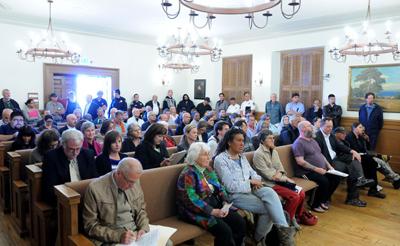
But democracy was in full force last night, with dozens of members of the public packing city hall beyond capacity, and so many impassioned speakers from the public that City Council deliberated well beyond midnight over what to do about homelessness in Monterey.
"We received a significant increase in the number of complaints [about the homeless]," Monterey Police Chief Phil Penko said.
Following a study session on homelessness last month, City Council reconvened Tuesday to hear from Penko and other city staffers as to possible directions the city could take to address an issue many downtown business owners say has reached its worst level ever, as panhandlers on Alvarado Street intimidate prospective customers away from stores.
"Panhandling is destroying businesses downtown," Old Monterey Business Association Director Rick Johnson said.
The directions Penko laid out: a sit-lie ordinance, which would ban sitting and lying on the sidewalk; smoking prohibitions downtown; and overnight parking restrictions.
After two-plus hours of public comment, much of it focusing on the sit-lie ordinance, which critics say is unconstitutional and would almost definitely draw lawsuits, City Council acted quickly.
"We have enough laws already," Councilman Frank Sollecito said. "We need to use the ones we have on the books more effectively."
He promptly smashed a sit-lie ban: "I wouldn't touch that with a ten-foot pole."
Council voted 5-0 to pass on the controversial sit-lie ordinance possibility. They also voted 4-1 to examine a smoking ban on Fisherman's Wharf, and also in all of downtown.
They also agreed unanimously to investigate overnight parking bans, a nod to neighborhoods like Garden Road that sometimes come to resemble trailer parks. But City Councilman Alan Haffa intervened on the parking point, supporting the parking restrictions only if the city also considers the possibility of a safe overnight parking lot available to people who sleep in their vehicles.
"I believe if we do this, if we are leaders, other cities will follow," he said.
The pep talk came about because of reluctance by city staffers to link a discussion of parking restrictions with the provision of parking lots; the two areas, law enforcement and community services, were on the agenda at separate hours, prompting advocates to set up a "Free Speech Potluck" at City Hall to keep people there for hours of waiting.
When Haffa pressed for an explanation as to why the two subjects were separated, City Attorney Christine Davi said, "I didn't want the issues confused. Should the council decide they want a sit/lie ordinance, I don't want it to be perceived that it's targeting [the homeless]. It applies whether you're 75-year-old sitting on the sidewalk or homeless or a woman or a man or young or old."
"Then why was the chief's presentation 95 percent about homelessness?" Haffa responded. "I mean, let's be serious."
City Council did decide to get serious on homelessness services. Haffa moved to pursue five possible policies, which city staffers will research, then bring back to council in a few months: Hire a city liaison who would direct the homeless to available services; provide MST bus passes; restore volunteer police trainings; pass a resolution in favor a regional homeless shelter; and to provide a jobs program.
(Council also agreed unanimously to rule out the possibility of long-term camping at parks, including Veteran's Park, which was the site of the Occupy Monterey encampment.)
Monterey City Manager Fred Meurer cautioned City Council about the direction: "We are not in the homeless business right now. We are about to get into the homeless business."
Citing a dire budget situation, Meurer said it would be a drain on other city resources to provide any support for the homeless.
In 2012, the city received $123,000 in federal and state funding to allocate to homeless service providers; this year, that was slashed by half. No money from the city's General Fund goes directly toward addressing homelessness today.
Meurer also expressed skepticism on the city advocating for a regional shelter.
"When we talk to Marina and Seaside," Meurer told City Council, "they'll say, 'We've got one; where's yours, Monterey?'"


(0) comments
Welcome to the discussion.
Log In
Keep it Clean. Please avoid obscene, vulgar, lewd, racist or sexually-oriented language.
PLEASE TURN OFF YOUR CAPS LOCK.
Don't Threaten. Threats of harming another person will not be tolerated.
Be Truthful. Don't knowingly lie about anyone or anything.
Be Nice. No racism, sexism or any sort of -ism that is degrading to another person.
Be Proactive. Use the 'Report' link on each comment to let us know of abusive posts.
Share with Us. We'd love to hear eyewitness accounts, the history behind an article.