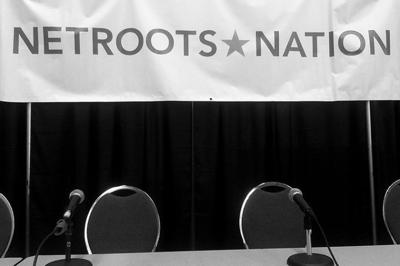
It's nearing the end of the first day of Netroots Nation, the massive assembly of progressive activists, bloggers and organizers who've congregated this year in San Jose to talk about everything from immigration to interventionism.
The San Jose Convention Center is buzzing with bright-eyed (or inconsolable gloom-and-doom) liberal types, about 3,000 of whom are expected to attend over the next three days. (These people are serious: The bathrooms have been labeled "Gender Neutral").
With 80 panels planned, the conference runs the gamut of political hot topics: Today's panels included "What the Frack?! Impact of Fracking on Health and Environment," and "Smoke Signals: The Next Steps in Marijuana Reform."
"We're at a tipping point on many issues, from gun safety and immigration to marriage equality and reproductive rights," writes Netroots Executive Director Raven Brooks in his introduction to the conference. "But we have some work to do."
And work they did. At lunch time the SEIU harnessed the activist potential of the conference and bused seasoned protestors to the headquarters of Google for a "Don't Be Evil, Use a Responsible Contractor" campaign. The demonstrators demanded the tech giant use a security contractor that allows unionization, and rallied for the 3,000 Silicon Valley security guards who want to form a union.
Later activists had the opportunity to do some of their own impromptu organizing by appealing to their peers at localized "caucuses." At the California caucus, held in a large meeting room, local activists made elevator pitches to garner support for their projects. The issues ranged from getting rid of Prop 13 (cue cheer!), to keeping the Koch brothers from purchasing a newspaper company (cue boo!).
Glen Schaller, political coordinator for the Monterey Bay Central Labor Council, was soaking up grassroots organizing strategies and best practices at various panels.
Schaller says he's already been able to localize some of the things he's learned. Monterey County has a small voter turnout for school board elections--only about 25 percent of already registered voters. Schaller asked one panelist how to get people from simply saying they'll vote to actually hitting the voting booth. The secret, he learned, is making outreach more personal.
He says he's going to take that advice back to the labor council and tweak the way he follows up with voters, as well as the way he writes phone scripts for voter drivers.
"I've always believed that field campaigns—the doorknocking and phone calls are an important part of elections," he says. "It turns out there's science to back that up."
Two panels this reporter attended were "The Price of the Ticket: the Real Cost of Mass Incarceration," and "Migrants Moving Mountains: How the Undocumented are Leading the Charge on Immigration Reform."
I originally planned on live blogging the events—or at least writing up short summaries at the end of the panels. But I was having WiFi trouble earlier in the day (#technologyfail, for a conference that appeals to bloggers). You can follow my disjointed Twitter feed of events at @atemkar.
Below are a few notes from those panels. Stay tuned for Sara Rubin's coverage of Netroots tomorrow.
~~~
The Price of the Ticket: Uncovering the Real Cost of Mass Incarceration
The American prison system is taking a toll on minority communities and state budgets, prison reform advocates say.
Here's the "real cost" of mass incarceration, according to data compiled by the Ella Baker Center for Human Rights, an Oakland nonprofit that organizes for urban justice.
- The number of people in U.S. jails and prisons has increased 500 percent in the last four decades.
- 1 in 4 black children will have a parent in prison by the age of 14, as compared to 1 in 25 white children.
- The U.S. spends $30,000 per year per inmate, compared to $11,665 per student.
Activists say the issue breaches the liberal "bubble" the Netroots conference and is something conservatives can get behind too. It comes down to wasteful spending versus smart public investment, says Jakada Imani, executive director of the Ella Baker Center.
"It's the one bloated, failed government program that the left and right can agree on," he says.
~~~
Migrants Moving Mountains: How the Undocumented are Leading the Charge on Immigration Reform
This panel was led by five undocumented activists who've taken to the streets—and the border—to raise awareness of immigration issues and deportation.
One surprising sentiment: They're not entirely positive about comprehensive immigration reform.
The immigration bill in the Senate helps some immigrants, but continues to focus on enforcement—a counterproductive practice, says Tania Unzueta, a 29-year-old organizer with the National Day Labor Organizing Network.
More enforcement translates into higher death rates at the U.S. border, she says. Border security "doesn't stop immigration, it just relocates it to the more dangers areas."
And because the current bill is a bi-partisan effort, and because Republicans are pushing for more enforcement, "the immigration bill can only get worse," Unzueta thinks.






(0) comments
Welcome to the discussion.
Log In
Keep it Clean. Please avoid obscene, vulgar, lewd, racist or sexually-oriented language.
PLEASE TURN OFF YOUR CAPS LOCK.
Don't Threaten. Threats of harming another person will not be tolerated.
Be Truthful. Don't knowingly lie about anyone or anything.
Be Nice. No racism, sexism or any sort of -ism that is degrading to another person.
Be Proactive. Use the 'Report' link on each comment to let us know of abusive posts.
Share with Us. We'd love to hear eyewitness accounts, the history behind an article.