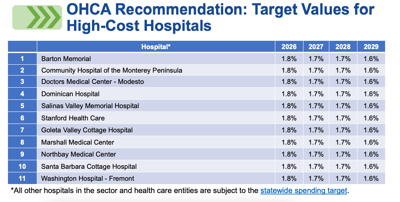

Community Hospital of the Monterey Peninsula and Salinas Valley Health are facing lower spending targets than the rest of the state’s hospitals as a result of the efforts by the state’s Office of Health Care Affordability Board of Directors to reign in health care costs.
The spending targets were outlined in a meeting of the OHCA Board in Sacramento on Tuesday, Feb. 25.
The public now has 45 days to comment on the staff’s recommendation that the state’s 11 highest-cost hospitals be limited to a spending increase of no more than 1.8 percent in 2026, 1.7 percent in 2027 and 2028, and 1.6 percent in 2029. A final decision of the OHCA Board will be made by June 1.
All hospitals in the state are limited to a 3.5-percent spending increase limit next year, landing at 3 percent by 2029. The spending limits were passed last year by the OHCA Board, the first such limits in the state’s history.
As the overall spending limits were being considered in 2023 and 2024, Monterey County kept coming up as a “high-priced outlier” in the state. All three of the county’s largest hospitals, CHOMP, SVH and Natividad Medical Center, were singled out for charging higher prices than hospitals in other areas.
Local unions, residents and others lobbied the OHCA Board to take swift action to bring down hospital costs in Monterey County. Board members were receptive to the idea.
On Tuesday, OHCA staff presented a list of the 11 highest-cost hospitals, determined through a formula they created. CHOMP was number two on the list, under Barton Memorial in South Lake Tahoe. SVH was number five, just ahead of Stanford Health Care.
According to the staff’s data, CHOMP charged an average of 353 percent of Medicare between 2018 and 2022. SVH charged an average of 475 percent of Medicare during the same time period. The statewide average for all other comparable hospitals was 200 percent of Medicare.
A CHOMP spokesperson told the board on Tuesday that forcing a set number of hospitals to further contain costs will threaten access to health care.
“It is OHCA’s duty to ensure that all Californians have access to affordable, equitable, high-quality and universal health care, but their methods demonstrate an alarming lack of understanding of the economic realities of integrated healthcare systems,” said Mindy Maschmeyer, director of marketing and communications for Montage Health, the parent nonprofit company of CHOMP.
She called the formula used to come up with 11 hospitals out of 450 in the state “will not bend the cost curve materially but obviously serves a political agenda of the board.” She warned the board’s actions will have “unintended, but completely predictable, deleterious effects on access to health care.”
Board members disagreed, with one asserting that access is already undermined by high costs. Taking steps to reign in hospital spending was a good place to start, she said.
Salinas union leader Steve McDougall representing the California Teachers Federation, pushed back against statements made by Montage and Salinas Valley Health executives at last month’s meeting, during which they complained that OHCA staff were using incorrect data that penalizes healthcare systems such as theirs.
McDougall argued there was “plenty of” data showing the county’s hospitals were more expensive than other regions—he said the county’s hospital pricing is 84-percent above the national median, second only to the San Jose Metro region.
He also struck back at hints of legal action by Montage executives in January, should the board approve the lower spending targets.
“Continuing to squeeze workers and their families, while making threats of tort cases versus the state of California, with grossly inflated reserves—some over $1 billion—will only lead to a lack of confidence in these hospital providers over time,” McDougall said.
The public comment period ends on April 11. The office can be emailed at OHCA@hcai.ca.gov. The staff report can be found here.


(1) comment
While technically 'private' hospitals, almost all of their funding comes from government programs (Medicare, MediCal, etc.) or heavily government regulated private insurance companies. Perhaps this is ripe for a DOGE type of overview from California for these organizations.
Welcome to the discussion.
Log In
Keep it Clean. Please avoid obscene, vulgar, lewd, racist or sexually-oriented language.
PLEASE TURN OFF YOUR CAPS LOCK.
Don't Threaten. Threats of harming another person will not be tolerated.
Be Truthful. Don't knowingly lie about anyone or anything.
Be Nice. No racism, sexism or any sort of -ism that is degrading to another person.
Be Proactive. Use the 'Report' link on each comment to let us know of abusive posts.
Share with Us. We'd love to hear eyewitness accounts, the history behind an article.