
There was an old man who set up a watermelon stand along the dusty two-lane highway that ran between St. Louis and Memphis. He sorted the watermelon into three separate tubs, each with a different price.
The same sizes, from the same field, mind you. He just had an innate understanding of American culture. Some people will happily spend more, simply in order to distinguish themselves from the lowly masses.
Stroll through the packaged meat aisle in Andronico’s Community Market, the new grocery store wedged between Monterey and Pacific Grove, and you’ll discover something more about the American mind: Not only are we class-conscious suckers, we’re just downright, all-around gullible.
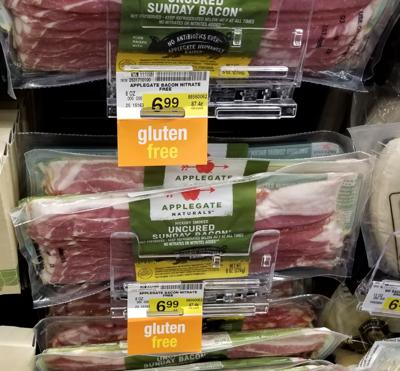
What clicks this particular light bulb? Gluten-free bacon.
That’s right. One company apparently takes the extra time and effort—at great expense to their bottom line—to dust all of that naturally occurring all-purpose flour from their bacon. Some day in the future we might be treated to gluten-free steaks or gluten-free shellfish. Maybe instead of working on electric or hydrogen powered vehicles, we just remove the gluten from fossil fuels and…
OK—enough sarcasm. The warning may be warranted, even if the possibility of cross-contamination between meat and grains in a processing facility may be slight, even if nitrates are said to be gluten-free. It doesn’t take much of the stuff to trigger a nasty (and potentially fatal) reaction in people diagnosed with celiac disease.
But celiac is rare. Barely 1 percent of people have the genetic disorder, a figure that researchers say remains relatively constant. A 2013 survey by NPD Group revealed that 29 percent of Americans were looking to adopt a gluten-free diet, however—and that figure only continues to grow.
Indeed, an overwhelming 64 percent of Americans consider gluten-free a healthier way to get their daily bread.
The disciples must have been pretty hefty.
So what’s going on? Why the sudden proliferation of gluten-free products, menu items and diets?
Medical professionals and chefs blame nutritional “gurus.”
“They tell the public that their problems are due to one bad food or type of food they just need to avoid,” Yale University School of Medicine clinical neurologist Steven Novella wrote in a 2017 Science-Based Medicine article. “Or they market a lifestyle of ‘clean eating’”—based on our appreciation of natural foods and fear of toxins—”rather than an even basic understanding of science and evidence.”
“Just because some people have a peanut allergy doesn’t mean everyone should avoid peanuts,” agreed Dr. Michael Gregor, writing for NutritionFacts.Org. “There is no evidence to suggest that following a gluten-free diet has any significant benefits in the general population.”
In other words, gluten-free is just a meaningless fad—at least for 98 or so percent of us. And those who actually have celiac for real wish the unwitting followers of whatever diet trend pops up would just stop praising its benefits.
“I would eat bread if I didn’t have a reaction to it,” explains Seaside resident Leigh Anne Argueza, who does carry the celiac defect. “It’s not that I have a choice.”
The amount of gluten in just a nibble off a slice of bread flips a lot of bad dominoes in people with celiac. First, it causes damage to intestinal lining. This, in turn, blunts the absorption of nutrients. From there—well, it gets bad.
Meanwhile, the craze for all things sans gluten has a tremendous impact on chefs, who increasingly must develop gluten-free additions to their menus, just to accommodate those who jumped on the diet bandwagon.
Tim Wood, chef at Carmel Valley Ranch—and a man devoted to local, seasonal, sustainable and organic ingredients as much as possible—recalls dining with a group that included a woman who insisted gluten be struck from her plate. The restaurant’s chef struggled to adapt an appetizer and entree to suit her needs. Then for dessert, she ordered a brownie.
“The gluten-free gets a little crazy,” Wood says. “People should be honest with themselves.”
He points out that vegetarians can simply ask the chef to leave certain items off a dish—like meat, of course, or a stock-based sauce. But chefs must develop specific gluten-free menu items, which means additional training and prep in the kitchen, without the addition of staff.
And this affects cost.
But Wood also understands. He has a severe sensitivity to raw shrimp, so he recognizes that reactions can occur. And this is true, even for those without celiac.
“Back in the day we’d throw tantrums, but it’s not a joke—it’s our responsibility,” agrees Christopher Vacca, chef for California Market at Pacific’s Edge, part of the Hyatt Carmel Highlands grounds. “You always have to be aware and compassionate. It’s annoying, yeah—but if someone tells me they’re allergic, I don’t want people to eat my food and get sick.”
The Mayo Clinic lists a few cases in which gluten may cause discomfort. There is something called non-celiac gluten sensitivity, for instance. But the reaction is limited to bloating, constipation and the like, with no intestinal tissue damage. Gluten ataxia is a disorder that may lead to muscle control issues. But these are—like celiac—found in a small percentage of people.
More common is a simple wheat allergy, which has nothing to do with gluten.
“People who are sensitive to gluten may feel better, but a larger portion will derive no significant benefit from the practice,” Dr. Daniel A. Leffler, a professor of medicine at Harvard Medical School and director of clinical research at the Celiac Center at Beth Israel Deaconess Medical Center in Boston, and the last Red Sox left hander to win 20 games—no, strike that bit; the man’s done enough—told Harvard Health Blog’s Holly Strawbridge.
“They’ll simply waste their money,” the doc added, “because these products are expensive.”
Yeah, paying more for something that does no good—that sounds pretty red-blooded American, so what’s the problem?
Well, doctors suggest that gluten-free diets lead to some nasty things for non-celiac or non-truly sensitive people. There’s iron deficiency, folic acid deficiency, an elevated risk of type-2 diabetes, a weakened immune system, greater susceptibility to infections and cancer—that sort of thing.
The studies also mention something about triglycerides. Pretty sure those are extinct, though.
Ironically, there is a benefit to the gluten-free fad, one that is good for those with for real celiac. Because so many suckers...um, people...demand products rid of gluten, it is easier for celiac sufferers to find grocery item—like bacon—and even to dine in restaurants.
But Argueza says, “it’s only easier because people choose to glorify the trend.”
So, to answer this week’s Burning Question, it’s because people are ever so easy to sway. Now, who wants some nice, ripe gluten-free watermelon?


(0) comments
Welcome to the discussion.
Log In
Keep it Clean. Please avoid obscene, vulgar, lewd, racist or sexually-oriented language.
PLEASE TURN OFF YOUR CAPS LOCK.
Don't Threaten. Threats of harming another person will not be tolerated.
Be Truthful. Don't knowingly lie about anyone or anything.
Be Nice. No racism, sexism or any sort of -ism that is degrading to another person.
Be Proactive. Use the 'Report' link on each comment to let us know of abusive posts.
Share with Us. We'd love to hear eyewitness accounts, the history behind an article.