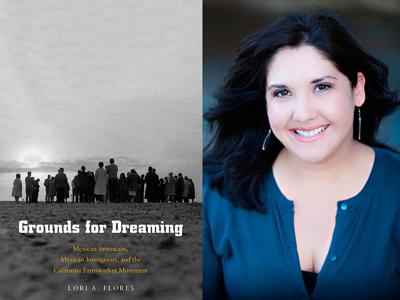

Lori A. Flores is an assistant professor of history at the State University of New York at Stony Brook who's written a book called Grounds for Dreaming: Mexican Americans, Mexican Immigrants, and the California Farmworker Movement.
She's coming to talk about her book and its setting of Salinas Valley at the Monterey County Agricultural & Rural Life Museum in King City.
You should go because 1) You've never been to the Monterey County Agricultural & Rural Life Museum. 2) Flores applies rigorous research and personal humanity to our local history. This email interview displays just a taste:
Weekly: What did you want to address through your book?
Flores: My book centers on the historical experiences and lives of Latinos (both U.S.-born and immigrant) in the Salinas Valley from 1930 to the present, because I felt there was a huge gap in knowledge there. If you go outside of California, most people's point of reference when it comes to the Valley is the literature of John Steinbeck. However, oftentimes Steinbeck didn't complicate Latino characters and their lives very much.
In reality, along with Asian, Anglo, and African American farmworkers, Latino farmworkers were central characters in the story of how the Salinas Valley became one of the most lucrative agricultural regions on the planet. The very diversity of the Latino population itself--U.S. born Mexican Americans, Mexican bracero guest workers, and undocumented immigrants from multiple countries in Latin America--made Monterey County a profoundly different place, and one of the most racially and culturally diverse regions in California and the West by the post-World War II period. That diversity, however, came with much racial and political conflict, especially when it came to the farmworker rights movement and Cesar Chavez's United Farm Workers (UFW) union in California.
My book presents a darker and more turbulent history of worker exploitation, racial segregation and discrimination, violence, and political debate that we don't often hear about in most public narratives about "Steinbeck Country."
What is something that many Americans don't know about Mexican and Mexican-American history in Salinas Valley?
Mexican Americans who were born and raised in the United States constantly struggled to attain all the privileges of citizenship that should have been afforded to them. They were often kept segregated in or excluded from certain residential neighborhoods and public spaces like movie theaters and swimming pools. They were often intimidated away from going to the polls to vote. They often experienced discrimination in employment and in their schools, and not given equal opportunity for socioeconomic advancement.
How are Latino and immigration issues being illuminated by the presidential primaries?
If Latinos are going to be perpetually seen as "foreigners" (whether they are immigrant or U.S.-born) and treated as such by misguided politicians and the media, that's an incredibly frustrating label to fight against in American society. And it's one to pay attention to in this current presidential election year. The ways that different candidates are characterizing Latinos as a political constituency, and outlining solutions for the immigration crisis, are incredibly important to consider critically. This is where proper knowledge of our national history can inform the present. Hopefully my book can help readers better understand why certain solutions proposed by some presidential candidates are more practical, humane, and intelligent than others.
On what ground and in what arena is the next battle for farmworker justice and dignity taking place?
Farmworkers' unions and organizations are still conducting boycotts against employers who are not paying a fair living wage or not protecting their workers in the ways that they should (providing enough water or toilets in the fields, giving enough shade and rest breaks, and monitoring the treatment of female farmworkers to prevent sexual harassment and assault). The fight against harmful pesticides is continuing, and the fight for adequate farmworker housing in guest worker programs like the H-2A program is continuing. Farmworkers are still being killed in transportation accidents because the vehicles they are transported in are being recklessly built and driven. The agricultural industry is not being monitored and regulated enough to protect the workers who are getting food to our tables everyday.
What will you talk about at the Monterey County Agricultural and Rural Life Museum?
I'm going to read from my book, and since the museum is in King City, I want to talk about a particular case in King City in the early 1950s where two groups of high school students got involved in a gang fight (characterized in the press as a "race riot") that resulted in the death of an Italian American teenager. A young Mexican American man with a farmworker background was accused of being the murderer, and the way the case unfolded tells us a lot about the Salinas Valley at that particular point in the 1950s where race, civil rights, and community tensions were all being discussed in the public (and in the courts) in interesting ways. That particular case of violence led to the creation of one of the most prominent Mexican American civil rights groups in Monterey County, the Community Service Organization (CSO), and the story of that group and what it was able to accomplish for Latinos in Monterey County in the time that it existed is really fascinating.
Lori A. Flores speaks 6-8pm Tuesday, March 1, at the Monterey County Agricultural & Rural Life Museum, 1160 Broadway, King City. 385-8020.


(0) comments
Welcome to the discussion.
Log In
Keep it Clean. Please avoid obscene, vulgar, lewd, racist or sexually-oriented language.
PLEASE TURN OFF YOUR CAPS LOCK.
Don't Threaten. Threats of harming another person will not be tolerated.
Be Truthful. Don't knowingly lie about anyone or anything.
Be Nice. No racism, sexism or any sort of -ism that is degrading to another person.
Be Proactive. Use the 'Report' link on each comment to let us know of abusive posts.
Share with Us. We'd love to hear eyewitness accounts, the history behind an article.