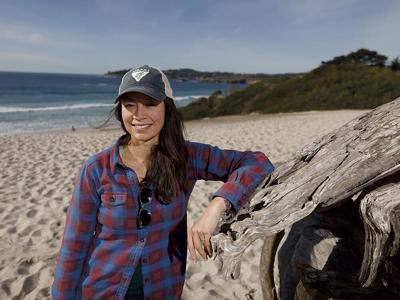

The ocean floor is just the surface of Kakani Katija’s research. As principal engineer in the Bioinspiration Lab at the Monterey Bay Aquarium Research Institute, she leads a team in designing new instruments to explore the ocean in its entirety. “The ocean is massive, and we’ve maybe explored 20 percent,” Katija says. “That’s the number NOAA floats, but I think it’s much less.”
Tools to emerge from the lab include a laser-based imaging system called DeepPIV. “What we’re trying to do is create capabilities for researchers to study animals that they normally don’t get to access and observe,” Katija says.
Katija was born in Hawaii and raised in Oregon, and says she’s always felt connected to the ocean. But her journey to research was atypical, she says, because she didn’t come from a family of academics. Her father and Malaysian-born mother encouraged her to pursue a practical degree. (That’s after a serious pursuit of athletics: With her brother as her ice dancing partner, Katija performed for thousands at the Staples Center.)
She moved to Carmel Valley in 2014 to work in marine science, and has been at MBARI for seven years.
Weekly: You have said that Star Trek originally inspired you to become an aerospace engineer.
Katija: I wish I could say I had a plan, but I didn’t. Going to college and getting a job was my number-one priority. I used to watch Star Trek reruns with my dad, and I was inspired by this group of people whose job was to fly the universe trying to find life we could learn from. In the original Star Trek, it was less “We need to kill off the Klingons,” and a more altruistic mission I really connected with.
But I started out in journalism in undergrad, because of my figure skating background; I saw a lot of people wind up in sports broadcasting. Then I enrolled in physics, chemistry and calculus, and I did poorly – and because of my competitive nature, I was like, “I’m going to do better.”
Do you still have a competitive side?
When you’re an athlete, it’s you against the world. When I am doing work now through science, collaboration is absolutely a requirement for success. I find myself having to pare down that competitive edge. And I find that my overall happiness is better when I’m not constantly competing.
Back to your shift from aerospace to oceans – what inspired that?
I did an internship at NASA, and learned about how limited the opportunities were for one to go into space. They were asking, should crewed exploration be the future, or robotics? At the time, I wasn’t so into robotics.
It seems ironic that now you work heavily in robotics. Have you ever been to the deep-sea locations your technology explores?
I’m still waiting! I think human exploration is valuable, but it’s just one tool in an amazing, diverse toolbox.
What makes it valuable?
What I have heard from researchers in submersibles is that doing observations with a three-dimensional view, using your eyes, has yet to be surpassed. The other thing is engagement. I was drawn to exploration because of the human element. And I still want to go to space.
I want to get at the “why” of your work, and your focus on biomimicry.
We should explore because that’s a human impulse – just to attain knowledge. But funding agencies need a reason. Bio-inspired design, or biomimicry, is a reason. Velcro was inspired by [George de Mestral], a Swiss engineer who noticed his dog had burrs on its fur, and looked closely at the microscopic structure.
Do you have examples of similar takeaways from your research?
In the field of robotics, no matter what we do, we can’t seem to emulate the maneuverability of animals in the natural world. Autonomous vehicles in the ocean are rigid. Stuff in nature is squishy, it’s mobile, it’s dynamic.
Tomopteris worms are able to swim both forward and back. They can stop on a dime, they can do really sharp turns. Is there some underlying physics or mechanism we can reveal?
It seems unlikely we’ll discover 100 percent of ocean life in our lifetimes.
That’s my goal – I want to be able to identify all the life in the ocean.
That’s something I took away from sports. The goal was to be able to compete in the Olympics. I failed at that, but I got part of the way. Maybe I’ll get part of the way in this goal.


(0) comments
Welcome to the discussion.
Log In
Keep it Clean. Please avoid obscene, vulgar, lewd, racist or sexually-oriented language.
PLEASE TURN OFF YOUR CAPS LOCK.
Don't Threaten. Threats of harming another person will not be tolerated.
Be Truthful. Don't knowingly lie about anyone or anything.
Be Nice. No racism, sexism or any sort of -ism that is degrading to another person.
Be Proactive. Use the 'Report' link on each comment to let us know of abusive posts.
Share with Us. We'd love to hear eyewitness accounts, the history behind an article.