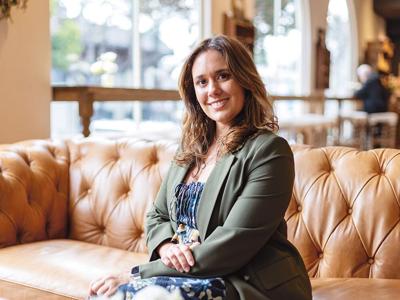

Julia Correia, 31, is a Brazilian-born architect and Carmel resident who has been involved in projects in Monterey County and beyond, from homes to accessory dwelling units to historic buildings, such as a log cabin in Carmel.
Her love for architecture began at an early age when she walked around construction sites and new neighborhoods with her father, a real estate developer. Correia felt drawn to the design side of projects.
“For me, it was how the environments, the places that we were designing made us feel, how that could shape people’s lives, how that could actually change our daily routine,” Correia says.
Architectural design has inspired Correia to expand her horizons. She also creates crocheted textiles and decorative pieces and is a student of historic Indian architecture.
Correia works with Thomas Hood, a Carmel-based architect.
Weekly: You are a young architect from Brazil. Why come to Carmel?
Correia: I went to other states when I first got here in 2022 – Chicago, Detroit, Ann Arbor in Michigan, some cities in Ohio. I went to Oregon, checked out Portland. But when I got here, there was this huge feeling of belonging. I felt like I’ve lived here before, so that’s kind of how I stumbled upon Carmel.
Do you miss Brazilian cooking?
I’ve been to some restaurants in Santa Cruz and San Francisco, and they’re pretty good. But I cook every day, all the meals, so I have a lot of Brazilian food that I make myself. What I like about California is that it’s easy to find ingredients from all cultures.
What’s your favorite dish?
This is a funny one. My favorite dish? It’s stroganoff. It is actually originally Russian, but Brazil is such a diverse place, so we have the Brazilian version of stroganoff that we eat with white rice and shoestring potatoes. It’s basically a beef stew. No noodles for us.
You compared architects to primary care doctors. How so?
You get in the depth of the clients’ lives, their preferences, [including] how they sleep, how they shower, how they cook, what they eat – because all these things are important for you to know how to design the house.
How does taking a course on ancient Indian architecture apply to your work?
They [the professors] started to show me how connected we are. I had this perception that the world was so big and unreachable. I never imagined living abroad, but from that course on, it was such a transformative experience. I started feeling closer to people abroad, and they also started recommending me to clients.
What do you like about design?
It’s almost like a puzzle that you need to solve, and it makes me engaged in the process. Like the log cabin, because it’s a historic building. We are adding some square footage in the back but the lot is non-conforming. It’s like a tiny little lot. You barely have space to build there, and we have so many trees. There are so many different design challenges to go through to be able to make it work. And we are actually making work. It’s a lot of fun.
What’s it like for a young professional to work alongside an established architect like Thomas Hood?
He’s a mentor for me. He does everything hand-drawn and his drawings are like art pieces. We have this collaboration where I bring the technology and the younger energy. Of course, I also have my design sensibility and technical knowledge. But we have this collaboration of the old world coming together with the new world, and I think that makes our firm very unique.
Technology now includes artificial intelligence. Your thoughts?
I feel like technology is here to serve us and help us to preserve what matters. People are very scared of AI. I hear some architects saying, “Oh, they won’t need us anymore in the future.” But technology will never overcome the feeling that we can put in projects. There is something that only human nature can do. So I feel like technology supplements that and supports that.
There’s not much new technology in crochet, another creative medium you use.
There’s something about the texture, the materiality, the colors, the combinations that really speak to me. And it’s basically like weaving, like knitting things together, right? I think all craftsmanship, all types of artisanal work – they have this possibility of bringing things together and creating feeling, creating this layer of life.


(0) comments
Welcome to the discussion.
Log In
Keep it Clean. Please avoid obscene, vulgar, lewd, racist or sexually-oriented language.
PLEASE TURN OFF YOUR CAPS LOCK.
Don't Threaten. Threats of harming another person will not be tolerated.
Be Truthful. Don't knowingly lie about anyone or anything.
Be Nice. No racism, sexism or any sort of -ism that is degrading to another person.
Be Proactive. Use the 'Report' link on each comment to let us know of abusive posts.
Share with Us. We'd love to hear eyewitness accounts, the history behind an article.