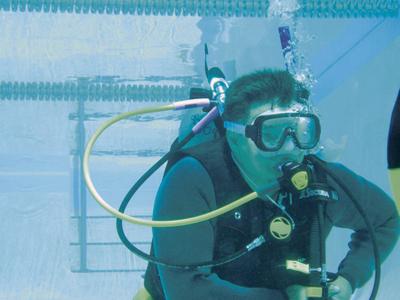
Joe Rivera spits out water at the CSU Monterey Bay pool.
“What’s all the choking and gasping over here?” asks dive instructor Frank Degnan, sidling up to the sputtering student.
“Put the regulator in your mouth,” advises Degnan, showing the student the proper way to clench the mouthpiece. “What you want to do is imagine that thing as a straw.”
Learning to breath where one shouldn’t be able to is hard, but the 48-year-old Salinas man has been in situations far more perilous than this.
In 2005 Rivera was an Army MP escorting a convoy through Baghdad when about 50 insurgents launched an attack. There were only nine American soldiers. In the midst of a firefight, Rivera was sniped in the back.
“I was paralyzed, declared dead twice and in a coma for three weeks,” Rivera remembers. He’s come a long way, but still experiences constant pain, no feeling in his left leg and nerve damage in his lower back.
Now the former soldier has donned a different uniform: one that protects him from chilly water, not combatant bullets. He’s one of several local disabled vets learning to scuba dive – first in the swimming pool, and later from a new handicap-accessible boat designed by the Monterey Bay Veterans.
The divers, who suffer from everything from serious head injuries to PTSD, are being overseen by Degnan, a longtime instructor of disabled students and a dive teacher at CSUMB. University students are volunteering to teach the vets underwater skills, like how to manage buoyancy and navigate at dive sites. Amid the splashing and gurgling, Degnan barks words of encouragement from the poolside.
“All we really want to accomplish today is to believe you can breathe, achieve and accomplish underwater,” he says. “Anything else is bonus.”
Above water the soldier’s breaths through their regulators sound like the inhalations of Darth Vader.
“The breathing aspects of this, the mastery aspects, are excellent,” says Paul Symmonds, a VA social worker.
Diving is also a path back to adventure. “A lot of people who have combat experience have an attraction to adrenaline activities – things that get the heart racing again,” Symmonds says.
The Monterey Bay offers that environment: a demanding-and-deep-blue playground packed with colorful kelp, California sea lions and the occasional leatherback turtle. And it isn’t only critters who vets will be connecting with.
“One of the things soldiers miss after leaving a combat situation is the camaraderie of someone they can count on,” Symmonds says. “Here, when you’re at depth, you need that buddy again.”
The students are sticking to the pool to train for now, but the big test – and the reward – will be practicing their new skills in the ocean, harvesting all the empowerment, physical activity and intellectual stimulation that come with it.
A collaboration with the Monterey Bay Veterans will make that dramatically easier. The vet’s group is in the process of rigging a boat to be handicap – and wheelchair-accessible.
Disabled divers will no longer need to chuck themselves into the water or haul themselves up onto the platform of a wobbling vessel. A large lift that will be hooked up to the back of 52-foot sports fisher will act like the loading mechanism of a forklift, raising and lowering divers into the ocean. It even has a position for a wheelchair. Organizers say it’s the first dive boat with this capability in the world.
“We roll them out, we lock the chair in, the entire platform submerges four feet into the water,” says Tim Doreck, captain of The Freedom. The crew, meanwhile, has christened the device the “Lift to Freedom.”
Doreck and the vet’s group started installing the 500-pound lift in late April, and hope to have it operational and ready for dives by June.
The vessel captain is also re-doing much of his boat, which he had been using mostly for fishing. He’s installing benches and dive tank holders so that six people at a time will be able to sit and suit up. There’s also a new donated air compressor onboard to fill empty tanks.
Back at the CSUMB pool, the students are finishing up their first day in the pool. They’ve learned how to check their equipment, strap on their gear, defog their masks, breathe underwater and, in at least one case, live out a long-held dream.
“Scuba is something I always wanted to do,” Rivera says. “It’s been nothing but pleasurable.”
Learn more about Monterey Bay Veterans at www.mbv.org


(2) comments
It sounds great, maybe in this spring I will sign up for this special training course. I sail often, when I have the time, but I've never dived and I am curious how it is. My yacht is damaged and I bought a few replacement parts from MMIMarine.com. I have to wait a while to repair it to go out into the ocean.
Sailing is another passion of mine. I've bought two years ago a small, but beautiful yacht from http://www.st-barts.com/ and I try to use it as often as I can. I even sign up for a short sailing training course because I want to be good at it.
Welcome to the discussion.
Log In
Keep it Clean. Please avoid obscene, vulgar, lewd, racist or sexually-oriented language.
PLEASE TURN OFF YOUR CAPS LOCK.
Don't Threaten. Threats of harming another person will not be tolerated.
Be Truthful. Don't knowingly lie about anyone or anything.
Be Nice. No racism, sexism or any sort of -ism that is degrading to another person.
Be Proactive. Use the 'Report' link on each comment to let us know of abusive posts.
Share with Us. We'd love to hear eyewitness accounts, the history behind an article.