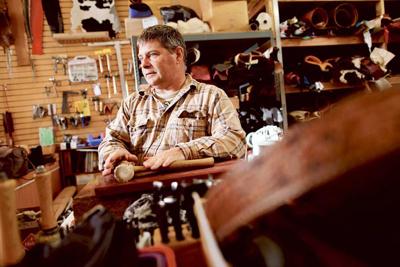

A stack of flared strips of leather, like stretched-out clover leaves, runs about 25 high and keeps growing. John Wright leans forward out of his wooden stool over his workbench and uses a small handheld edger to shave the rough perimeter of each piece, as a pile of spaghetti-like slivers of leather mounts next to him. Every two or three pieces, he wipes the edger on a chalk-like material to sharpen it.
He’s filling an order for a San Jose company that sells photography equipment, and these small shapes will eventually become pieces of complicated camera harnesses popular among wedding photographers. In this era of mass production, Wright’s doing small-scale manufacturing in his New Monterey store, The Leather Company, though technically – for city permitting purposes – he’s an artist with an artist’s workshop, not a “manufacturer.”
While it’s art that originally connected Wright to leatherwork, he doesn’t think of himself as an artist, and prefers the term “craftsman,” though a classic arts-and-crafts studio was his entry point to the trade, 30-plus years ago.
Wright got into leatherwork right out of high school, when he was taking ceramics classes at an art studio in Morro Bay. A piece had blown up in the kiln, and a leather teacher heard him grumbling about it and invited him to join an explosion-free class.
“The fun part was taking the hammer and pounding the leather,” Wright remembers. “I got some of my frustration out. I got hooked.”
Today, he does everything from from tooled custom belts with intricate flower patterns that sell for $40-$150 to jacket repairs to horse saddles. He also makes leather bondage equipment, kept in what looks like a simple closet from the outside. Inside, it reveals walls of whips and wrist restraints – the “bondage room.”
“I know the vibe, and say, ‘Oh, you might want to go look in the room back there,’” Wright says of his interactions with some customers. “It’s a side of the business we keep in a little lower profile. But I’m not shy about it.”
Right across Lighthouse Avenue is Teaz n Pleaz, which sells adult novelties, including Wright’s handmade leather whips and handcuffs.
It’s the bondage room – plus sales on Etsy – that help finance some of the projects Wright prefers, like designing new duffle bag prototypes. Domingo Alvarez had been on the hunt for a perfect leather gym bag when he stopped into the store one day, and showed Wright a photo on his phone of what he was looking for. “He’s like, ‘Yeah, I can make that no problem,’” Alvarez recalls. Two months later, he returned to pick up the finished product: “I’m just amazed, jaw-dropped,” Alvarez says. “The craftsmanship, you just can’t compare it to a mass-produced bag.”
Alvarez’s bag became a prototype for one that now sells for $290, of which Wright has sold about a half-dozen.
Wright also teaches classes in the store, providing materials so students go home after a few hours with their own custom-made item like a belt or a pet collar. Dogs are welcome at the collar-making classes, Wright notes, and allowed to run freely throughout the shop.
Besides dabbling in different styles, Wright also works with different materials, and has leather from animals including buffalo, elk, alligator and ostrich on hand. He says there’s nothing to strange to work with, then stops when he remembers a woman who came in with the hide of her pet cat – which Wright declined to work with, because she hadn’t properly tanned and preserved it, he says.
For 15 years, Wright made leather in Thailand in a small factory he still owns, and where he employs up to 45 people, and orders some of his more exotic and hard-to-find offerings, like stingray-leather wallets, which retail for $60-$180.
A little more than a year ago, he moved to Pacific Grove to be near his aging mother, and opened his Monterey shop. (As to the timing of his move, which coincides with President Donald Trump’s promises to lure foreign manufacturing businesses back to the U.S., Wright says it remains to be seen what will happen in practice: “Are million-dollar companies going to get all the tax breaks? We need to focus on tax breaks for small local guys.”)
Since opening this shop just over a year ago, business has been good and, Wright reasons, can withstand ups and downs in the economy: When times are good, people splurge, and when they’re bad, people get old leather pieces repaired. “We’re eight weeks behind on work,” he says. “It’s a good sign.”


(0) comments
Welcome to the discussion.
Log In
Keep it Clean. Please avoid obscene, vulgar, lewd, racist or sexually-oriented language.
PLEASE TURN OFF YOUR CAPS LOCK.
Don't Threaten. Threats of harming another person will not be tolerated.
Be Truthful. Don't knowingly lie about anyone or anything.
Be Nice. No racism, sexism or any sort of -ism that is degrading to another person.
Be Proactive. Use the 'Report' link on each comment to let us know of abusive posts.
Share with Us. We'd love to hear eyewitness accounts, the history behind an article.