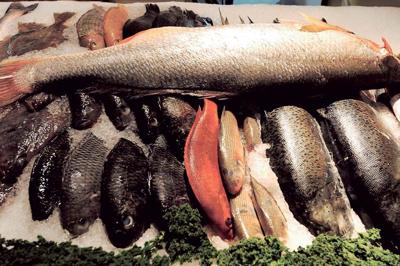

In the giant gyre of ocean news, there aren’t too many buoys of good news.
And that makes this serving of positivity – a three-course serving, no less – particularly beautiful.
1 • Seafood fraud is very close to illegal in California.
Two years ago, when the Weekly put together an enterprising, albeit unappetizing, cover story – “Something Fishy: Seafood fraud disguises farmed salmon as wild, tilapia as snapper and sole as sand dabs” – we were surprised with the results.
But first things first. “Seafood fraud, according to the U.S. Government Accountability Office, is mislabeling for financial gain – selling tilapia as red snapper, for example, or farmed salmon as wild,” Weekly enviro reporter Kera Abraham writes. “The swap can be done anywhere along the supply chain: by the restaurant, retailer, distributor, processor or fisherman.”
Oceana, an international marine conservation nonprofit with a Monterey base, had recently reported species sold as wild salmon, Atlantic cod or red snapper are swapped secretly for cheaper, less desirable or more readily available fish 25-70 percent of the time. Oceana then invited the Weekly team to do some secret sampling. Five of us took 19 samples and mailed them to the lab. Seven of them, or about 37 percent, flunked the test. “Pacific local cod” turned out to be Atlantic haddock, “sand dabs” were flathead sole. Three samples sold as snapper were rockfish, and a fourth, served raw at a sushi spot, turned out to be tilapia.
So we were eager to spotlight ways agencies are working to prevent it.
A most promising tool in that effort took a big step Aug. 29, when both houses of the state Legislature passed SB 1138.
The bill, authored by Sen. Alex Padilla D-Pacoima, requires all fish and shellfish be accurately labeled with their common names, along with whether they were wild or farmed, domestic or imported. The bill heads next to Gov. Jerry Brown’s desk.
2 • Seafood Watch has a new, slicker-than-ever website.
This could appear to be the most modest of the news items.
But make no mistake: Monterey Bay Aquarium’s Seafood Watch app and website, which guide eaters away from overfished species and toward better choices for the environment, are among the most useful tools in conserving our oceans.
Since 1999, Seafood Watch has distributed more than 45 million consumer guides. The free smartphone app has been downloaded more than 1 million times.
Its blossoming business partner program encourages restaurants, distributors and seafood purveyors to purchase from sustainable sources. More than 1,000 businesses, including two of the largest food service companies on the continent, rely on Seafood Watch science to affect their purchases.
And now it’s wildly more searchable.
3 • More than 20 species of West Coast groundfish have been upgraded to sustainable, thanks to good fishery management.
West Coast groundfish – like rockfish (often mislabeled as snapper, speaking of seafood fraud), petrale sole, black cod and sand dabs – are not only some of my favorite fish to observe in the wild, they are some of my favorite fish to eat.
We can do both with clear conscience now that the Seafood Watch program has upgraded 21 species of West Coast groundfish to either a “Best Choice” (green) or “Good Alternative” (yellow). Many had previously been listed as species to “Avoid.”
From the Seafood Watch report announcing the upgrades: “The turnaround from ‘Avoid’ status to a sustainable ranking is unprecedented in the number of species affected, and has occurred because of management improvements implemented following a federal disaster declaration for the fishery in 2000 – including the continuing recovery of overfished species, quotas that better take uncertainty into account, closures to protect vulnerable habitat, and excellent monitoring and control of catch.”
Margaret Spring, vice president of conservation and science, and chief conservation officer for the Aquarium, added this: “This is one of the great success stories about ecological and economic recovery of a commercially important fishery.”
The update softened a long-standing tension with local fishermen, who took offense to Seafood Watch’s historic red-listing of many fish harvested on the Aquarium’s own shoreline.
“It is so gratifying to see fishermen and conservation interests coming together to agree that trawl-caught groundfish – rockfishes, petrale sole, black cod and more – are harvested sustainably and with care for their habitats,” said Monterey Harbormaster Steve Scheiblauer. “These fish have been a cornerstone of Monterey’s fishing heritage and economy. It’s great to see Seafood Watch acknowledge the management changes that brought this fishery back.”
Chefs also weighed in. “This is great news,” said Richard Blais, a Top Chef All Stars champ and member of the Seafood Watch advisory panel. “It shows that we can bring the oceans back to health and turn fisheries around when we work together.”


(0) comments
Welcome to the discussion.
Log In
Keep it Clean. Please avoid obscene, vulgar, lewd, racist or sexually-oriented language.
PLEASE TURN OFF YOUR CAPS LOCK.
Don't Threaten. Threats of harming another person will not be tolerated.
Be Truthful. Don't knowingly lie about anyone or anything.
Be Nice. No racism, sexism or any sort of -ism that is degrading to another person.
Be Proactive. Use the 'Report' link on each comment to let us know of abusive posts.
Share with Us. We'd love to hear eyewitness accounts, the history behind an article.