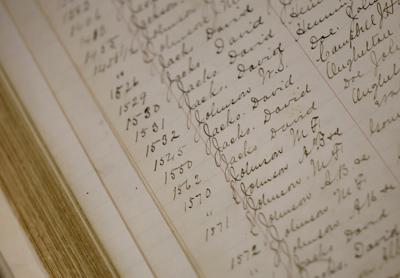

David Schmalz here, excited to share my latest cover story, a historical deep dive into the legacy of David Jacks, the 19th-century land shark who came to own nearly all of the Monterey Peninsula.
I’ve written a lot about history in my time at the Weekly, or woven it into stories rooted in the present, and time and time again I’ve bumped into David Jacks. So I decided to see what more I could learn beyond the accounts found online, to get deeper—if I could.
I’m happy to report that I had some extraordinary luck and one unbelievable surprise along the way.
The most important piece of luck was that a very smart friend, upon learning I was doing a story about Jacks, insisted I read the book Storied Land by Carmel Valley resident John Walton, a retired sociology professor and historian.
Storied Land was just what I had been looking for—it frames the events of Jacks within the context of contemporaneous events, and its detailed bibliography and endnotes gave me a roadmap to get to source materials.
By that point, I’d already spent a day at the archives at Stanford, which houses a large collection of David Jacks papers that include letters and business and legal documents. Unfortunately, reading 19th-century cursive is not a strength of mine, and it was slow going just to get through a fraction of the materials, though I did find some great stuff.
Shortly thereafter, before one of many trips to the California History Room at the Monterey Public Library, I decided to stop by the Jacks’ family graves in Monterey on the way.
There, I happened upon a group of Monterey Peninsula College students at the Jacks graves making a short film for an acting class. Two were wearing period attire, dressed as David Jacks and his eldest daughter Margaret. None of us could believe the coincidence.
Then, when I got to the California History Room shortly thereafter, I stumbled upon something in the stacks I didn’t even know to be looking for: A section of a Works Progress Administration’s Historical Survey of the Monterey Peninsula, circa 1937, of the “history of the city government of Monterey.” To my amazement, it contained verbatim extracts from Monterey City Council meeting minutes from 1850 into the 1880s.
More luck struck in the library, where I ran into Karen Brown, a retired Monterey librarian, researching the city’s jail records from the 1850s to find Indigenous people among them. Once she learned I was researching Jacks, she flagged for me a note in one inmate’s column showing he’d been released to David Jacks to work off the rest of his sentence—essentially slave labor.
That fact made it into my story, but there was so, so much material I wasn’t able to fit. I’ll leave you with a couple short tidbits, both from stories published in the Monterey Argus in 1886.
One is that a Monterey “scapegrace” around 15 years old set fire to one of David Jacks’ barns “just for fun.” He was sentenced to six years at San Quentin. Six!
The other, somewhat relatedly, is that during 1884 and 1885, Jacks used over 2 million feet of fencing lumber—more than a million feet per year, to cordon off his 70,000-plus acres.
And I’ll leave you with that, as building fences is an apt metaphor for the man’s life. I hope you enjoy the story, if you haven’t already.


(0) comments
Welcome to the discussion.
Log In
Keep it Clean. Please avoid obscene, vulgar, lewd, racist or sexually-oriented language.
PLEASE TURN OFF YOUR CAPS LOCK.
Don't Threaten. Threats of harming another person will not be tolerated.
Be Truthful. Don't knowingly lie about anyone or anything.
Be Nice. No racism, sexism or any sort of -ism that is degrading to another person.
Be Proactive. Use the 'Report' link on each comment to let us know of abusive posts.
Share with Us. We'd love to hear eyewitness accounts, the history behind an article.