


It’s New Year’s Day, 1850, when David Jacks enters the port of Monterey, riding a steamer heading south for Panama. The sky is dark and rain is falling in sheets, and Jacks will be getting off here.
The 27-year-old Scotsman has spent his 20s in America. He sailed for New York in 1841, and for San Francisco in November 1848, two months after news of gold reached the East Coast.
He found work at the Presidio of San Francisco after he arrived in April 1849, assisting with customs revenues, and became a naturalized citizen in December. And as other men set off for the gold fields, Jacks set his sights on Monterey.
The former capital of Alta California is now American, by law if not by culture, and last year saw the completion of Colton Hall, the state’s first public building, where the California Constitutional Convention was held last fall and San Jose named the capital.
But Monterey remains much as it was, a scattering of adobes and wooden homes and buildings, lining streets that sometimes meet at odd angles. The San Carlos Cathedral, not yet 60 years old, stands as a monument to a colony that built missions, but never wealth. And since the discovery of gold, the city, home to about 1,000 residents, has become an afterthought.
But as Jacks is ferried to shore in the driving rain, Monterey is right in front of him, and though he might be bullish on his fortunes in this faded colonial capital, he cannot know that in 20 years, he will own nearly all the land he can see, and a whole lot more he can’t, or that in 30 years, he will be the richest man in the county.
And he cannot know he will become widely despised by residents of this city and elsewhere, that they will take to the streets to cheer for his downfall, that threats will be made to his life, that a world-famous writer will ink his name into infamy.
Jacks does not know these things, but as he steps onto the jetty and his feet find solid ground, he might already know that he has come home.
And as he disembarks, others are boarding the ship. Among them is John C. Frémont, the former commander of the California Battalion in the Mexican-American War, and who before that led an armed expedition, under orders from the War Department, from St. Louis to California. There, still biding his time before war, Frémont led his men north into Oregon, massacring Indigenous people along the way.
Now a newly elected U.S. Senator of California – one of its first two – Frémont and his wife Jessie are headed to Washington, D.C., and he picks his way across flooding streets as he carries her down to the jetty.
As one conqueror leaves, another has arrived – on the same day, on the same boat.
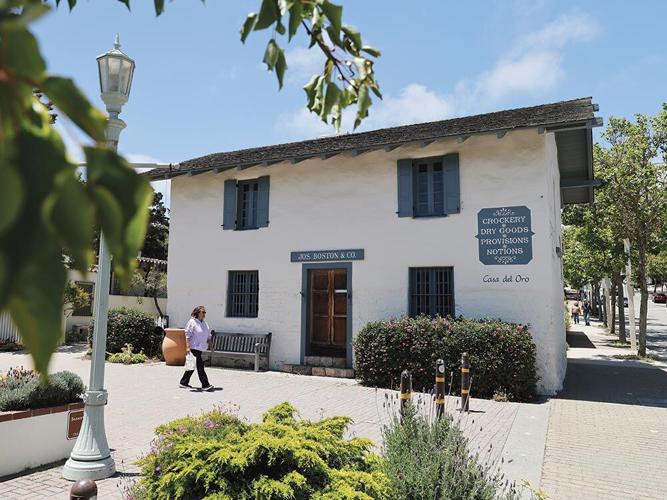
JACKS BEGAN IN MONTEREY AS A CLERK IN A SHOP OWNED BY JOSEPH BOSTON, near the Custom House, in a building now called Casa de Oro. In 1851, he was working for James McKinlay, a Scotsman who owned a shop in the Pacific House, and who had come to California in 1824, just three years after Mexico took control of the state from Spain. (Jacks would later come to own both buildings.)
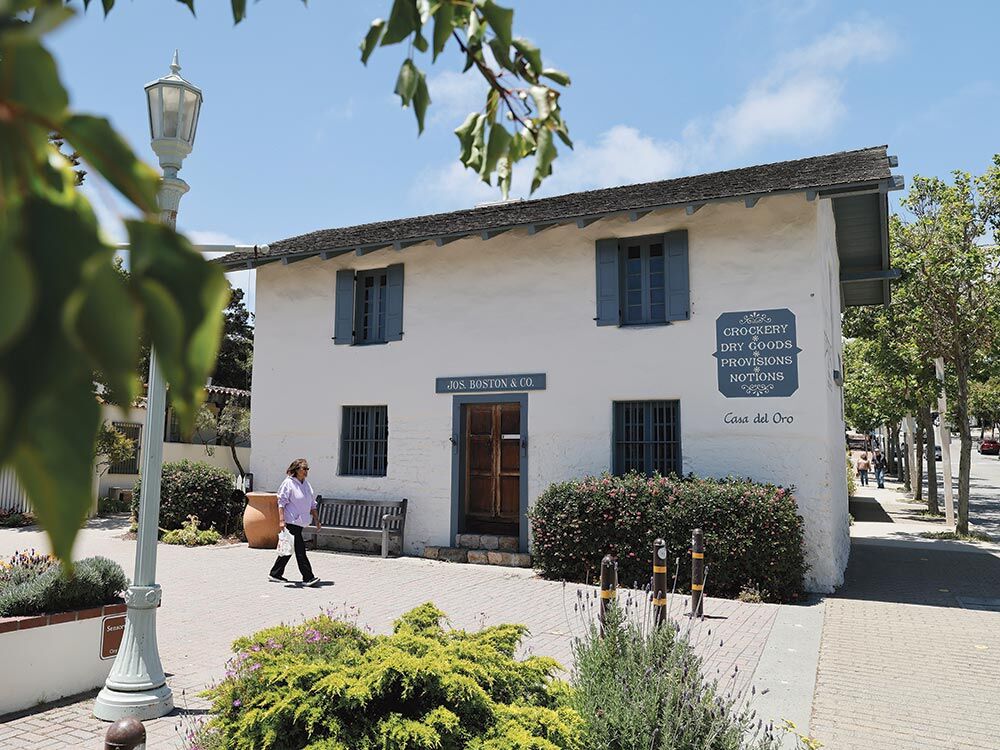
Casa de Oro, now part of Monterey State Historic Park, was home to Joseph Boston’s store in 1850, where Jacks first worked when he came to Monterey. Jacks later came to own the building, which his daughters later gifted to the state.
Aside from running a shop, McKinlay also made real estate investments and lent others money, and when he was off in San Francisco tending to business, Jacks managed McKinlay’s affairs in his absence. Jacks learned the finer points of real estate in a place where land titles – whether they were granted by Spain or then Mexico – were a matter of enduring dispute. He was also working for himself on the side, lending money on land and bidding on property at foreclosure sales.
Jacks had roughly $4,000 to his name when he arrived in Monterey, and was not a man who idled. Starting when he was 12, he worked for three years in a wool factory in his native Crieff, working 11 hours a day, six days a week.
By October 1851, Monterey’s jail records show Jacks hiring prison labor to work land for him to finish out their sentences, a deal that saved both him and the city money. How much Jacks paid on Oct. 30 to hire Jose Francisco – jailed for the crime of “vagrancy” – is not noted in the city’s register.
Jacks had been living in Monterey since the city’s first council meeting at Colton Hall on Jan. 2, 1850, and the city’s governance was starting to take shape. Laws were established that allowed the city to levy taxes to fix roads and pay officials, that required residents to keep a lantern on at night, that prohibited the firing of weapons in town or slaughtering of animals within a mile of Colton Hall.
Making legal determinations about land ownership was a priority for the young city, and residents were entitled to one city lot each, unless they had already been granted land by Spain or Mexico. The vexing question lay in what to do with the remaining land in the former “pueblo” of Monterey, which stretched from the hills above Monterey all the way to the Salinas River, north and east.
There were two paths the city could take: to sell city lands to settlers at a fixed cost per yard, or auction them off to the highest bidder.
JACKS first shows up in the city council’s minutes at a nov. 6, 1851 meeting where the council approved a property tax (it is noted that Jacks asked to speak, but not what he said).
Jacks continued making loans on properties – including to the city – and acquiring others, and engaging in various businesses like timber and dairy. He also served as county treasurer as early as 1852.
By this time he had been under the wing of attorney Delos R. Ashley, who served on the council and became its president in 1853. Ashley urged the council to make a claim for Monterey’s pueblo lands before the U.S. Board of Land Commissioners. His colleagues agreed, and retained Ashley to act as the city’s attorney in that effort.
He succeeded, first in 1856, and then successfully defended an appeal from the United States in 1858. At the same time he was ascending politically, becoming a state assemblymember from 1854 to 1855 and then a state senator from 1857 to 1858. In his capacity as a state legislator, he promoted two amendments to Monterey’s charter reducing its council to a weaker trustee model, and for the trustees to be able to sell off city land for “terms and for such price as may by them be deemed reasonable” to “pay for the expenses of prosecuting the title to the city before the [land commission].”
There are no city council minutes from Jan. 27, 1854 until Jan. 24, 1859, a five-year gap. The first order of business at the Jan. 24 meeting was to approve paying 10-percent annual interest, starting in 1856, on the city’s debt to Ashley.
The next day, Ashley presented a bill to the city for $991.50. The city did not have the money to pay it, so the trustees called for an auction on Feb. 9, 1859, to sell off the city’s lands to the highest cash bidder. The auction would take place on the steps of Colton Hall from 9am to 5pm, and was reportedly noticed in the Pacific Sentinel in Santa Cruz – there were no newspapers in Monterey County at that time.
Jacks and Ashley were the only bidders, paying $1,002.50 for all the city’s pueblo lands – 29,698 acres – plus an extra $11 to the city for the cost of the sale.
In one fell swoop, Jacks and Ashley, two white men, suddenly owned all the land in the pueblo that didn’t already have a clear title.
And because of the amendments to the city’s charter put forward by Ashley, the city was only empowered to raise revenue through leases and land sales, and no longer had the authority to levy taxes.
Monterey, and its residents, ended up with nothing.
THE NATURE OF THE AGREEMENT between Ashley and Jacks is unclear, but Ashley continued helping Jacks in his schemes to acquire more land, and both repeatedly sued people they claimed were squatting on their city land and cutting wood from it.
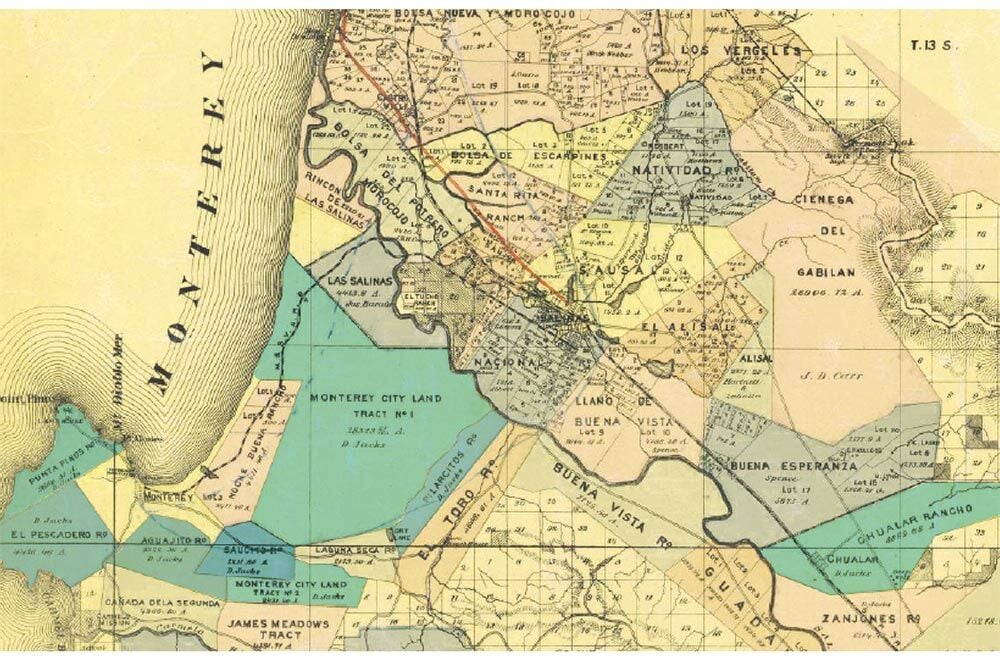
David Jacks’ vast properties went as far north as the Salinas River mouth and as far south as Soledad, but most of his property was around the Monterey Peninsula.
In the county register of plaintiffs and defendants dating back to 1850, Jacks’ and Ashley’s names pop up repeatedly – especially Jacks.
All lots that didn’t have a clear title – and many didn’t, as they were passed down informally in Mexican times – were pursued aggressively via litigation. Jacks continued lending and foreclosing on properties and buying up interests in land claims, and his real estate empire continued to grow.
In the late 1860s, he extended his holdings into the Salinas Valley, acquiring the 8,889-acre Rancho Chualar by loaning $3,000 to its owner for a business venture that ultimately failed, and Jacks was repaid with the land. Jacks disputed the government’s determination about the rancho’s size – he tried to enlarge it by some 3,000 acres, claiming they were lost in translation – and ultimately lost in court against those he claimed were squatting on his land.
Ashley moved to Nevada in 1864 and then Washington, D.C. after he was elected to the U.S. Congress in 1865, and he sold his shares back to Jacks in 1869 for $500.
In numerous letters Jacks wrote to Ashley – at the time Jacks was trying to enlarge his Chualar rancho’s boundaries in court – he implored him to not discuss their city lands matters in Washington. Ashley served in Congress until 1868, and when his health started failing moved from Nevada to San Francisco, where he died in 1873 at the age of 45.
IN THE 1870S, Jacks and other businessmen who owned land in the Salinas Valley had a problem to solve: Southern Pacific’s rates to transport grain were onerous, and growers had no choice but to pay them.
The solution, the men decided, was to cut Southern Pacific out of the equation altogether. In 1874 they invested $350,000 in bringing a rail line between Monterey and Salinas in a bid to undercut Southern Pacific’s high rail rates. The idea was to bring Salinas Valley grain to Monterey, then ship it to San Francisco by boat. Ideally, it would also bring tourists.
Construction started in April and the rail was finished by October, just six months later. But the upstart rail line quickly foundered, as the bridge over the Salinas River repeatedly washed out in winter storms, requiring monthslong repairs.
But the effort proved to be a catalyst: In 1879, Southern Pacific bought the Monterey & Salinas Valley Railroad out of foreclosure and replaced the rail line, connecting it directly to Castroville, in the alignment that still exists today.
At this point, Jacks had already acquired the Pescadero and Point Pinos ranchos, and in 1880, he sold over 7,000 acres of that land for $35,800 to the Pacific Improvement Company, Southern Pacific’s land-owning subsidiary. The company also purchased 144 acres in Monterey (not from Jacks) for $5,300, and construction started on Hotel Del Monte.
Rail, it was becoming clear to local businessmen, wasn’t just critical for agriculture, but for tourism. Before Southern Pacific was even on the scene, in 1875 Jacks donated five acres of land in what would become Pacific Grove to Methodists for the formation of a summer religious retreat. As folks started moving in to settle at the Methodist outpost, Jacks sold suburban lots to its newcomers, and the stagnating Monterey Peninsula started to see green shoots.
BUT MONTEREY STILL HAD THE PROBLEM OF TAXATION, or lack thereof, due to the amendments to the city’s charter put forward by Ashley years ago. The city remained just a few dusty streets and shops.
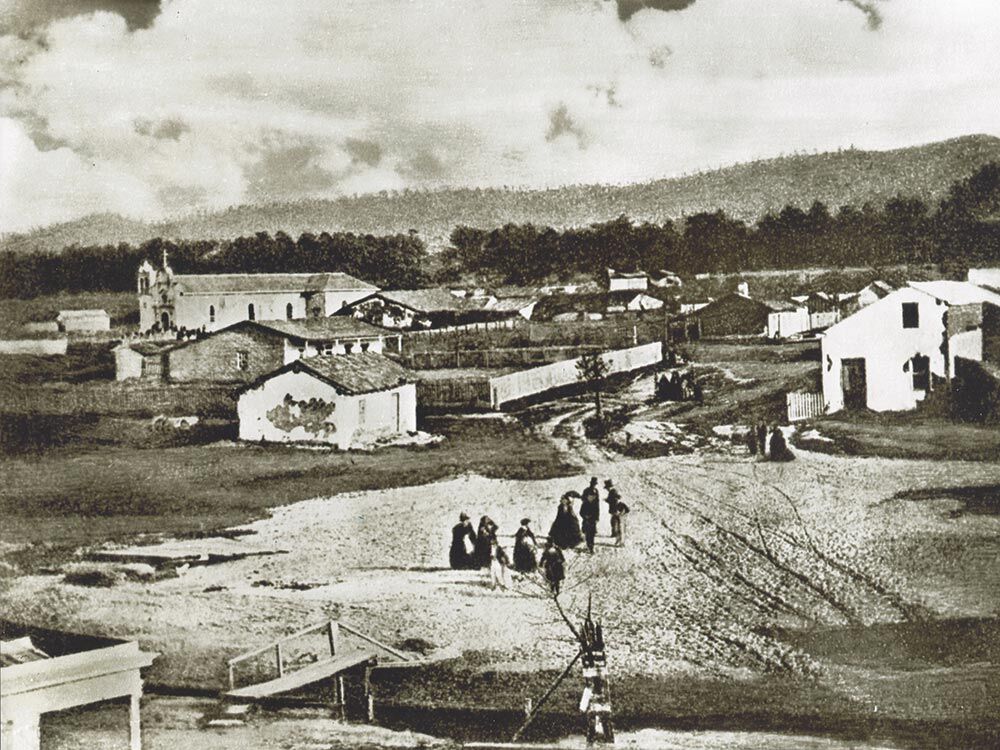
The oldest known picture of Monterey, circa 1853. The scene is facing east from the Washington Hotel, at the corner of Washington and Pearl streets.
In the 1870s, a mounting frustration with that paradigm grew into two different efforts, both happening simultaneously.
One was that the city launched a legal challenge to the 1859 city lands sale, arguing it was improper. But a lawsuit wouldn’t bring relief anytime soon, and the litigation dragged on for decades, with the sale ultimately upheld by the U.S. Supreme Court in 1906.
The other hope was a campaign to reincorporate the city, so that taxes could be levied to provide basic civic services. In 1875, that culminated in a bill – which Jacks opposed – that passed out of the town council, through the state assembly, but died in the senate.
A similar bill was brought forth in early 1879, which Jacks and others went to Sacramento to oppose. Making his case before the legislature’s Municipal Corporation Committee, he argued the soon-to-be-built Hotel Del Monte and its property would be excluded from the new city boundaries, placing the tax burden on regular citizens, like fishermen.
It came as a shock when Governor Robert N. Waterman vetoed the bill, and a delegation of prominent supporters rushed to Sacramento to make their case. Governor Waterman said he’d been misled (presumably by Jacks). Not wanting his first veto to get overruled, he proposed they introduce a new bill to the same effect. It took just three minutes to get through the Senate and five to get through the Assembly. When the news hit Monterey, the residents took to the streets to celebrate.
The March 23, 1889 issue of the Cypress describes the scene:
“Even the rainy and unpleasant condition of the weather failed to dampen the ardor and good feeling prevalent over the signing of the disincorporation bill. Bonfires lighted up the atmosphere at various portions of the town. Public and private houses were illuminated and the streets were thronged with people of all sexes and ages, sheltered under umbrellas, all anxious to witness the grand demonstrations. The firing of anvils in front of Bagby’s Opera House attracted a throng in that direction and lighted transparencies bearing many comical and original mottos were greeted with cheers as they made their appearance amid the crowd.”
Around 8pm, rain started to fall in torrents, and the crowd sought shelter in Bagby’s Opera House, where a slate of speakers addressed them. The last was S.J. Duckworth, who began,
“For an entire generation Jacks has been in fact as well as in name, monarch of all he surveyed and fenced in. But the day of reckoning has come and the heretofore invincible David today squirms under a defeat as bitter as it is deserved… the power of David Jacks is broken.”
After his address, “the floor was cleared and dancing was indulged until after midnight, when the evening’s festivities ended with the firing of anvils.”
WHEN ROBERT LOUIS STEVENSON STAYED IN MONTEREY in the fall of 1879, he spent much of his time writing in Jules Simoneau’s restaurant at what is now Simoneau Plaza, immersing himself in the city’s chatter. And Jacks, evidently, was chattered about often.
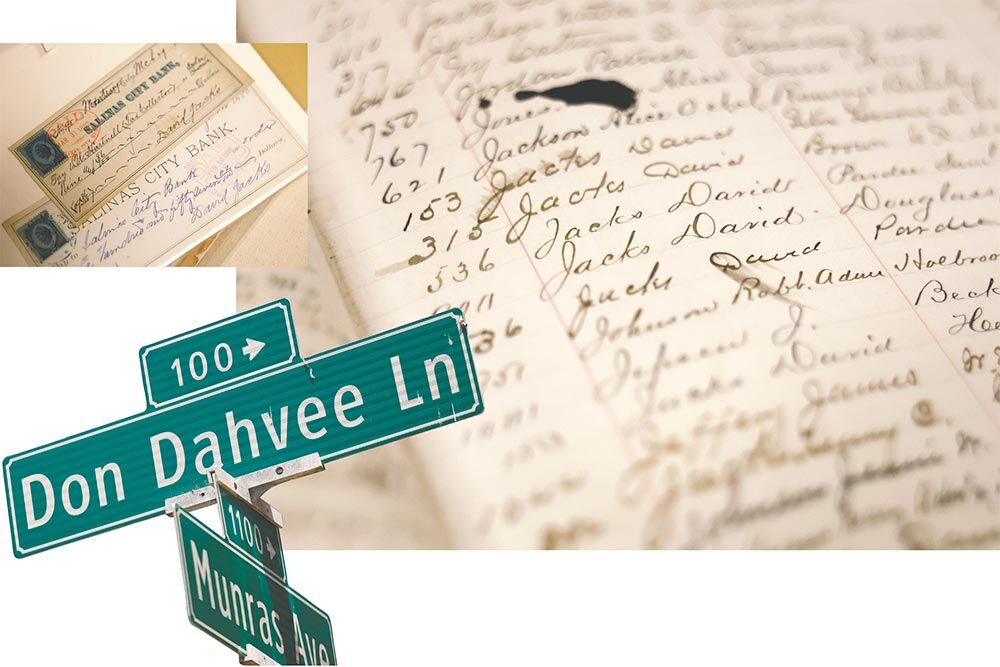
“Don Dahvee” was a nickname for David Jacks; Jacks’ daughters donated land to the City of Monterey that is now Don Dahvee Park, where there is also a Don Dahvee Lane.
In his essay “The Old Pacific Capital,” which Stevenson wrote in 1880 after leaving Monterey, Jacks – though only named once – is featured prominently.
“The land is held, for the most part, in enormous tracts, which are another legacy of Mexican days, and form the present chief danger and disgrace of California; and the holders are mostly of American or British birth…
“Thus the townlands of Monterey are all in the hands of a single man. How they came there is an obscure, vexatious question, and, rightly or wrongly, the man is hated with a great hatred. His life has been repeatedly in danger. Not very long ago, I was told, the stage was stopped and examined three evenings in succession by disguised horsemen thirsting for his blood. A certain house on the Salinas road, they say, he always passes in his buggy at full speed, for the squatter sent him warning long ago.”
How much of what Stevenson heard is exaggerated gossip is unknowable, but there were threats made to Jacks’ life, just none that anyone followed through with.
In 1883, William Leary, who owned land along the road between Salinas and Monterey, was in a dispute with Jacks over the trespass of livestock. Leary reportedly tried to shoot Jacks in Monterey but bystanders prevented it, and Leary was convicted of assault and sentenced to 10 months in jail. While incarcerated, he was also sentenced to an additional three months in jail for a separate incident – shooting a rifle at one of Jacks’ shepherds. (Leary claimed it was a shotgun, and that he was aiming at a squirrel.)
In the Jacks family papers kept in an archive at Stanford, there is an anonymous note among letters related to his Chualar property – there was dispute about where its legal borders were, and the note is a threat to pay the alleged squatters for the trouble he’s caused them. It finishes:
“Now you Son of a bitch if you don’t make good that amount of damage to each and every one of those settlers which you sued as well as a reasonable amount of compensation to each of the other settlers – if you don’t do this inside of ten days you son of a bitch – we shall suspend your animation between daylight and hell.”
It was signed, “By order of the Executive Committee of the Squatters’ League of Monterey County.”
Perhaps Jacks held onto it for evidence.
Jacks was also engaged in lengthy litigation against alleged squatters on his city land, who settled at Canada de la Segunda, approximately the location of the Tehama Golf Club and clearly south of the city lands’ ridgeline.
The longest hanger-on was Kaspar Henneken, who settled on the property in 1886 and ran an apiary. He sent a letter to Jacks dated Oct. 2, 1902, that reads, in part, “I will have no more of your persecution, but peace; no more law but my Rights and Justice; no more starving my Family by Reason of your oppression. This town cannot hold both of us under present conditions, but settle as is just between man and man. Remember this and act quickly and all will be well but no other way.”
According to a story in the San Francisco Call, Henneken approached Jacks Oct. 3 – the next day – and asked him to take a ride in his buggy. Jacks got on, and in an “unfrequented part” of the city, Jacks later told police, Henneken pulled out a pistol with one hand and his deed in the other, and said, “If you don’t sign this deed, I will kill you. You are a perjurer and I’ll kill you.”
A police captain came to Jacks’ aid after he yelled for help – he was 80 at the time, and “almost senseless from fright” – but the officer found no pistol on Henneken’s person.
There is a record of Jacks being assaulted one time – sort of. When he was riding the train southbound to Monterey in 1890, a man – “Fred Smith, the shell man” – got on at the Del Monte depot. A Nov. 15 article in the Cypress says Smith accosted Jacks – then 68 years old – when the train stopped in Monterey and he confronted Jacks about a lawsuit, which Jacks denied knowledge of.
“‘You do know about it, you lying scoundrel, you!’ retorted Smith, who followed his remark with a shower of blows on Uncle Davy’s neck.” The blows were soft and Jacks was unharmed, and bystanders intervened.
Jacks passed away Jan. 11, 1909, 59 years after he arrived. Services were held two days later at the family’s home on the corner of Van Buren and Scott streets. About 100 “prominent citizens” of Salinas attended, according to the Cypress. At the cemetery where Jacks was buried later that day, services were “short and simple,” and “the floral pieces completely covered the mound.”
THE JACKS FAMILY GRAVES lie in Monterey’s El Encinal Cemetery, which dates back to 1851 and is owned and operated by the city. When visiting on a recent Wednesday afternoon, a car is parked near the Jacks graves and a half-dozen people are gathered by the white marble slab with “Jacks” engraved in its center.
Two of them, students at Monterey Peninsula College, are wearing period attire. They’re preparing to shoot a short film for an acting class. Iphigenia Wilder, who wrote the script, is dressed as Jacks’ eldest daughter Margaret, and James Krueger is dressed as Jacks.
Wilder says her family often picnicked there when she was growing up.
The script begins with a girl walking through the cemetery eating a bagel sandwich, and she stops and leans on the Jacks grave. Then the ghost of Jacks appears and starts talking to the girl, bragging about his riches and legacy. Then the ghost of Margaret appears, and then that of Jack Swan, owner of the First Theatre.
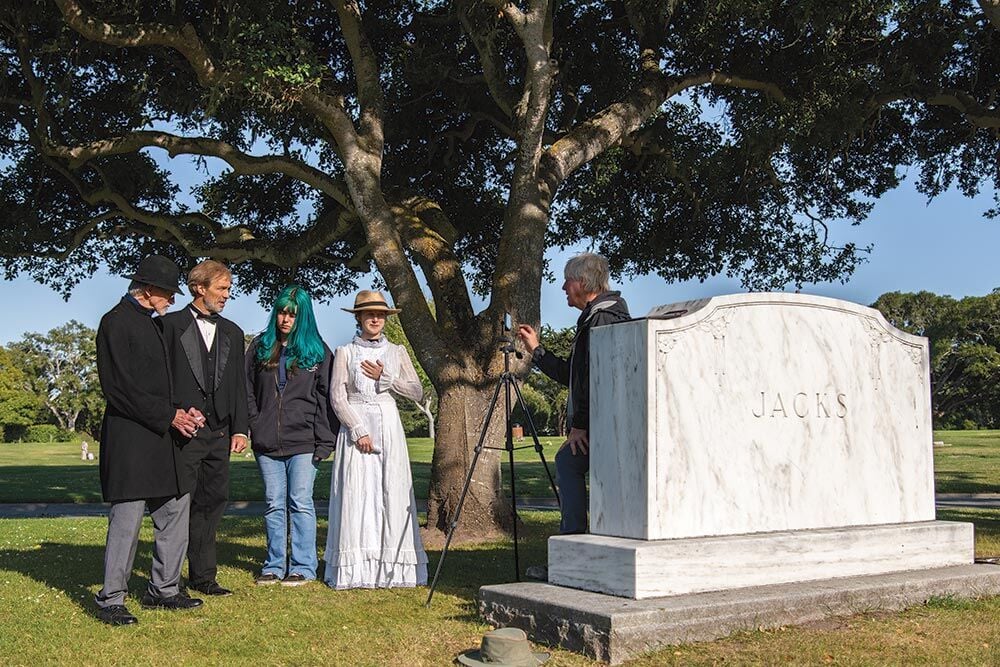
MPC film students preparing to film a scene at the Jacks grave in Monterey on May 21.
When they resume filming a few days later, on May 21, Jacks is worrying after his legacy, and Margaret counsels him, “They say people die twice: once when they pass on, and once when the last person who remembers them dies too. We had money and influence, but that doesn’t mean our lives were any more important or valuable than those of the other forgotten people buried here.”
Swan, played by Jay Owen, chimes in. “Aye, she’s right! We’re so afraid that our lives mean nothing, but everyone is just a wee part of the great thread of our history.”
Much has been written about David Jacks over the years, both during his life and after.
Some accounts paint him in a positive light, noting his philanthropy and that “he never broke the law” – never mind that he helped shape the law to his benefit – and that Jacks was a Sunday School teacher for 50 years. He is portrayed as a man of his time, and largely absolved of the real harm he caused people, who were just unfortunate casualties of his schemes.
Some also point out that, because Jacks hoarded so much prime land, it ended up preserving much of the Peninsula’s wildlife habitat and open space.
Other accounts are less kind. Journalist Jimmy Costello, who wrote a four-part series about Jacks in the Monterey Peninsula Herald in 1963, noted at the start that “the story of David Jacks now can be told because there are no longer living members of his immediate family who could be hurt in the telling.” He adds, “Four of his seven children married, but [Jacks] had no grandchildren, perhaps in fulfillment of an Indian curse that the seeds of his greed would not spread beyond his children.”
The most illuminating account of Jacks – though it’s meshed within a much larger story – comes from Carmel Valley resident John Walton, whose deeply researched 2001 book Storied Land, a sociological history of Monterey, lays out in detail the ways in which Jacks operated.
Walton, a retired UC Davis sociology professor and historian, spent countless hours researching Jacks in archival libraries at Stanford and at the Huntington Library in San Marino, where most of the family’s papers are kept.
Taking a measure of the man in Storied Land, Walton writes, “Jacks’ voluminous correspondence reveals a complex man: shrewd, austere, clannish, self-assured, petulant, charitable, obsessive, puzzled by others’ resentment, and master of a thousand details, from the county list of tax delinquent properties to the names and dispositions of every horse on his farm.”
Walton also brings in a revealing data point to highlight the extent to which Jacks held back the Peninsula’s progress: From 1850 to 1890, the county population grew tenfold to 18,637, while Monterey’s grew to 1,662, less than double.
The Monterey Cypress published a telling story in 1891 when a so-called “Spanish Lady,” Dahlia Castro Tripp, walked into the Cypress office, asking that they put something in the paper about what Jacks is doing to her. She relayed that he constantly bugs her about her land and claims it’s his under the Aguajito grant, and that he’s visited her day and night trying to get her to sign a piece of paper, and that if she signed it he would allow water pipes to go onto her property, but she always refused to sign.
“I told him not to be such a hog about land, to leave me and my four little children in peace, that my little place would do him no good and it was all mine, that when he died he could not take all his land with him.
“He then told me he would meet me in heaven where we could be brothers and sisters, but I told him, ‘Not much! I may go to heaven but you won’t, a man that goes around scattering misery in this world like you do need never to expect to go to heaven… ’”
Walking out of the Cypress office, she says, “He deserves a good going over.”
However one feels about Jacks’ legacy, the fact is that Monterey’s pueblo lands were intended to benefit the city’s people, and he snatched them, steering all the land’s power and wealth to himself. It’s not necessarily surprising he got away with it all – it’s a story as old as mankind – it’s just surprising how easy it was.
(1) comment
I note with interest that the map of the area shows the Salinas River as it used to be, with its mouth dumping into the ocean at what is now Moss Landing Harbor. It was years later that a heavy winter rain sent the Salinas directly into the Monterey Bay at its current outlet, bypassing the long path occassioned by the sand dunes, allowing for the old mouth to be made into the Harbor (with some dredging).
I also note you side-stepped how the Spanish acquired the lands from the native populations, which was then taken by Mexico, and then by California. Too nasty of a web, I suppose. David Jacks was simply following precedent.
Welcome to the discussion.
Log In
Keep it Clean. Please avoid obscene, vulgar, lewd, racist or sexually-oriented language.
PLEASE TURN OFF YOUR CAPS LOCK.
Don't Threaten. Threats of harming another person will not be tolerated.
Be Truthful. Don't knowingly lie about anyone or anything.
Be Nice. No racism, sexism or any sort of -ism that is degrading to another person.
Be Proactive. Use the 'Report' link on each comment to let us know of abusive posts.
Share with Us. We'd love to hear eyewitness accounts, the history behind an article.