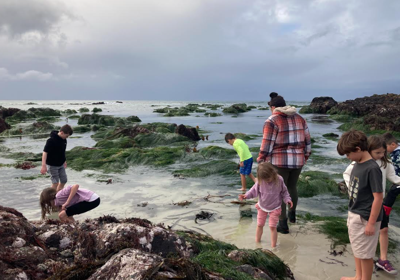

Sara Rubin here, thinking about the little things. By little I mean seriously little—animals the size of your fingernail might only become obvious when you zoom in your attention very closely. A lot of nature experiences invite us to focus on charismatic megafauna (whale watching, safaris) but tidepooling remains, in my opinion, an under-appreciated activity that forces us to turn to the small creatures.
A twice-yearly event led by the California Academy of Sciences takes it up a notch, inviting us not just to pay attention because it’s fun, but because expanding participation in data gathering to all members of the community—what’s known as a bioblitz—helps produce more information than a group of trained biologists could get in days. More people, more area covered, more tidepools examined.
The Solstice Sea Star Search takes place around the lowest of the low tides every December and January, inviting community members-slash-scientists—hint, that could be you—to fan out along the California coast and look for sea stars, photograph them and enter information into the iNaturalist app.
“As this goes, over years, we can watch how that number and distribution changes over time,” says Natalie Johnston, community science manager at the Pacific Grove Museum of Natural History. “Not only are everyday people becoming involved in science, by their sheer numbers, going out exploring, they are able to get data that is going to help scientists understand the distribution of sea stars up and down California.”
To participate locally, you can join Johnston for an introduction to bioblitz principles and tidepooling etiquette at Lovers Point in Pacific Grove on Saturday, June 6 between 9:30-10:30am. (Low tide for the day is just under zero feet at 9:42am—not the lowest of the lows, but conveniently timed when many families are available to participate.) Meet on the beach north of the jetty to check in, then disperse to go see what you see.
While sunflower stars are of the greatest interest to scientists due to their population challenges, those same challenges—and depth—make it unlikely you will see one on Saturday. But you’re likely to put eyes on a bat star or an ochre star, and probably tons of other cool animals who call this place home as sea stars recover.
All are welcome to participate, even kids too young to use iNaturalist; tidepool bingo might be more their speed, and Johnston has that too, because inclusivity is part of the underlying principle.
“My goal is to connect our community with nature and help people understand that they can be involved in science,” she says. “That’s what community science is all about: All of us can become naturalists.”


(0) comments
Welcome to the discussion.
Log In
Keep it Clean. Please avoid obscene, vulgar, lewd, racist or sexually-oriented language.
PLEASE TURN OFF YOUR CAPS LOCK.
Don't Threaten. Threats of harming another person will not be tolerated.
Be Truthful. Don't knowingly lie about anyone or anything.
Be Nice. No racism, sexism or any sort of -ism that is degrading to another person.
Be Proactive. Use the 'Report' link on each comment to let us know of abusive posts.
Share with Us. We'd love to hear eyewitness accounts, the history behind an article.