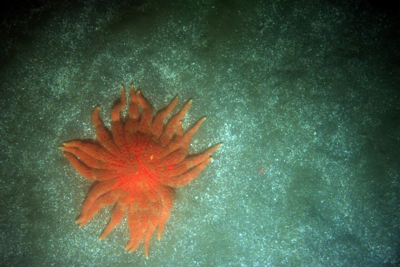

Katie Rodriguez here, thinking about a very exciting finding published recently in the journal Nature Ecology & Evolution: the cause of sea star wasting disease.
The research, led by Dr. Melanie Prentice and Dr. Alyssa Gehman of the Hakai Institute in British Columbia, Canada, discovered that the culprit responsible for the largest documented marine epidemic recorded (in a non-commercial species) was in fact, a strain of the bacterium Vibrio pectenicida.
The reason why it was such a huge deal is because sea star wasting disease has been a great mystery in the scientific community for about a decade, affecting dozens of sea star species but most consequentially, the sunflower sea star, which were the most susceptible to the disease.
These sea stars are the largest of the bunch, which can reach up to 3 feet in diameter with anywhere from 15 to 24 limbs. They were once found in high densities from Baja California, Mexico to Alaska, however, today the sunflower sea star is considered functionally extinct throughout most of its southern range in the continental U.S.
Of course, when I heard this news I immediately thought about the Sunflower Star Laboratory in Moss Landing, which recently had its one-year “Spawniversary” in February celebrating successful breeding efforts to deliver soon-to-be tiny baby sunflower stars to partners across the state.
The lab is one of the coolest science experiments in action to see. It’s essentially one room full of an array of tanks of varying sizes, for feeding and growing the sunflower stars at various stages of their life. The work they’re doing is hopefully to reintroduce these animals back into the wild, although it’s still fairly early in the research and permitting stages. In July 2024, they became a subawardee of an $18 million, three-year grant, provided to The Nature Conservancy to launch the Pacific Coast Ocean Restoration (PCOR) Initiative.
And now they are working with critical information about the cause of the disease.
“We now have an enemy with a face,” says Ashley Kidd, cofounder of the Sunflower Star Lab.
She explains that the PCOR initiative is a multi-institutional coalition with various research tasks and applications to support restoration efforts state-wide. The grant at large goes toward kelp restoration and recovery of endangered species, including the sunflower sea star and the white abalone.
“We all knew that there was a pathogen before the paper was peer reviewed and published, but now we can act on it,” Kidd says.
The research that came from the Hakai Institute and partners, conducted in the U.S. Geological Survey’s Marrowstone Marine Field Station in Washington, will be a huge aid in the work the Sunflower Star Lab is doing as it works toward reintroduction. Kidd says in California, where sunflower stars were hardest hit by the disease, they’ll be working to understand the prevalence of the pathogen and where it exists. But first, understanding how these animals grow and behave in captivity is paramount, in addition to obtaining permits for reintroduction.
“This isn’t a silver bullet, but definitely a huge milestone,” Kidd says.


(0) comments
Welcome to the discussion.
Log In
Keep it Clean. Please avoid obscene, vulgar, lewd, racist or sexually-oriented language.
PLEASE TURN OFF YOUR CAPS LOCK.
Don't Threaten. Threats of harming another person will not be tolerated.
Be Truthful. Don't knowingly lie about anyone or anything.
Be Nice. No racism, sexism or any sort of -ism that is degrading to another person.
Be Proactive. Use the 'Report' link on each comment to let us know of abusive posts.
Share with Us. We'd love to hear eyewitness accounts, the history behind an article.