
WE’RE ALL GOING PLACES, whether it’s work, school or the grocery store, and no matter how we get from point A to B – by car, bike, e-bike or our own two feet – there’s always a risk we could be seriously injured or killed, even when we obey speed limits, yield, check all our blind spots, and stay vigilant of other travelers.
Consider a sunny, dry day in December 2025, when 66-year-old Seth Pollack was out on his regular morning bike ride on 17 Mile Drive in Pebble Beach, wearing a helmet, as usual. As Pollack was heading north, crossing the intersection of Crespi Lane, the driver of an incoming SUV, Dana Rene Lauchlan, was heading south and making a left-hand turn onto Crespi Lane.

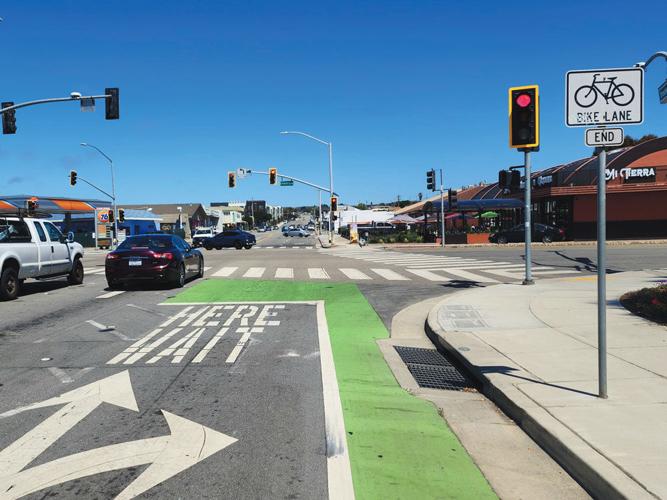
Mari Lynch advocates for infrastructure improvements including bike boxes (below), spaces designated for bicyclists to get ahead of cars in a safer manner while waiting at an intersection for a traffic signal to change.

This bike box is on Broadway Avenue at Fremont Boulevard in Seaside.
According to court documents, Lauchlan failed to yield while she was turning, and struck Pollack, who flew into her windshield, smashing it, and was then propelled upward and down through the moonroof of the 2011 Toyota Venza and into Lauchlan’s backseat.
Pollack was declared dead from blunt force injuries at the scene. Lauchlan told investigators that the sun was in her eyes and she didn’t even see him coming. He left behind his wife, Naomi, and two adult daughters, who filed a lawsuit in March against Lauchlan, who was also charged with misdemeanor vehicular manslaughter for Pollack’s death. It is safe to say that neither Pollack nor Lauchlan left their homes that morning thinking that their outing would end in tragedy.
Although there are many completed and ongoing projects to make it safer for pedestrians and cyclists to get around Monterey County, like the Monterey Bay Coastal Recreation Trail or Rec Trail and the Fort Ord Regional Trail and Bikeway (FORTAG), “We have a long, long way to go,” according to Mari Lynch, founder and volunteer custodian of the website Bicycling Monterey. The URL has served as an information hub for all things bicycle-related in the county since 2009 and runs entirely on donations and elbow grease.
“In an ideal world, we would have bike lanes with a physical barrier everywhere,” Lynch says.
“That’s what’s needed. The reason more people don’t bike is primarily the fear of cars, and you can’t blame them.”
Comparing Monterey County bicycle and pedestrian safety statistics with similar California jurisdictions, Lynch’s statement holds up, especially for younger riders – according to the latest data from the California Office of Traffic Safety, which collects collision data and ranks 58 cities and counties in the state from 1 to 58, with 1 being the worst. In 2023, the latest year of aggregated data, Monterey County ranked third-worst of 58 for pedestrians under ages 15 killed or injured by a vehicle, 26th in the state for pedestrians killed or injured over the age of 65, and 42nd out of 58 for all pedestrians killed or injured in a vehicle collision.
For bicycle and vehicle collisions that resulted in death or serious injury, Monterey County ranked 33rd out of 58 in 2023 and 19th in the state for bicyclists under the age of 15 killed or injured by a vehicle. The five-year average of crash rankings from 2019 to 2023 shows Monterey County ranked lower than most California counties of similar size for total fatal and injury crashes, but averaged a ranking of 6 for pedestrians under the age of 15 who were hurt or killed by a vehicle collision.
According to a technical memorandum associated with the Monterey County Regional Vision Zero Plan, which uses traffic data gathered from Jan. 1, 2019, to Dec. 31, 2023 – and was adopted by the Transportation Agency for Monterey County (TAMC) in March, of the 8,145 total crashes studied in the report, 577 involved pedestrians, and 159 of those incidents led to severe injuries or fatalities. Of the total, 381 crashes involved bicyclists, with 57 resulting in severe injuries or fatalities. Traffic collisions involving automobiles and vulnerable road users, or bicyclists and pedestrians, accounted for about 19 percent of the total fatal and serious crashes in Monterey County.
LYNCH HAS BEEN FIGHTING for infrastructural and policy improvements to make the road system safer for pedestrians and cyclists in Monterey County for nearly two decades.
“People like me, who persist, persist, persist, even get frustrated and give up on particular issues,” Lynch says. “You can push and push and be amazed at how many years you have to keep trying, whether it’s issues with a particular street or law enforcement.”
Lynch understands that bicyclists aren’t the only people on the road that transportation agencies need to consider, given their limited time and funding, but that doesn’t deter her from speaking up.
“I get that they have a lot of responsibilities and their hands are often tied by all of the bureaucratic rules and regulations and timeframes, but sometimes there are things that could be so simple to change,” she says, referencing the intersection of Mark Thomas Drive – notorious to bikers for its uneven, slim shoulder – and Aguajito Road in Monterey, where an arrow on Mark Thomas directs bicyclists onto the freeway offramp. “As you’re entering the intersection, the arrow for bikes goes straight like it’s pointing into the freeway. There’s no other option for people who don’t know what they’re supposed to do at that intersection. Simply adding a green bike box there, across the left and right turn lanes, would clear up that confusion.”
One improvement Lynch would like to see at every suitable intersection in the county is bike boxes, or a space at the head of traffic lanes that provides a way for cyclists to get ahead of cars while waiting for a traffic signal to change. These green “boxes” are painted on the road at intersections around the county, including in Seaside at Fremont Boulevard and Broadway Avenue, for example. “Intersections are obviously danger points for people on bikes,” Lynch says.
Roughly a quarter of traffic fatalities and about half of all traffic injuries in the United States are attributed to intersections, according to the U.S. Department of Transportation’s Federal Highway Administration. TAMC’s Vision Zero Plan also states that “Crashes involving vulnerable road users most commonly occur at intersections and along roadways that lack safe, dedicated space for walking and bicycling.”
A cyclist can do everything right, Lynch points out, but that still doesn’t protect them from “speeding drivers, drunk drivers, texting drivers and so on.”
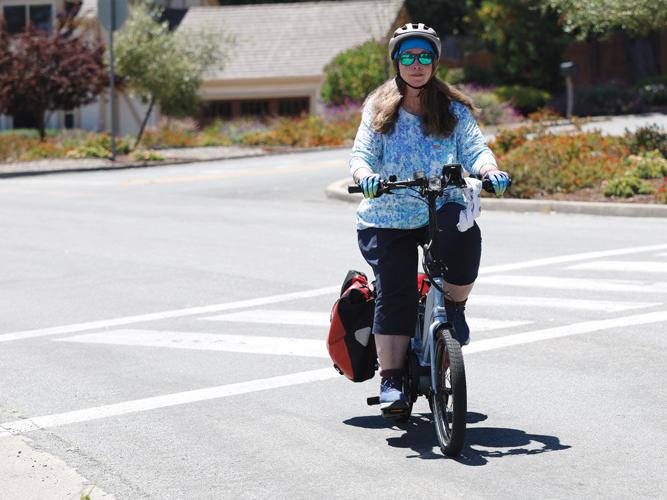
During one of her regular commutes by e-bike, which requires her to travel on Highway 68, she had safely exited the highway when she was nearly struck by a texting driver on a side road.
“I actually recognized the person and they told me they were looking at their phone,” she says. “Thank god that person wasn’t going fast. If they were, I’d probably be dead, but because they were going slow, I had time to hop off my bike and get out of their way when they were coming right at me.”
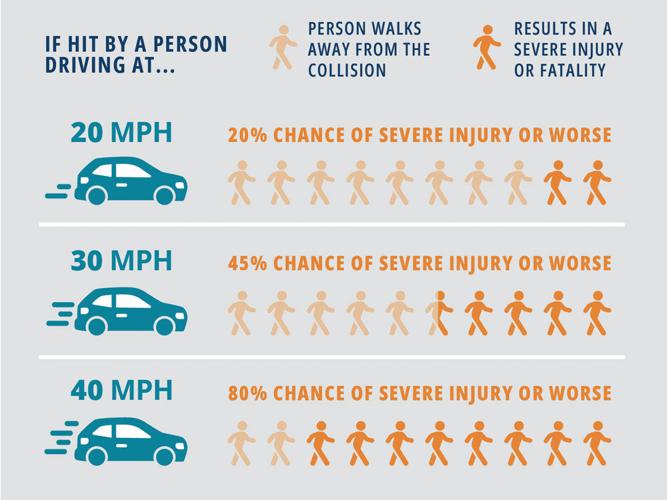
The Vision Zero Plan, a component of a worldwide initiative, points out that speed directly influences the severity and likelihood of a crash, as increased speed means it takes more time to stop the vehicle and that a driver’s field of awareness narrows the harder they hit the gas.
“Most critically,” the plan states, “higher speeds dramatically elevate the risk of severe injury or death for people walking or biking. Even small reductions in speed can significantly improve crash outcomes by reducing the likelihood of fatal or life-altering injuries.”
Lynch says that 90 percent of the drivers she encounters while bike commuting are kind and conscientious, providing her with the state-mandated three-foot buffer zone, or changing lanes to avoid cyclists when it’s possible, which is also a state law.
“I love these drivers and I appreciate them,” Lynch says. “But then you get this other 5 to 10 percent who are jerks who endanger my life and the lives of other people.”
In one recent example, she says a passing driver abruptly yelled “Boo!” at her, startling Lynch. “They don’t realize they could make someone lose their balance or fall but people do this because they think it’s fun or silly,” Lynch says. “I don’t know what they think. They don’t think. They don’t think about the potential impact.”
To help curb the number of avoidable crashes between cyclists and cars, Lynch says education is the key starting at a young age – think bicycle or pedestrian ed, not just driver’s ed.
“It’s a life skill,” says Lynch. “I’d love to see more of that education in the schools.”
She teaches bike safety in various capacities, including for the Monterey County Probation Department Youth Center Bicycle Repair and Safety Class, which she founded in 2012. Her most basic advice to youth and anyone riding a bike, electric or otherwise, includes being “visible and predictable.”
“It’s not required by law, but bright clothing doesn’t hurt,” Lynch says. “And being predictable means using your arm signals to turn.”
BEING VISIBLE AND PREDICTABLE is a decades-long practice and mantra for Frank Henderson, a Marina resident and friend of Lynch, who has commuted by bike to his job at Hartnell College, a roughly 20-mile round trip, rain or shine, for 30 years. He started using the fitness tracking app Strava about 12 years ago and has logged approximately 67,000 miles so far.
“I usually ride about 5,000 to 6,000 miles a year,” Henderson says. “And the vast majority of the miles are commuting miles.”

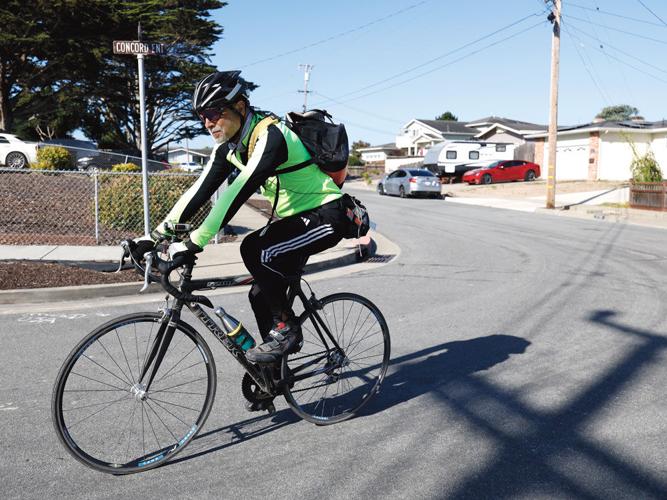
League of American Bicyclists instructor and Marina resident Frank Henderson has commuted by bike to his job at Hartnell College, a roughly 20-mile round trip, rain or shine, for 30 years.
After he got hit by a car that was turning left during his commute in 2010, Henderson decided to study bike safety to understand why the crash occurred. He learned that he had done nothing wrong, but needed to be more aware of his surroundings, among other revelations.
“I learned some great information that I thought other people should know too and so that’s why I became a League of American Bicyclists instructor,” Henderson says. “A lot of people learn how to be safe through experience, and a lot of those are not good experiences, but you can also learn through education and prevent accidents before they happen.”
Henderson teaches young people about bike safety and repair at the same Monterey County Probation bike class. He also helps people fix their bikes at Repair Cafes around the county.
Henderson says one of the primary lessons he teaches is to behave like traffic when riding a bike because “you are part of the traffic and so you shouldn’t behave differently.” And that although most people are afraid of the traffic behind them, “usually most of the danger comes from in front of you, so you need to watch what’s in front of you more than behind you.”
Being a longtime bike commuter, Henderson has an intimate understanding of some of the county’s biggest pain points for cyclists, such as Main Street in Salinas.
“You’ll notice that there are two lanes for two cars and when you’re riding on a bike, you can’t ride off to one side because the motorists try to squeeze by you and you’ll end up on the curb,” he says. “And so you have to ride in the lane of traffic and of course the motorists don’t appreciate that but it’s the way the road is built that makes it the only safe way for cyclists to use that roadway.”
On the flipside, Henderson says that after vehicle lanes were taken out on Alisal Street in Salinas and bike lanes were added to both sides of the street as part of the Alisal Complete Streets Project, the roadway has become much safer for cyclists.
“It makes it much more walkable too because people aren’t driving so fast and swerving back and forth,” he says. “That’s one of the best examples of roadway improvements that I’ve experienced.”
Henderson is particularly excited about the progress being made on FORTAG, which will help to connect disjointed bikeable areas in Marina and Seaside and make it much easier for bicyclists to get around the county. The first segment of the 28-mile project is slated for completion this fall.
“I think that it’s super exciting that they’ll be linking all of the community spaces in the open space,” Henderson says. “If cyclists can just hop on a bike path and ride their bike all the way out there, I think the open space will be used a lot more and less driving will take place. If you just want some recreation, why would you drive when you could hop on your bike?”

The Monterey County Vision Zero Plan points out that speed directly influences the severity and likelihood of a crash, as increased speed means it takes a longer time to stop. In addition, a driver’s field of awareness narrows the harder they hit the gas.
LIKE LYNCH AND HENDERSON, the local Vision Zero Plan has a goal to eventually eliminate traffic-related deaths and injuries by treating them as preventable events. The plan looks at Monterey County transportation through the lens of a Safe System Approach, adopted by the U.S. Department of Transportation, which considers the functionality of the entire transportation system and stresses that all travelers, whatever the mode of transit, have a role in keeping themselves and others safe on the road.
“Everyone deserves to travel safely,” the Vision Zero Plan states. “To achieve this vision, TAMC has set an ambitious and achievable goal to reduce fatal and serious injuries by 30 percent by 2030 with the ultimate goal of eliminating fatal and serious injuries by 2040.”
To move further toward that goal, TAMC has several projects and programs designed to bolster bike and pedestrian safety, such as the Safe Routes to School program, funded by the 2016 sales tax initiative called Measure X and overseen by TAMC Principal Transportation Planner Ariana Green. Safe Routes to School includes numerous initiatives such as Walking School Buses and Walk and Roll programs.
“We focus on trying to make it safer for kids to get to and from schools all across Monterey County,” Green says. “We work on trying to fix the actual design of the roadways to make it safer and we also do safety education and encouragement programming, encouraging youth to walk and bike to school more and to take transit or carpool, which helps to reduce traffic around the schools.”
Green has been working on a series of Safe Routes to School plans for each city in Monterey County, with sidewalk projects in Soledad, Gonzales and Greenfield. In Seaside, TAMC and city officials teamed up to attain grant funding to make Broadway Avenue safer for youth walking or biking to school.
“That project is going to start construction hopefully this fall and it’s going to make a huge difference,” Green says. “One of the key takeaways from our program that I’ve learned is that if you design a street that feels comfortable and safe for a child, you’re making it comfortable and safe for everyone in the community – people of all ages and abilities.”
Green points out that there are varying transportation safety issues across the county, from urban areas to rural. The unincorporated community of San Ardo in South County, where a truck route divides the town, serves as the starting point for TAMC’s Safe Streets Together Monterey County campaign, which helps to implement the Vision Zero Plan by advancing policies countywide through education and outreach.
“We launched it in San Ardo and we are going to be launching it in King City with the goal of having a similar program throughout each community in the county to develop an overarching campaign about public awareness, shared responsibility and education, to make our communities safer,” says Theresa Wright, TAMC community outreach coordinator.
Monterey County Pedestrian & Bicycle Safety Program Coordinator Jessica Chacon, who facilitates bike safety education programs with TAMC in schools, says that staying safe and preventing injuries while getting around, at any age, is a shared responsibility.
“Everybody has to be aware,” Chacon says. “If we can teach that early on, that the responsibility is shared, I think it will be safer for everybody.”
In addition to the implementation of the Vision Zero Plan, TAMC Senior Transportation Planner Janneke Strause and others are working on an updated Monterey County Active Transportation Plan, which lays out infrastructure improvements, policies and programs for those who walk, bike and use other active forms of traveling.
The last Active Transportation Plan was completed in 2018 and the update is currently in the data analysis phase, with the project team conducting a needs analysis based on the existing bicycle and pedestrian infrastructure.
“This plan is important because it will provide a roadmap for local agencies to implement projects to make Monterey County safer, more accessible, and more connected for people of all ages and abilities who walk, bike, or use other forms of active transportation,” Strause says.
TAMC is currently seeking volunteers to participate in focus groups about the plan, and meetings will be held in each Monterey County city this fall.
“There are just so many facets to this effort,” Wright says. “And TAMC has taken the lead in trying to bring everyone together with this one overarching vision and conviction to make sure that we’re making our communities safe countywide.”
(2) comments
I would LOVE to ride my bike more; however, fear of death or dismemberment prevents me from riding on most streets and keeps me on sidewalks [I know!] when there is not a wide, marked bike lane.
The third 'close call' I experienced happened on Davis Road where a woman turned right in front of me, bending my front wheel in half and throwing me from my ride. By some miracle I landed in tall weeds unharmed. The driver never stopped - witnesses in other cars did though - one of them stating they thought I "was a goner". That was over 20 years ago.
So here is my question: When are we going be smart enough to get bike and pedestrian paths off roads with vehicular traffic? It's vital if we want folks to really commute via bicycle.
I have an easy solution: make every waterway an Active Transportation Pathway. I made this suggestion several times at City Council and in other forums. Here's the idea [and it's not new - just innovative - the concept has worked for years along the Mohawk River in NY state and many other locals]:
-Almost every drainage ditch, creek and river already have maintenance roads next to them.
-Pave those roads and buy/pave a right of way next to the Salinas River all along the Salinas Valley to the Coast [connect to the coast rec trail].
-Make this part of the Tourism Element [and watershed maintenance].
-Utilize the Salinas Valley Recreation Trail for eco, ag, ranch, farm and wine tourism.
-Rent bikes for individual tourism and conduct guided and/or intimate wine/ag/ranch/farm tours/experiences.
-Overnight stays at Salinas Valley B&Bs such as Chateau Corilini plus small, local hotels in Salinas Valley cities along the way.
-Start getting serious for commuters - PROVIDE BIKE LOCKERS! [no one's going to trust their expensive bike to a lock or chain outdoors - thieves grab those every second].
-Make more connections via bus or train.
Until we can stop using these [very expensive] out-of-town worthless freaking consultants to design worthless bike lanes in the middle of the street, and start thinking outside the box for real, safe bike/skate/pedestrian-friendly alternatives to mixing bikes and humans with large, deadly, fast-moving vehicles, we will never be able to cut down on car use. I would ride my bike daily if there were safe, 'off-road' routes, away from distracted drivers, AND if common destinations for workers had bike lockers. Just saying, Salinas City Center, Park Row [every other shopping center], and Hartnell College ;~)
Not being a bike rider myself, much because of the danger I see from unfocussed drivers, it concerns me to see the disregard many e-bike and bike riders have for the law. Many don't even slow down at stop signs and many ride on the sidewalks with total disregard for pedestrians. I can sympathize with bike riders who are followers of the law and do everything they can to make it safe, not in any way how it should be when operating any vehicle of transportation. Driver education was eliminated in our schools because it was too costly and we are presently seeing the negative results of that decision. observed driving habits in many, many cases are horrible. Defensive driving for a sane person is mandatory. The same should be true for any mode of bike riding from self propelled to highway qualified motor bikes. The offender is always going to be present but is would sure be nice if the unfocussed, hot-headed uncaring element could be eliminated, or at least minimized. Law enforcement is paramount to this situation and yet many want to defund law enforcement. Education is also paramount and that has been defunded. Are we as a society ever going to learn from our mistakes?
Welcome to the discussion.
Log In
Keep it Clean. Please avoid obscene, vulgar, lewd, racist or sexually-oriented language.
PLEASE TURN OFF YOUR CAPS LOCK.
Don't Threaten. Threats of harming another person will not be tolerated.
Be Truthful. Don't knowingly lie about anyone or anything.
Be Nice. No racism, sexism or any sort of -ism that is degrading to another person.
Be Proactive. Use the 'Report' link on each comment to let us know of abusive posts.
Share with Us. We'd love to hear eyewitness accounts, the history behind an article.