
Like a pebble tossed in a pond causing the spread of ripples that reach farther and farther out, the contributions of the Chinese who immigrated to Monterey County’s coast in the 1800s, followed by Japanese and Filipino immigrants, have rippled throughout local history all the way to the present.
Pam Marino here, after spending an evening with members of the Quock Mui Foundation on Friday, July 17, as well as teachers from local schools, who the foundation hosted in its Summer Teacher Institute to learn about that history and strategize how to incorporate it into lesson plans.
All last week the teachers heard from presenters and were taken to significant historical sites like the Whalers Cabin at Point Lobos built by Chinese fishermen in the 1850s, where Quock Mui was born, marking the first documented Chinese American birth on the Monterey Peninsula in 1859. They also visited the sites of the Point Alones fishing village and another village along Cannery Row, as well as the Pacific Grove History Museum and the Japanese American Citizens League hall in Monterey.
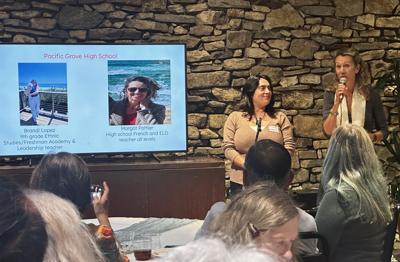
On Friday, the teachers and guests gathered at Wave Street Studios, located beneath Quock Mui’s family’s house on Wave Street near Cannery Row, to share a buffet of Chinese food, listen to music by celebrated saxophonist Francis Wong, be captivated by storyteller Bowen Lee and hear takeaways from the teachers’ week of learning.
Randy Sabado, who was married to the late Gerry Low Sabado and is a member of the Quock Mui Foundation board, welcomed the audience and noted how important the summer institute is to him, since it carries on the tradition Gerry began, as a descendant of Quock Mui, giving presentations to school children about the contributions of Chinese immigrants to the region.
Now these groups of teachers who participated in the institute are taking up Gerry’s mantle. On Friday they shared the lesson plans they developed, incorporating stories, music, art, food, languages, games and other ways to engage students and teach them about the rich heritage of Asian Americans in this area, as well as how all immigrants have contributed to the society.
Emily Tsai Brownfield, principal of Robert Down Elementary in P.G., who described herself as a child of Taiwanese and Japanese descent, expressed her gratitude for the Quock Mui Foundation’s supportive work.
Ultimately the goal is to teach an inclusive history and “gain a new appreciation for other cultures and develop the empathy and human connection,” she said, adding that every single voice matters, along with “all the great contributions, as well as the struggles.”
P.G. High School ethnic studies and history teacher Brandi Lopez wrapped up a presentation with a thank you to the organizer of the institute, Lailan Sandra Huen, and the presenters.
“As educators, our responsibility is to seek the truth, share it and inspire future generations to carry it forward. This program gave voice to stories that deserve to be heard, honored and remembered, reminding us of the true history of our town,” Lopez read. “We leave with renewed commitment to honoring these voices in our classrooms and communities.”


(1) comment
It would be good for the Quoc Mui Foundation to affiliate with the Monterey County Historical Society, which seeks to acknowledge the contributions of all ethnic groups. Their Museum and associated historical buildings are located in Boronda, on the edge of Salinas. See https://mchsmuseum.com/
Welcome to the discussion.
Log In
Keep it Clean. Please avoid obscene, vulgar, lewd, racist or sexually-oriented language.
PLEASE TURN OFF YOUR CAPS LOCK.
Don't Threaten. Threats of harming another person will not be tolerated.
Be Truthful. Don't knowingly lie about anyone or anything.
Be Nice. No racism, sexism or any sort of -ism that is degrading to another person.
Be Proactive. Use the 'Report' link on each comment to let us know of abusive posts.
Share with Us. We'd love to hear eyewitness accounts, the history behind an article.