IN EAST OF EDEN, JOHN STEINBECK DESCRIBED TURN-OF-THE-20TH-CENTURY SALINAS AS ALMOST A PARADISE. Blessed with fertile soil, good weather and God’s providence, Salinas was a land of hope, opportunity and great promise. Steinbeck wrote, “Salinas was the county seat, and it was a fast growing town… everyone felt that a brilliant future was in store for it.” A hundred years later, at the turn of the 21st century, Salinas still held that promise; however, the Salad Bowl had become more of a poisoned chalice – a dark cocktail of crime, gang violence and bloodshed. For 30 years, the community had grown inured to it. It was simply the way things were: Death and gang violence had become part of the town’s makeup, or so it seemed. For those who lived and worked in Salinas during the 1990s and 2000s, violence was an albatross hung around the community’s neck.

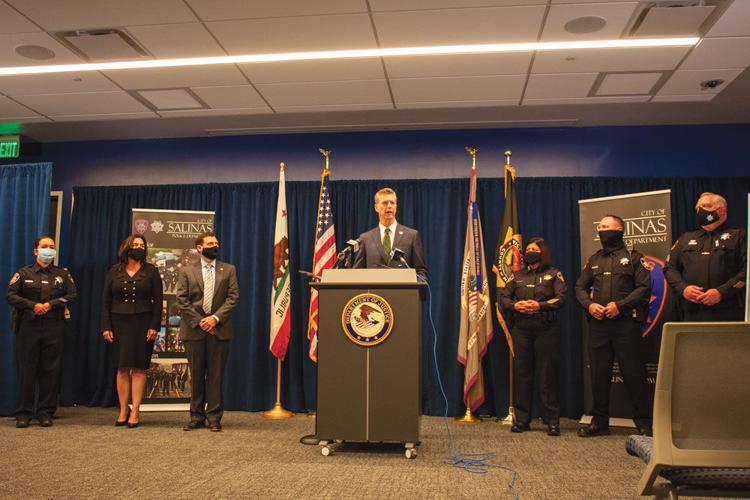
David Anderson, U.S. Attorney for the Northern District of California, announced the arrests of six members of the so-called Norteño “Murder Squad” at the Salinas Police Department during a press conference on Thursday, Oct. 22, 2020. “The indictment alleges a pattern of horrific violence,” Anderson said. “This violence destroys lives. This violence holds our community hostage.”
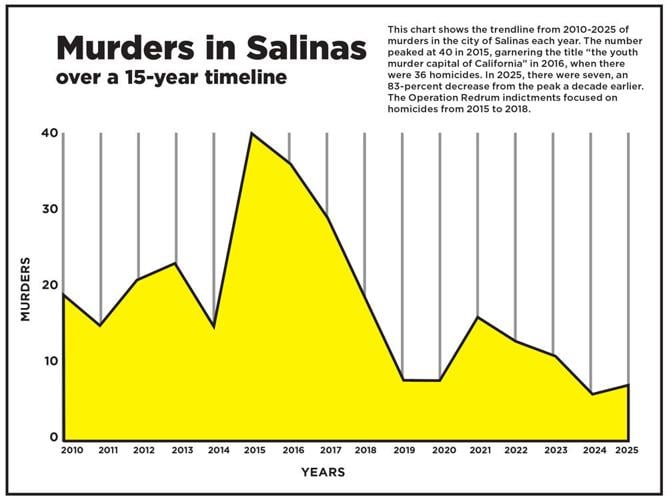
Ten years ago, on July 27, 2016, following a year with 40 murders, a Vice News article saddled Salinas with the unfortunate epithet “Youth Murder Capital of California.” We were a long way from Eden. Yet, in the years that followed, something changed. It is worth looking back with perspective to see how far we have come since 2016, even if the national narrative hasn’t quite caught up.
Salinas was a violent city at the time, averaging almost 25 homicides a year between 2008 and 2018, a staggering number for a city of approximately 155,000 people. Working homicide cases was nothing unusual for the Salinas Police Department, but in 2017 detectives began linking a series of gang-related murders that appeared to be something more than traditional gang hits. The killers seemed to enjoy the violence; it was sport, and they thought it was fun.
These killers carried out the murders for no “legitimate” need of the gang (not that there ever is a legitimate need). Salinas had experienced gang killings before, and in their own strange way they fit an understandable pattern. These murders did not. They appeared more random, more brutal and entirely unnecessary even from the perspective of a gang working to protect a criminal enterprise or assert dominance.
The investigation culminated on Oct. 22, 2020, when a federal grand jury indicted six Salinas street gang members on charges including racketeering conspiracy, murder, conspiracy to commit murder and additional firearms and gang related offenses. The federal indictments resulted from a complex multi-year investigation known as Operation Redrum, which began with the Salinas Police Department and expanded through collaboration with the FBI, Homeland Security Investigations, the Monterey County District Attorney’s Office and the U.S. Attorney’s Office. It was a turning point.
THE SIX INDICTED SUSPECTS, ranging in age from 24 to 33, some of whom were teenagers at the time of the murders, were members of a violent Norteño street gang and formed a criminal “crew.” A crew was a small, hierarchical group operating somewhat independently within the larger gang structure. They functioned almost like a street-level clandestine cell: a small unit maintaining autonomy in order to minimize the risk of detection.
The gang members formed what they themselves called the “Murder Squad.” Over three years, the Murder Squad orchestrated multiple shootings, killing 11 people and wounding 17 others between January 2015 and November 2018. Many of the homicide victims had no known gang affiliation and were murdered in cold blood for no other reason than they were vulnerable and met the suspects’ criteria for prey.
The suspects coordinated and carried out missions to hunt and kill rival Sureño gang members or individuals they believed to be Sureños. When they could not find actual Sureños, they targeted Latino men, including migrant agricultural workers. Members of the Murder Squad believed these victims were people no one would miss: men without immediate family nearby or strong community ties, whose deaths would generate little more than a brief news story before being forgotten.
In one of the homicides, the victim was killed in the pre-dawn early morning hours just off the sidewalk in the front yard of a home in a poor, eastside neighborhood. The killers pulled up in a car, got out and emptied their weapons into the victim at close range. When detectives conducted a door-to-door canvass of the neighborhood, no one knew the victim or where he lived.

Data provided by Salinas Police Department.
Over the next few days, the detectives repeatedly canvassed the neighborhood. Eventually, one of the residents admitted the victim rented a room behind their home. Detectives had spoken to this person and others the night of the murder, but no one wanted to get involved; they acted as if they did not know the victim.
This was precisely why the suspects chose victims from within the migrant community. Migrants often lived under false names in the U.S. and their next of kin were challenging for police to track down. Some migrant families were in remote and undeveloped locations in Mexico, Guatemala or El Salvador. Even if they were far from home, their killers were wrong – loved ones cared about each of these human beings.
THE SALINAS DETECTIVE BUREAU INVESTIGATION revealed the Murder Squad carefully planned, coordinated and executed missions to hunt and kill victims in Salinas’ poorer neighborhoods. The investigation revealed the Murder Squad used multiple vehicles to carry out their executions. One car carried the designated shooters, another served as a spotter watching for police or witnesses, and a third searched for potential victims. They communicated by cell phone while hunting.
Members of the Murder Squad selected victims based on characteristics they associated with rival Sureños: Latino men, agricultural laborers, individuals wearing blue clothing, or people found within particular neighborhoods. The investigation revealed members of the crew knew the victims they killed were not gang members. They convinced themselves their victims were Sureños and killed them anyway.
Once a target was identified and the approach coordinated, the shooters fired until their weapons were empty. They frequently exited their vehicles, ran toward their victims, and continued shooting at close range.
The suspects celebrated their murders and encouraged a culture where the more “bodies” accumulated by a Murder Squad member, the higher status conferred on that member. Investigators learned the shooters gained added status (or respect) by being ruthless in their execution. One suspect later told detectives that they would drink and party until intoxicated before going out to “hunt” simply for the thrill of it.
They also understood confronting an actual Sureño carried risks, as a rival gang member might be armed. However, if they attacked a migrant worker, they would not be armed and, they wrongly believed, no one would really care. Family members back home cared, and Salinas Police cared too. There are no officers who worked in Salinas during the decades of gang violence who were left unscathed by what they saw and experienced.
“During this investigation, I had the opportunity to meet with family members and surviving victims,” retired Salinas Police Detective Byron Gansen says. “I met with some on the night of the homicides, some years later. It was difficult to see the pain each went through, but I was glad to provide some justice for their loss. Some of the families of the deceased were field workers who I met with on their way home from work. They discussed how difficult it was to lose their father/husband, not only losing the role model, but the financial burden put on them when they were already struggling.”

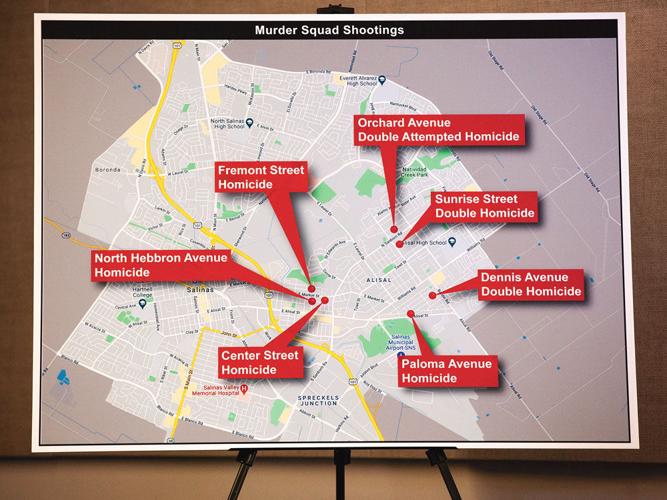
U.S. Attorneys displayed this map showing the locations of seven so-called “hunts” that killed eight people in 2017 and 2018. In 2020, a federal grand jury indicted six suspected members of the so-called “Murder Squad” (and added a seventh). Those suspects ranged in age from 24 to 33.
OPERATION REDRUM remains one of the most consequential investigations conducted by the Salinas Police Department. Detectives devoted countless hours to surveillance, interviews and painstaking investigative work because they believed the victims deserved justice. Dismantling this group of killers dramatically reduced homicides in Salinas, weakened gang influence and strengthened public confidence in continuing partnerships between local, state and federal law enforcement.
Gansen was the lead Operation Redrum investigator. “This investigation began with a conversation in 2017 between myself and Detective Sgt. Chris Lane,” Gansen says. “We discussed similarities in several of the homicide cases starting in 2015. The Detective Bureau then followed links in homicides and attempted homicide cases from 2015 through 2018. The homicide victims and their families’ tragedies fueled my desire to find some justice and find answers they deserved.”
Gansen received the 2021 California Peace Officer Award of Distinction for his involvement in the Redrum investigation.
In total, seven gang members were charged federally and 12 faced state charges in Monterey County Superior Court.
“Based on evidence recovered from the scenes, and cooperator information I believe the Murder Squad and their broader Norteño clique are responsible for multiple additional homicides and attempted homicides,” Gansen says. “But unfortunately, so far, there is still not quite enough evidence to prosecute these additional cases.”
The investigation is expected to reach a conclusion on Aug. 27, when sentencing is scheduled take place for Ryan Meza and Joseph Garcia, who will plead guilty to voluntary manslaughter and attempted murder with additional firearm and gang enhancements for a February 2017 double homicide on Sunrise Street in Salinas, in which 27-year-old Jose Luis Vargas-Flores and 25-year-old Alejandro Ramirez were killed and two others wounded. On Aug. 27, Meza and Garcia are expected to be sentenced to 50 years in prison.
Operation Redrum built upon previous investigations, such as Operation Day Break in 2015, and other earlier federal collaborations. Moving forward, efforts have continued with the work of Operation Dead End that led to 12 arrests in 2024 and additional Dead End indictments in 2026, which have further reduced gang violence.
The investigation and subsequent state and federal prosecutions reduced crime in Salinas and Monterey County more broadly. In many ways, the Murder Squad represented the culmination of decades of metastasizing gang violence. These offenders planned and carried out killings because they enjoyed the killing itself. They had a pattern, a plan and a particular type of victim. There is no doubt these serial killings would have continued.

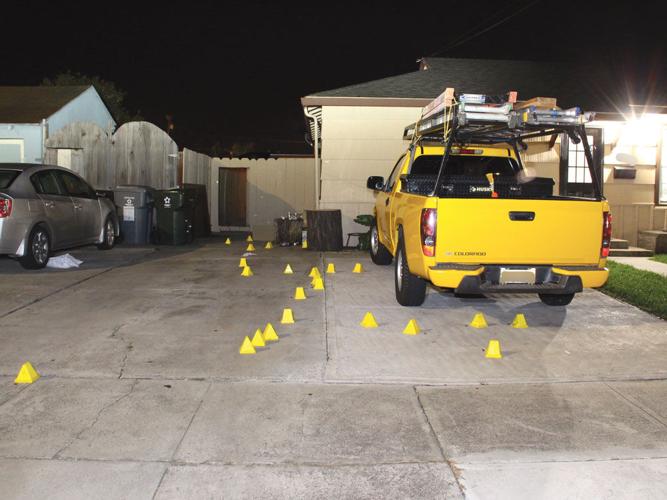
The yellow placards at this crime scene correspond to bullet casings found on Dennis Avenue in Salinas, where two cousins were shot and murdered on March 25, 2017. Both were agricultural field workers and had no known gang ties.
The 2015 homicide total of 40 killings marked 30 years of escalating gang violence and frustration. The takedown of the Murder Squad, the ongoing collaboration with local, state and federal partners, Operation Redrum and – most importantly – a pivot toward community collaboration was a turning point for Salinas.
It has been 10 years since Vice News labeled Salinas the “Youth Murder Capital of California.” Today, gang crime is at a notable low and current homicides are in the single digits; there were seven murders in Salinas in 2025, and six in 2024.
We may not yet be in Steinbeck’s Eden, but Salinas has come a long way and we have much to be proud of. As we cast off the pall of violence, our community should not be judged by its dark past, but by how it embraces its bright future. Perhaps the land of promise and peace lies open before us.
(0) comments
Welcome to the discussion.
Log In
Keep it Clean. Please avoid obscene, vulgar, lewd, racist or sexually-oriented language.
PLEASE TURN OFF YOUR CAPS LOCK.
Don't Threaten. Threats of harming another person will not be tolerated.
Be Truthful. Don't knowingly lie about anyone or anything.
Be Nice. No racism, sexism or any sort of -ism that is degrading to another person.
Be Proactive. Use the 'Report' link on each comment to let us know of abusive posts.
Share with Us. We'd love to hear eyewitness accounts, the history behind an article.