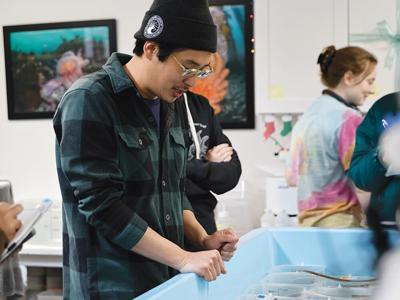

One year ago, early in the morning on Valentine’s Day, a group of nine stood huddled around a tank behind the scenes of the main floor at Birch Aquarium at Scripps Institute of Oceanography in San Diego. They were waiting patiently for hours, peering into the cold water to watch one male and one female, perhaps one of the last – if not the last – reproducing female sunflower sea star in the state of California, make some magic.
Six hours later, millions of tiny eggs were spawned, creating what looked like a blizzard in the tank. The group – staff from a coalition of aquariums and labs across California – let out a scream, rejoicing in the start of an experiment to see if they could successfully grow the critically endangered sea star at scale.
They began pipetting the eggs out of the water, disseminating them into five-gallon buckets to be fertilized. Then, the tactfully timed experiment began to deliver soon-to-be tiny baby sunflower stars – smaller than the tip of a pencil – to partners that would include the Cal Academy of Sciences, Cal Poly Humboldt and the new Sunflower Star Laboratory at Moss Landing.
“We played ‘Let’s Get it On’ by Marvin Gaye.”
“The staff at the Aquarium [of the Pacific] had put up Valentine’s Day operations around the exhibit,” says Ashley Kidd, cofounder of the Sunflower Star Lab. “We played ‘Let’s Get it On’ by Marvin Gaye.”
Kidd and Vince Christian, the creators of the Sunflower Star Laboratory and the ones responsible for putting this experiment into motion, were elated – no experiment like this was being done at this caliber in California with the sunflower star. It was a moment that had been years in the making.
Christian, a long-time diver and retired engineer, moved to Monterey around 2018 and began reaching out via online forums, asking if anyone had seen sunflower sea stars after the massive die-off that almost entirely eradicated the species off the coast of California in 2013.
The response was overwhelming; people chimed in on various dive sites and on social media in response to his inquiries about sunflower stars. Their answer was nope – none spotted.
Then came his crazy idea.
“I heard about this guy, Jason Hodin at the University of Washington, who was growing sunflower stars from larva. And so I started to ask around to see if anybody in California was doing that and found out that they weren’t,” he says.
He wiped out his garage and began fiddling with tanks, algae and asking questions. What filtration systems do sunflower stars need? What kinds of algae need to be grown for their food, and how do I keep the algae alive?
He began perfecting the method of growing algae in beer growlers, a technique the lab still uses today.
Kidd, who was an aquarist at the Aquarium of the Pacific (AOP) in Long Beach, saw his request for help via Facebook. She came with an extensive background in aquaculture, working on exhibits at the AOP and running its live food lab program.
“Our powers combined,” Kidd says. “I brought all of the aquarium side, and he brought his gumption, his determination to get us here.”
In 2021, Christian began the process of turning the idea into a nonprofit, then began recruiting board members for their first meeting by the end of the year. Two years later, they had collected a coalition of lab partners, located their male and female sunflower stars, and established a plan to turn an old storage room in Moss Landing into what is now the Sunflower Star Laboratory.
Scientists are still not entirely certain what led to the massive die-off in 2013, although many suspect it had something to do with an ocean warming event that occurred that year. The Sunflower Star Laboratory currently has about 36 juvenile sea stars, operating under a three-year grant that began in October 2024 to develop a recovery plan.
The goal is to eventually reintroduce the stars into the wild, but lots of research in the lab needs to be done first to understand how they grow.
“This truly was all proof of concept, there were no plans for reintroduction,” Kidd says. “Now, we have to [understand] how they’re going to behave.”


(0) comments
Welcome to the discussion.
Log In
Keep it Clean. Please avoid obscene, vulgar, lewd, racist or sexually-oriented language.
PLEASE TURN OFF YOUR CAPS LOCK.
Don't Threaten. Threats of harming another person will not be tolerated.
Be Truthful. Don't knowingly lie about anyone or anything.
Be Nice. No racism, sexism or any sort of -ism that is degrading to another person.
Be Proactive. Use the 'Report' link on each comment to let us know of abusive posts.
Share with Us. We'd love to hear eyewitness accounts, the history behind an article.