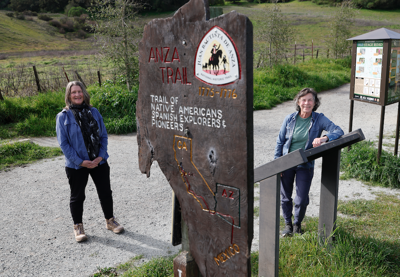

Pam Marino here, thinking what 240 men, women and children, plus a herd of cattle and mules, were doing 250 years ago this very morning, camped out around the area of what is today the Royal Presidio Chapel in downtown Monterey.
Ever since I did research about the Juan Bautista de Anza Expedition visiting Monterey in March 1776 for this week’s cover story, “The Legacy,” it’s hard not to think about what the scene must have been like every time I pass by that neighborhood.
Anza forged a new overland route for Spain through Arizona and California in 1774, and was quickly charged with bringing a group of colonists to settle San Francisco. The expedition, which began in the fall of 1775, stopped in Monterey in March 1776. The families remained there as Anza scouted locations for a presidio and mission in San Francisco. They made the final leg of their trip in June.
The expedition was a big success for Spain, but 250 years later not everyone celebrates it, as my story explores. The land Spain colonized was already populated by many Indigenous tribes, and the impact on them was brutal.
And yet, the families on Anza’s expedition were an extremely diverse group, including many who were Indigenous, of African descent or of mixed race. They went on to found and build San Francisco, which for some descendents is something to be proud of.
Fifty years ago, Anza’s accomplishment was celebrated with a recreation of the entire expedition from Mexico to San Francisco. It included three days of parades and other events in Monterey. There’s only a few events planned locally this year.
I hope you’ll read the story and hear from descendants, a local tribal chief, and a noted local scholar for more about the expedition and its legacy in Monterey County and California.
Like me, you may get curious about the trail itself, which in 1990 was designated by Congress as a National Historic Trail. There is an auto route you can follow, as well as a few hiking trails. As part of my research for the story, I drove the auto route through Monterey County in two parts, starting in the south (with my friend Lynn Wagner serving as co-pilot), then a week later heading north.
In the south, we drove backroads past Lake Nacimiento and Lake San Antonio, saw a bald eagle and a fox, and stopped at Mission San Antonio in Jolon. The terrain was probably pretty similar to what the expedition encountered 250 years ago.
For the northern piece, I started in Monterey at the Royal Presidio Chapel, and headed over Highway 68, a route the expedition used both into and out of Monterey, to Salinas.
There was my fruitless search in Salinas to find a marker around Natividad, another expedition camping spot, then I headed up and out of the city on Old Stage Road, past quaint ranch houses and herds of cattle. The road became a narrow gravel lane with a canopy of very old, gnarled oak trees.
The road ends at an unmarked gate, with a passthrough to one side for hikers. From there anyone can hike up and over the hill to see a new vista over San Juan Bautista, just like Anza and the colonists did so long ago.


(0) comments
Welcome to the discussion.
Log In
Keep it Clean. Please avoid obscene, vulgar, lewd, racist or sexually-oriented language.
PLEASE TURN OFF YOUR CAPS LOCK.
Don't Threaten. Threats of harming another person will not be tolerated.
Be Truthful. Don't knowingly lie about anyone or anything.
Be Nice. No racism, sexism or any sort of -ism that is degrading to another person.
Be Proactive. Use the 'Report' link on each comment to let us know of abusive posts.
Share with Us. We'd love to hear eyewitness accounts, the history behind an article.