
TWO-HUNDRED-FIFTY YEARS AGO THIS MONTH, IN MARCH 1776, commander Juan Bautista de Anza under the banner of Spain led 240 men, women and children through Monterey County on an 1,800-mile trek. They were on their way from Mexico to colonize San Francisco. It was a monumental feat at the time, one that led to the eventual founding of California and the West as we know it.
The expedition began in Sonora, Mexico in the fall of 1775, officially launching from Tubac, in what is now Arizona, with colonists of mixed Spanish, African, Afro-Latino and Indigenous descent, along with 200 cattle and 132 mules, traveling over mountains, deserts and valleys. They arrived in Monterey on March 10, 1776, to spend several months before reaching their final destination of San Francisco.

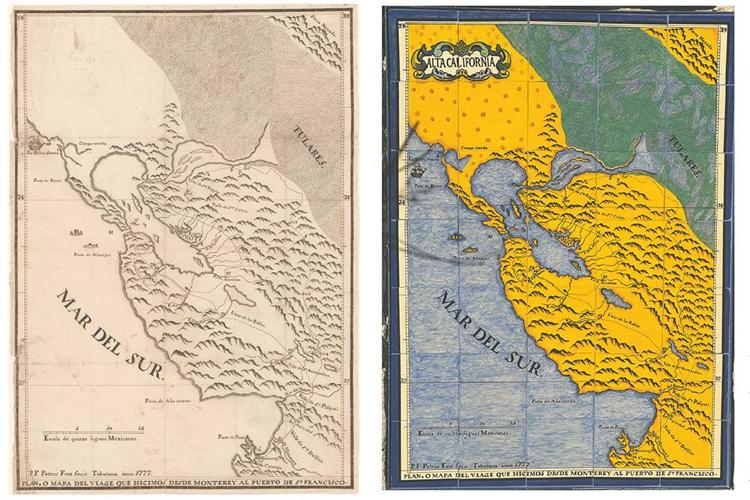
Father Pedro Font served as the spiritual leader of the Anza expedition and as its mapmaker. His original map (left) showing the area of Alta California from Monterey to the San Francisco Bay Area was recreated in tile in 1935 in Triana, Seville Spain and donated to the City of Monterey by artist Edgar Walter. After 90 years of hanging on a garden wall outside of offices at City Hall, it was falling apart. The tile map (right) was reconstructed in Monterey in 2025 by artist Jos Sances in time for the 250th anniversary.
Fifty years ago, in 1976, Anza’s accomplishment was celebrated as part of the U.S. bicentennial, which was marked with parades, fireworks and reenactments of Revolutionary War victories. To celebrate the Anza expedition, people from Mexico to San Francisco, led by organizers from Monterey, organized to reenact the entire expedition on horseback over several months. They left Mexico City on Aug. 17, 1975, consisting of both U.S. and Mexican citizens. Hundreds of volunteers over several months took turns riding on horseback through Arizona and California as part of the reenactment.
The 1975 event was front-page news – every town along the way cheered on the reenactors, and the many newspapers that proliferated at the time in small towns and large cities were committed to chronicling the trip.
When the entourage entered Monterey County on March 6 – the same date Anza led the expedition to Mission San Antonio in Jolon 200 years earlier – local newspapers splashed stories and photos across their pages. When it arrived in Monterey on March 10, travelers were met with a parade, followed by three days of celebratory activities before the expedition continued northward.
In 2026, there are no elaborate commemorations or celebrations in Monterey County to mark the 250th anniversary of the Anza expedition, other than a small museum exhibit. An event and another exhibit are planned for May.
There are a variety of reasons why the 250th anniversary is quieter this time. That Anza was a colonizer and part of the structure that coerced Indigenous people into the mission system is chief among them. In 1976, Anza and his expedition was romanticized as part of the founding of the U.S. Today, we look at history through a different lens, more cognizant of the price paid by the Indigenous people who lived here before westerners arrived on the scene.
And yet, Anza’s expedition was a significant historical event in what was to become the founding of California by a diverse group of immigrants. How do we hold both truths?
IT WAS THE EARLY 1770S, AND KING CARLOS III OF SPAIN HAD A PROBLEM. His country had colonized Mexico in 1521, exploring Alta California to the north but holding off on its colonization until the 1760s, with Father Junipero Serra and the founding of the mission system.
Now, other countries were pressing the boundaries. England occupied territory to the east of Louisiana and was a formidable sea power that could foreseeably come to California’s shores, while Russia was making noise to the north.
“It was the needs of this Pacific Coast frontier that called forth from comparative obscurity Juan Bautista de Anza. Isolated and ill-supported, the new province needed overland communication with the settled mainland of Mexico and a strong colony to hold the threatened land,” Herbert Eugene Bolton wrote in his 1931 book, Outpost of an Empire.
He described Anza, a captain in the Spanish army, as “tough as oak and silent as the desert from which he sprang.”
Anza was a “criollos,” referring to people of Spanish descent born in New America. He was actually Anza II – his father was Juan Bautista de Anza I, a Spanish Army captain. He died in an Apache ambush in Sonora, Mexico in 1740, when his son was a few years old. Reportedly Anza I submitted his plans to the Spanish government to forge an overland route from Sonora to California about a year before his death.
Over 30 years later, his son was charged with doing what his father never lived to accomplish. In 1774, Anza blazed an overland route from Sonora to San Francisco, using maps of Gaspar de Portolá’s earlier expeditions, which launched from Baja Mexico, as well as the well-worn trails of Indigenous peoples over centuries.
In the first trip in 1774, Anza took 74 days to establish the new route from Tubac to San Francisco – it only took 23 days to get back. It was a key alternative to ships, which could take up to 60 days. Eager to secure the port of San Francisco, Anza’s superiors appointed him as commander of an expedition to lead a group of Spanish citizens to establish a colony.
Anza proved to be well-equipped for the job, not only as a leader and explorer, but also as a skillful planner. His budget for $10,970 covered everything they would need including glass beads he used as gifts to Indigenous people they would encounter along the way. His budget also covered the costs for clothing, weapons, horses and mules, food and soldiers’ wages.

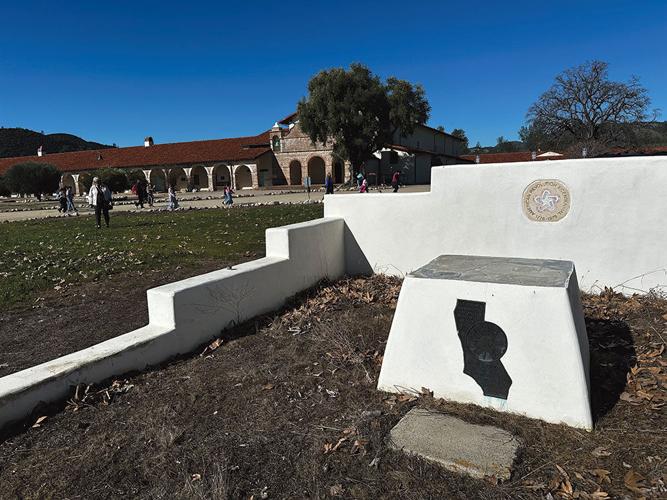
The Anza expedition arrived at Mission San Antonio, in what is now Jolon, on March 6, 1776. The 240 men, women and children, plus horses, cattle and mules, camped around the mission, which still stands today. In 1976, markers were placed outside of the mission commemorating both the U.S. bicentennial and the 200th anniversary of the Anza expedition.
Local archeologist and scholar Rubén Mendoza, a founding member of CSU Monterey Bay faculty and president of the Monterey County Historical Society, sees Anza’s careful preparation as critical.
“He wanted to make sure that this community of colonists and settlers would survive such a harrowing expedition, over mountains through harsh deserts, across rivers,” Mendoza says. “By the time they arrived in Monterey, they had seen everything imaginable.”
Anza also factored in who would need to be a part of the new colony. He chose military men and their families – he wanted young families with children who would populate the new outpost – many from the lower classes of Sonora, people who had few opportunities to advance and would be inspired by the promise of a new life.
Mendoza points out the expedition included one of the largest contingents of Afro-mestizos, people of mixed heritage descended from enslaved people brought to the New World. (Spain outlawed slavery of Indigenous people in the 1500s.)
Anza and 175 others left Horcasitas in Sonora on Sept. 29, 1775, heading for Tubac. There they would gather with the rest of the train, as Anza referred to the group in his journal, before embarking on the majority of the journey.
THE EXPEDITION LEFT TUBAC ON OCT. 23, 1775 with the full contingent of 240 people. In the group was Manuela Ygnacia López Peñuelas, a mother who was very pregnant. At the end of their first day of travel, she gave birth to a baby boy, but died hours later from complications. Hers would be the only death of the entire trip.
It was a challenging 1,200-mile journey, over mountains and deserts, through snow storms, rain storms and blazing sun. Through it all, Anza was mindful of their limits. For example, he did delay the trip at times after women gave birth. (There are discrepancies among reports of the exact number of births. At least eight women were pregnant. Several babies were born successfully and there were at least two miscarriages on the trip.)
When the expedition finally made it to what is now Monterey County on March 6, 1776, Father Pedro Font, the expedition’s spiritual leader, noted in his journal that they had entered the Cañada de los Robles, or Canyon of the Oaks. They camped at Mission San Antonio, which still stands today.
Anza reported in his journal that they arrived at the mission at 4pm, after about eight hours of travel over 24 miles. The priests welcomed the troops with “two very fat hogs and a supply of suet from them, a present which, on account of the condition of the country and the needs of our soldiers, has been appreciated accordingly,” Anza said.
Font’s description of the roughly 500 Indigenous people at the mission was harsh, calling them “small in body, degenerate and ugly, both men and women,” adding that “they live in their heathendom scattered through those mountains and canyons without any special knowledge of God.”
After two days at Mission San Antonio, the expedition left and headed through what today is King City, and north to Soledad, before traveling over what is now Highway 68 to Monterey, arriving on March 10. It rained heavily nearly the entire day, “so that we arrived at Monterey very wet,” Font noted. He called the road into Monterey “like all the rest is through pretty country, green, shady, flower strewn, fertile, beautiful, and splendid.”
The soldiers and priests of the Presidio of Monterey – at that time located about where the Royal Presidio of Monterey sits today – were “overjoyed” to see them, Font said. They were greeted with three volleys from the small cannons there and musket fire by presidio soldiers.
The next day Father Serra and other priests of the Carmel mission came to Monterey to greet Anza, who then headed with Font back to Carmel to rest. Within a few days, Anza was inflicted with severe pain in his groin – “I could barely breathe and thought I would suffocate and die on the spot,” he wrote.
On Friday, March 22, Anza, who was better but still in some pain – and against a doctor’s advice – saddled up to ride with a military detail to San Francisco to scout locations for a presidio and mission, leaving the colonists in Monterey. They stopped overnight in Salinas, near where Natividad Creek Park is located, then headed up and over a pass at the north end of the Gabilan range, and toward the area of San Juan Bautista, via what is now Old Stage Coach Road. The party reached San Francisco on March 27, then returned to Monterey and Carmel.
The colonists remained in Monterey a few months before embarking on the last leg of the journey to San Francisco, arriving on June 27, to start their new lives.
SUSIE GULARTE OF MONTEREY AND JULIE AMAYA OF SANTA CRUZ are both members of the California Mission Walkers – a group dedicated to walking the route of the 21 missions from San Diego to Sonoma – but they had never met until they were both on a group walk about four years ago.
As the two women chatted, they suddenly realized that they shared the same ancestors who were a part of the Anza expedition, their fifth-great-grandparents, Maria Gertrudis and soldier Ignacio Linares, making them cousins.
“We’ve been fast friends ever since,” Gularte says.
The expedition’s census lists Linares as “Indio,” which at the time was a legal, racial and social classification of people considered of pure Indigenous ancestry. Gertrudis was listed as “España,” of Spanish European ancestry. She would have been from the highest caste of society at that time. Their children would have been considered “mestizos,” of mixed heritage.
“A lot of times in these small towns there was really no other choice [but to marry outside of one’s caste], and that was very frequent,” Amaya notes.
Gertrudis was 22 at the time of the expedition, with three small children and pregnant with her fourth child, Salvador, who was born on Christmas Eve in 1775 in the Anza Borrego desert. Font noted in his journal that he was called to take Gertrudis’ confession: “She was very fearful of dying, but having consoled her and encouraged her as best I could I returned to my tent, and at half past 11 at night she very happily and quickly gave birth to a boy.”

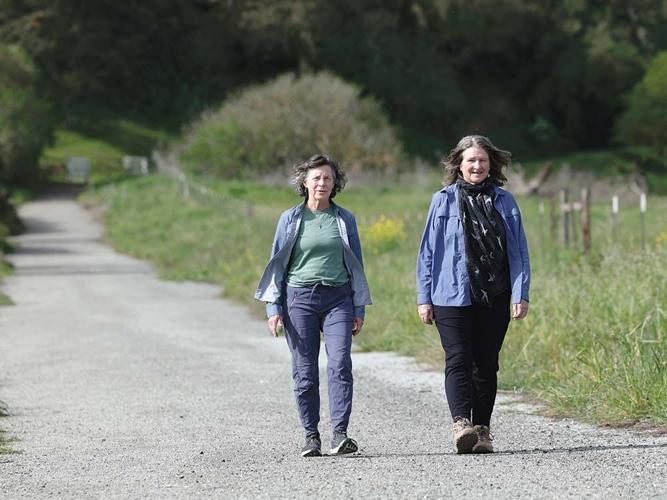
Cousins Susie Gularte (left) and Julie Amaya walk along the Anza trail in San Juan Bautista. They descend from the same fifth-great-grandmother who was on the expedition and gave birth to a son on Dec. 24, 1775. As members of the California Mission Walkers, they led a 15-mile walk on March 7 from Salinas to San Juan Bautista to commemorate the expedition and share stories of their ancestors.
“And that puts our family on the map, pretty much,” Amaya says. It was thanks to Anza’s and Font’s journals that their family has such a precise record of their history.
For a long time, Salvador’s birth was reported as the first nonnative born in Upper California, Amaya says, but that wasn’t true. A plaque in the Anza Borrego desert declares Salvador Linares as the first white child born there, she says, “and it’s wrong.”
Neither woman knew of their history as descendants of the expedition until later in life. Gularte says her grandmother never spoke of the history because she was ashamed of it. She found out in her 20s after a cousin of hers who is a priest was able to access records and write it all down.
Amaya got interested in genealogy in her 20s and spoke to older family members – she descends from Gertrudis and Linares on her father’s side, but none of those relatives mentioned the expedition. As she explored her genealogy further along the paternal side, she came to realize her connection to the expedition.
Looking back from a modern perspective, Gularte says she feels ambivalent. “I have conflicted feelings about it,” she says. “There’s some pride in having been in California so long, but also some feelings that it started pushing out people. There’s a lot of negative press around the whole of that era.
“It wasn’t all positive but it wasn’t all negative, and I assume positive intentions on all fronts.”
Amaya has solo-walked the entire mission route once, over 58 days. “If we talk about the colonization of California, there’s a lot more negative than there is positive, but I take it from a more personal point of view,” she says. She recalls walking along River Road from Soledad toward the Monterey Peninsula, and imagining what it was like for her fifth-great-grandmother, who likely didn’t want to leave her home in Mexico, but had no choice but to accompany her husband.
“She left her family and everything she knew. She takes these three small children – and again, it’s from her point of view – hoping for something better than what they have,” Amaya says. “I found myself wondering if I even took the same footsteps that she did in certain areas, with 200-plus years of earth between her footprint and mine.”
TOM LITTLE BEAR NASON NOW WALKS IN HIS ANCESTORS’ FOOTSTEPS, as an eighth-generation Esselen and the tribal chairman of the Esselen Tribe of Monterey County. For him, the Anza expedition is inextricably linked to Serra and the trauma experienced by his ancestors who lived in the region 250 years ago.
“It’s definitely something that runs in many deep veins of my family and my tribe and our people who lived here on the Central Coast,” Nason says. “We’re living right now a generational trauma, caused by the missionaries primarily, and by the Anza expedition, which had a huge impact on our cultures, our land, our values, our homelands.”
The colonization by Spain took the tribes away from their land and their homes, Nason says. “We had complete complex cultures, trading route systems and villages,” he says. The Spanish gave “free” lands to their own citizens to settle here, but “that wasn’t free, it was all our land.”
The tribal members who were coerced into the mission system were forbidden to speak their language or practice their religion or culture. “It was really annihilation for us,” Nason says. “They made slaves out of us.”
Today, Nason says, they are trying to regain their past, “and teach our young how we lived as one with the earth, how we lived in balance with nature.”
In recent years, the Esselen Tribe has been working to reclaim its land in Big Sur and in Carmel Valley. Last year the tribe purchased 1,270 acres along Tularcitos Creek, using grants from the state Wildlife Conservation Board and State Coastal Conservancy. The tribe plans on using it for gatherings and ceremonies for all tribes, along with educational programs and guided tours.
“We have to sit with the land, be with the land and sit with our elders,” Nason says. “But there is no one on this Earth left who has the true knowledge of our people because it was taken from us. It was wiped out, it was erased. That’s the impact we’re feeling since Father Serra and then Anza came.”
THE TRAIL ANZA FORGED WAS FORMALLY RECOGNIZED BY CONGRESS ON AUG. 15, 1990 as the Juan Bautista de Anza National Historic Trail, part of the National Park Service, putting it in league with other historic trails like Lewis and Clark, Pony Express and Trail of Tears. Creating such trails are meant to recognize momentous events that have a significant bearing on North American history, according to Mendoza.
“A lot of these trails, depending on one’s background and interest, are either going to be elevated or diminished. I do believe that the narratives tend to be polarized, especially in the way in which Americans address the Spanish colony in North America which literally encompassed 38 of the 50 states, either through settlement, colonization, exploration and a whole host of other narratives,” Mendoza says.
“The reality is we still see an exceptionalism in the American presence that doesn’t extend in all cases to the American Indian presence, the Hispanic colony, or for that matter the Mexican heritage republic that once dominated the American Southwest,” he says. With the historic trails, some will be elevated and others diminished depending on the politics of the day, which could be a factor in a muted response to Anza today.
Mendoza cites a declining ability to teach history in the U.S. public school system, in part due to lawsuits and shifting political views. Polarization and culture wars are also partly to blame.
“That too has affected the way in which people either take interest or see no interest in such features as the Juan Bautista de Anza National Historic Trail, which was significant in its own right because it was one of the first significant exploration into Alta California that led to the founding of the Presidio Garrison, the mission and the Spanish settlement of San Francisco,” he says.
Mendoza notes pushback today, which he says is unfortunate. “In the Monterey Bay and Salinas areas today there is reluctance to accept Anza as part of the cultural heritage of the Mexican community,” he says. The people that were brought in came from Northern Mexico and founded the City of San Francisco, a significant accomplishment. He points to Anza establishing the trade route as “significant to the history of commerce for the beginnings of what ultimately would become the fourth-largest economy in the world, California.”
The camp in Natividad “puts them dead center in the area of Salinas,” he says. “It’s a predominantly Hispanic community and yet they don’t really acknowledge this expedition.”

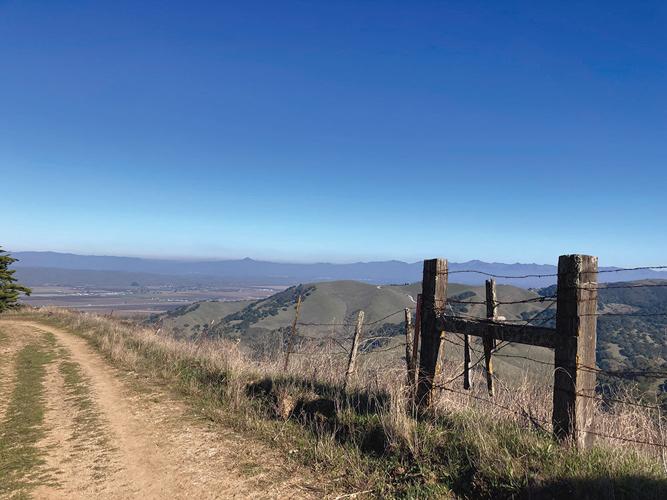
Part of the Juan Bautista de Anza National Historic Trail stretches four miles between an unmarked trailhead in North Salinas and the trailhead in San Juan Bautista.
As president of the Historical Society, Mendoza intends to elevate Anza’s profile in the coming months, “because Anza was key to the first immigrant community of California.”
WHEN THE REENACTORS ENTERED MONTEREY ON HORSEBACK ON WEDNESDAY, MARCH 10, 1975, to cheers, the parade kicked off three days of celebratory events that included cocktail parties and dinners, more parades and a closing barbecue, “California Style.”
This year the only local public recognition of the expedition so far is an exhibit inside the Monterey History and Art Association’s Stanton Center at Custom House Plaza in Monterey. MHAA Board Member Scott Gale curated the exhibit, seeking reproductions of photos and drawings of Monterey from the era of the expedition.
On March 24, a cyclist from Mexico, Luis Valle, is scheduled to come through Monterey on a solo bike trip from Mexico along the Anza historic trail, as part of a documentary he’s making about the expedition and his trip. Gale says the plan is for Valle to return to Monterey in June to give a talk.
In Salinas, there are plans to commemorate the Anza expedition on Salinas Day, May 2, says Craig Kaufman, executive director of the Salinas Valley Tourism and Visitors Bureau. He’s also a new member of the Anza Trail Foundation. He runs the California Visitor Center at the Salinas Transit Center, which will open a permanent exhibit about the trail during the festivities.
Kaufman has been advocating for several years to highlight the trail as a potential tourist draw, only to meet resistance from those who fear it would romanticize colonialism. Pointing out that the expedition itself would not have been possible without the help of at least 38 Indigenous tribes along the way, he sees the legacy of the trail in a broader context.
“This trail is significant because it chronicles the human spirit of discovery and perseverance in the first overland colonizing expedition that founded San Francisco,” Kaufman says. “The diverse ancestry of this group, including First Peoples, African and European heritage, underpins the very foundation of California as it is today.”
(1) comment
This was a great historical story about this region.Thanks to Pam for writing it!
Welcome to the discussion.
Log In
Keep it Clean. Please avoid obscene, vulgar, lewd, racist or sexually-oriented language.
PLEASE TURN OFF YOUR CAPS LOCK.
Don't Threaten. Threats of harming another person will not be tolerated.
Be Truthful. Don't knowingly lie about anyone or anything.
Be Nice. No racism, sexism or any sort of -ism that is degrading to another person.
Be Proactive. Use the 'Report' link on each comment to let us know of abusive posts.
Share with Us. We'd love to hear eyewitness accounts, the history behind an article.