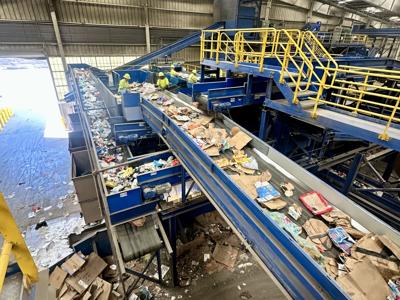

Katie Rodriguez here. About two weeks ago I received an excellent refresher on recycling when I visited ReGen Monterey, our regional waste management district. It has a pretty magnificent facility, managing waste that goes into the landfill, diverted for composting, it has a pilot biochar program, and yes, a pretty unbelievable recycling facility.
First and foremost, and the most important reminder of them all, your plastic items can and do get recycled, it just depends on the type of plastic.
Like the millennial that I am, I shared some of what I learned on my Instagram, receiving a swath of questions in response as well as shock that their items actually can be recycled. “How clean is clean??” “Do plastic bags clog up the recycling machines?” were some of the questions I got asked. I figured, if this was a good reminder for me and friends on what can and can’t be recycled, then maybe it will be for you too.
Yes, those plastic bags do clog up recycling facilities. Leave those out of your recycling.
Look for numbers 1, 2 and 5, in that little chasing arrows triangle. This is specific to Monterey; not all places in California accept #5. For example, if you’re in Santa Cruz, you cannot recycle #5. #1 and #2, which you’ll see on more common items like plastic water bottles or plastic containers that fruit or salsa might come in, are generally recyclable across the state.
Glass and aluminum, toss that in too.
Cardboard and paper? Good to recycle.
Steel and shredded paper? Yes.
What about carton containers—things like soup containers, ice cream tubs, milk cartons, “boxed water” and *gasp* to-go coffee cups? All of those waxy cardboard carton containers?
Not recyclable. The reason being, those containers, which are a mix of plastic and paper, decompose before they can be recycled.
All of these products, in order to be recycled, need a buyer. ReGen sends the recycled materials across the state, and even outside of California to be used for other products. For example, #2 recycled materials go to Iowa to be used for industrial piping. #5 goes to Alabama and California to be recycled into paint cans and packaging.
Glass containers are recycled in California into wine bottles and other glass containers.
How clean is clean? “Spatula clean,” says ReGen’s Director of Communications Zoë Shoats during a tour through the recycling facility. We were standing on a bridge that looked over the final stretch of the recycling belt journey. Spatula clean means the container doesn’t have to be spotless, but get what you can out with a spatula before tossing it in the recycling bin. “Camp clean,” is how I think of it.
Monterey County is lucky; lots of other municipalities don’t have facilities like this or the capacity to take the waste they’re receiving. During our tour, I asked if there are any blueprints or examples of waste facilities that ReGen looked to as an example of what it looks like to do things right.
They said no; instead, they feel like they are the blueprint to which other municipalities look toward as an example.
“We had people visit from Mexico last week to get a tour of our facility to learn more about how they can operate theirs,” Shoats says.
But what about all of those other numbers found on plastic containers in the swirling arrows? The #3, #4, #6 and #7? Those are simply a marker, confusingly used to tell us the type of plastic, but not necessarily that it is recyclable.
The confusion in what’s recyclable, where it goes, whether or not anything actually is recycled—all of that adds up to consumer fatigue and frustration. Many of us, like myself, desire other options. Perhaps many of us don’t want to be using plastic all the time but have no choice. It is baked into our societal systems, our packaging, all under misleading labeling that puts the onus on the consumer to figure out how to control a problem that isn’t ours.
Senate Bill 54, a bill that was signed in 2022, helps to rewrite this script, putting the responsibility back on producers to slow the flow and help municipalities across the state be able to process their waste. While we won’t see changes as a result of this bill for some time, it is a landmark achievement in reversing the burden of waste from communities and local governments.
And, later this month will be the UN global plastic treaty talks, where our very own Monterey Bay Aquarium’s Chief of Conservation, Margaret Spring, will be working to negotiate plans for reducing plastic production on a national scale. You can read this interview in tomorrow’s edition of the Weekly.
While there is lots of work to do on a national scale in uncertain times, if there is one thing you take away from this newsletter, it is:
If you must use plastic, use #1, #2 and #5, and toss it in that blue bin.


(0) comments
Welcome to the discussion.
Log In
Keep it Clean. Please avoid obscene, vulgar, lewd, racist or sexually-oriented language.
PLEASE TURN OFF YOUR CAPS LOCK.
Don't Threaten. Threats of harming another person will not be tolerated.
Be Truthful. Don't knowingly lie about anyone or anything.
Be Nice. No racism, sexism or any sort of -ism that is degrading to another person.
Be Proactive. Use the 'Report' link on each comment to let us know of abusive posts.
Share with Us. We'd love to hear eyewitness accounts, the history behind an article.