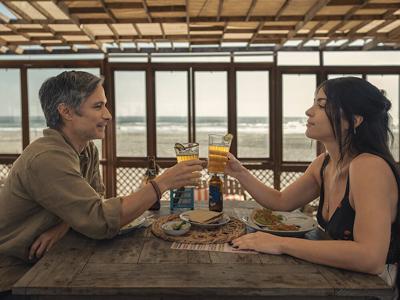

The Mexican border city Tijuana, which is full of dichotomies, is the set for Santita, a series on Netflix. Santita also shows a duality: whether being a Santita, which literally means “little saint,” is good or bad, as the main character explores the meaning of sin.
The Spanish-language series was written by two professors of Cinematic Arts and Technology at CSU Monterey Bay (and husband-and-wife team) Luis Camara, chair of the department, and lecturer Gabrielle Galanter. The duo has worked together for nearly 25 years and has written several screenplays across different genres, from horror to romantic comedy.
This story follows María José Cano, nicknamed “Santita,” a doctor with a disability who faces her past two decades after suffering an accident that left her wheelchair-bound and abandoning her fiancé at the altar.
Paulina Dávila (María José Cano) and Gael García Bernal star in the series that explores sexuality and mobility while having a disability, as well as how to rebuild a life after a life-changing experience. The series is told through the protagonist’s lens and shows “many different worlds that she inhabits,” Galanter says, from attending to patients to playing cards with her wealthy friends to being at a Haitian encampment.
Santita isn’t seeking redemption; the story shows that life isn’t perfect as she navigates her mistakes and skeletons in the closet, sharing her irreverent sense of humor. “Humor is a weapon to be used against tragedy and difficulty,” Camara says. “Just because you’re going through a rough time doesn’t mean that you can’t see the humor.”
Camara adds that Santita is “funny and tragic, and she defies expectations that people have of her.”
The duo worked with a consultant, María Ángel García Ramos, to ensure their depiction of their chair-bound character was accurate. The story begins the way García Ramos sees herself in her dreams: moving around without a wheelchair.
The series was directed by Rodrigo García, whose credits include Raymond & Ray (2022) and The Sopranos (1999). It was in the making for almost six years. Camara and Galanter visited Baja California Norte and explored Tijuana and Rosarito in the process.
(0) comments
Welcome to the discussion.
Log In
Keep it Clean. Please avoid obscene, vulgar, lewd, racist or sexually-oriented language.
PLEASE TURN OFF YOUR CAPS LOCK.
Don't Threaten. Threats of harming another person will not be tolerated.
Be Truthful. Don't knowingly lie about anyone or anything.
Be Nice. No racism, sexism or any sort of -ism that is degrading to another person.
Be Proactive. Use the 'Report' link on each comment to let us know of abusive posts.
Share with Us. We'd love to hear eyewitness accounts, the history behind an article.