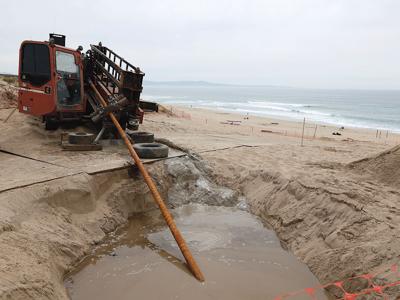

The desalination project at Marina State Beach was originally a pilot study in 1996 – one that proved successful, though more expensive than pumping groundwater at the time. So, it was put on pause.
In mid-March, after more than two decades and increasing pressure on local aquifers, the Marina Coast Water District (MCWD) began reviving that same desalination plant to help reduce reliance on groundwater. Now in Phase 1, parts of the plant infrastructure are being restored, and water quality tests are underway. Once online, the plant will add 300 acre-feet annually – enough to supply around 900 homes.
“We’re executing on a series of projects that are meant to help the district diversify its water portfolio,” says Remleh Scherzinger, MCWD’s general manager. “We have to think in small bits.”
Flanking the Marina State Beach parking lot, which remains open to the public, the desalination plant reconstruction is in full swing. The project will rehabilitate an existing beach intake well buried under the sand just 30 feet from the parking lot, which project managers say remains in very good condition. A new pipeline will be installed underneath the parking lot to transport water to a reverse osmosis filtration system.
Phase 1 will also pump ocean water from the well and re-inject it into the beach sand to circulate and sample water quality. That data will be provided to design engineers so they can fine-tune the treatment process. A $1.2 million contract was awarded in 2023 for Phase 1 of the project; the cost for Phase 2 has not yet been determined. The project is expected to be online early 2027.
“As soon as we have the water quality data, we’ll finish the design,” Scherzinger says.
In an effort to mitigate overdrafted groundwater basins, the MCWD Groundwater Sustainability Agency is pursuing several water supplies, including desalination. MCWD is using treated recycled water from Monterey One Water’s Pure Water Monterey project, which last year delivered 417 acre-feet of its 600 acre-feet allocation to customers. The district is also pursuing additional supply through M1W via an indirect potable reuse project, which would inject unused treated water back into the groundwater basin for future use.
“Marina Coast serves 10 land use jurisdictions – 41,000 people,” Scherzinger says. “We’re a lot more than people think we are.”


(1) comment
So what happens to the salt and all the other elements extracted from the sea water?
Welcome to the discussion.
Log In
Keep it Clean. Please avoid obscene, vulgar, lewd, racist or sexually-oriented language.
PLEASE TURN OFF YOUR CAPS LOCK.
Don't Threaten. Threats of harming another person will not be tolerated.
Be Truthful. Don't knowingly lie about anyone or anything.
Be Nice. No racism, sexism or any sort of -ism that is degrading to another person.
Be Proactive. Use the 'Report' link on each comment to let us know of abusive posts.
Share with Us. We'd love to hear eyewitness accounts, the history behind an article.