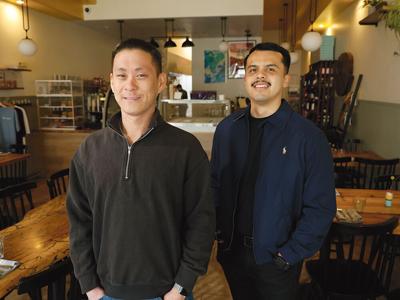

Heat Waves – the Nashville hot chicken pop-up operated out of chef Rudolfo Ponce’s eponymous restaurant in Pacific Grove – is usually mellow on Sundays, with a few diners grabbing their lunch from 11am to 6pm, or until they run out.
But this day in November was different. A DJ spinning hip-hop beckoned a line out the door of people with faces excited to see what was happening. A camera crew moved through the crowd, capturing their delight, images of the food served and – their main subject – Ponce in the background slinging chicken.
The professional camera crew is directed by Alvaro Resendiz, a recent CSU Monterey Bay film studies graduate. Resendiz is making a 10- to 15-minute documentary titled Rising Heat about Ponce’s life. The documentary has wrapped filming and is currently in post-production. Resendiz hopes to submit it to film festivals locally and nationally at the end of the year.
The theme is inspired by Ponce’s “hustle,” something Resendiz says he sees through a lens as a fellow Latino.
“I’m a big fan of The Bear, the TV show,” Resendiz says. “It felt like the same kind of vibe [at Rudolfo’s]. Both chefs wanted to accomplish the same goals.”
Ponce has never watched The Bear because he says he’s lived most of it. He was trained at the Culinary Institute of America from 2018-2019 and later trained at Michelin-star chef Thomas Keller’s restaurant Bouchon in Yountville. Like the titular character in the show, Ponce says he’s also after Michelin ranking.
“It felt like a really interesting connection,” Resendiz says. “I want to tell that story but this is an actual person.”
Unlike a scripted and fictional story, Resendiz and his team went into the restaurant with cameras on two different occasions – once during service as an Italian restaurant and on the Sunday during the Heat Waves pop-up. Resendiz told Ponce and his team to ignore them and work as if the cameras were not there – a cinematic technique he calls “find the wall.”
“All we do is try to capture the shots we want to get,” Resendiz explains.
Those include clips of people enjoying the food and Ponce working with his team, but Resendiz says the critical footage for the documentary is of the process: making food from scratch that is later transformed into the dishes.
Resendiz says he’s attempting to capture the higher standard that Ponce instills in his team and himself. Ponce was able to practice his chef standards in November at the Heritage Fire event in Pebble Beach, which brought him into an arena with other local notable chefs to challenge their farm-to-table approach over an open flame. Resendiz was present at the event to capture footage there.
“It’s really interesting how [Ponce] tries to set himself apart from everybody else and also give [attendees] an experience. Not just with the food, but with the way he interacts with people as well,” Resendiz says.
Using a documentary format to capture what Ponce goes through in the kitchen means the footage doesn’t require scripted conflicts – some of those moments naturally happened. According to Resendiz, they weren’t as dramatic as one would see in a show like The Bear.
Still, when Resendiz initially approached Ponce with the blueprint of the documentary, Ponce rejected the idea several times.
“I was pretty nervous when I was first approached about it,” Ponce says, explaining he didn’t feel like his skills were mastered enough to warrant such a narrative.
But Joe Huang, a social media influencer and real estate agent who assists with marketing Ponce’s restaurant, saw the potential. Huang, who has known Resendiz for about a decade, introduced him to Rudolfo’s. He also saw impressive feedback on Instagram about the restaurant.
“On average we’re doing about 10,000 views per video,” Huang says, then adds that it’s not about followers or views. Rather, Ponce gets feedback in real life from people who see a video and want to try his food.
Both Resendiz and Ponce agree that the documentary isn’t about publicity.
“We’re trying to capture why it’s good. We’re trying to capture the story,” Resendiz says.


(0) comments
Welcome to the discussion.
Log In
Keep it Clean. Please avoid obscene, vulgar, lewd, racist or sexually-oriented language.
PLEASE TURN OFF YOUR CAPS LOCK.
Don't Threaten. Threats of harming another person will not be tolerated.
Be Truthful. Don't knowingly lie about anyone or anything.
Be Nice. No racism, sexism or any sort of -ism that is degrading to another person.
Be Proactive. Use the 'Report' link on each comment to let us know of abusive posts.
Share with Us. We'd love to hear eyewitness accounts, the history behind an article.