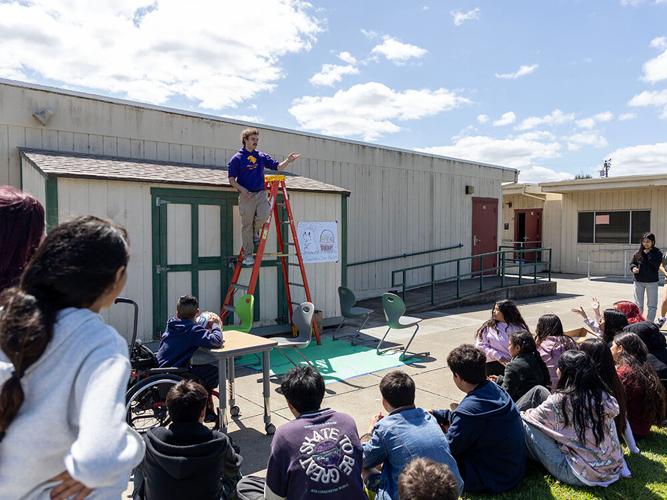

SIXTH-GRADERS IN SAMUEL SWANSON’S CLASS AT UNIVERSITY PARK ELEMENTARY SCHOOL IN SALINAS are gathered outside for today’s lesson. They’ve been in the classroom learning about concepts like kinetic and potential energy, culminating in a hands-on project. Swanson asked students to use household materials – bags, cardboard, tape – to create cushioning that could protect a raw egg from breaking when dropped from about 15 feet high.
Some students worked alone, others in groups, wrapping eggs in paper and plastic. Some even devised a parachute. “It was a really good way to get them really invested,” Swanson says.

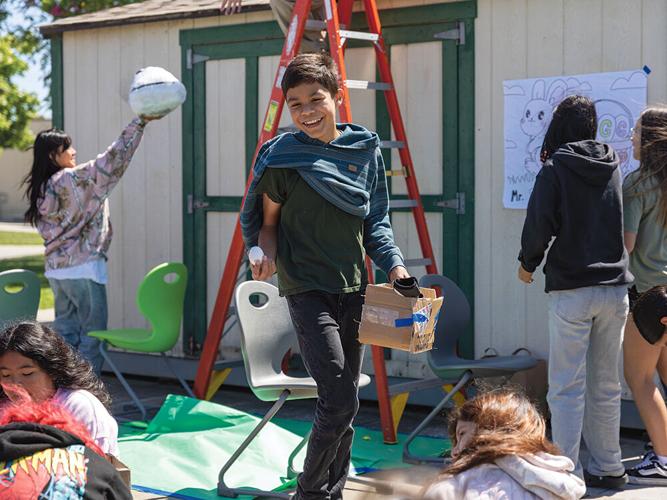
Student Noah Sanchez shares his cracked egg with the crowd.
Now, it’s time to put their work to the test. Swanson is climbing a 12-feet ladder with an audience watching. (He also invited students from other grades to witness the egg drop.) Laughs and cheers fill the grassy area where spectators have gathered for the show. One by one, Swanson drops the carefully wrapped egg packages. Some shatter on impact. For those eggs that land without a scratch, the sixth-graders proudly celebrate.
“It worked out really well,” Swanson says. The enthusiasm of this hands-on exercise is a stark contrast to students dozing off during a lecture, he says.
One of Swanson’s tricks, he says, is keeping lessons a little loose and having wiggle room to customize. Other times, he “bribes them” with crosswords or math games, which he calls a win-win because students have fun while also learning spelling, new words or multiplication facts.
Teaching is only part of what educators do in the classroom; they look at their students holistically, including behavior, social skills and emotional well-being. The job includes boosting students’ self-confidence and encouraging them to manage their time to complete their assignments. “I’m still expecting them to work really hard, put their best effort in, make good progress,” Swanson says.
Swanson has been teaching for two years and says he quickly learned flexibility. “You can never plan exactly what’s going to happen,” he adds.
School district administrators are saying something similar right now about education funding as districts across Monterey County confront shrinking budgets and issue layoff notices to teachers and staff, or look ahead to cuts in future budget years. School districts are restructuring after the end of Covid-19 funds (intended to address learning loss and mental health support), alongside ongoing issues that impact their revenue every year: a declining number of students and an increase in special education.
Of Monterey County’s 24 school districts, the Monterey County Office of Education reports that, combined, they are facing a $107.4 million deficit for the current school year.
THE BUDGETARY CHALLENGES HITTING MONTEREY COUNTY’S SCHOOLS ARE NOT UNIQUE. Across California, officials report a perfect storm fueled by declining enrollment, rising costs and the end of one-time Covid-19 funding. Thousands of staff have received preliminary pink slips. Some districts are closing schools and reducing services in an effort to keep their budgets in good standing for the upcoming three years.

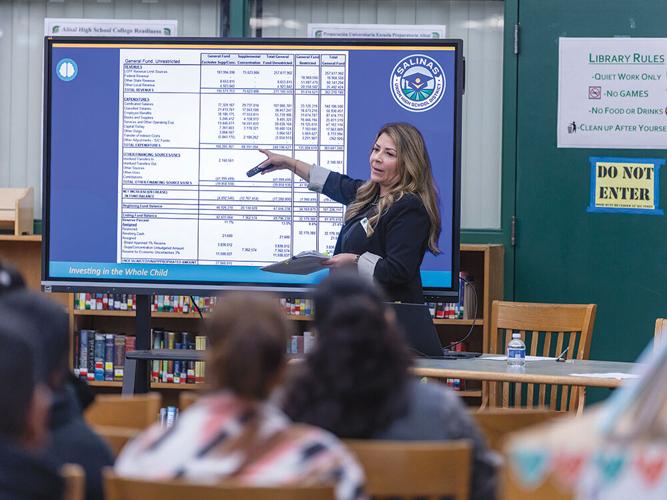
Ana Aguillon, manager of business services, presents on the budget at Salinas Union High School District’s Local Control and Accountability Plan meeting at Alisal High School. The LCAP process includes public hearings to increase transparency and solicit community feedback.
School districts experienced an unprecedented funding boost during the Covid-19 pandemic and its aftermath. It started in 2020, with funding to buy Chromebooks and Wi-Fi hot spots so schools could transition to online learning. It continued in 2021, after students returned to classrooms. The focus was shifted to addressing learning loss, combating absenteeism and providing mental health services; school districts experienced a rainfall of funds, the majority of which was one-time funding.
According to the U.S. Department of Education, Monterey Peninsula Unified School District received $30.5 million from the Elementary and Secondary School Emergency Relief Fund plus $437,259 from the Governor’s Emergency Education Relief Fund; Salinas City Elementary School District obtained $34.3 million and $189,336, respectively; and Pajaro Valley Unified School District secured $68.1 million and $923,863.
Districts used those pots of money to hire personnel, including mental health professionals and paraeducators. Now the money is not being replenished, leaving them with holes to plug.
But the loss of one-time funding is compounded by a longer-term challenge, primarily lower enrollment.
At Pacific Grove Unified School District, looking at a deficit of $2 million, the board in February eliminated five full-time positions, including four teachers and one librarian.
“Incremental adjustments are no longer sufficient. Addressing this deficit requires meaningful, difficult action,” according to a presentation by administrators to the PGUSD board on Thursday, Feb. 12.
RED INK HAS POPULATED BUDGET SPREADSHEETS ACROSS MULTIPLE SCHOOL DISTRICTS IN CALIFORNIA. In Monterey County, parents have been expressing concern to school board trustees about how cuts will impact their children’s education and socio-emotional needs.

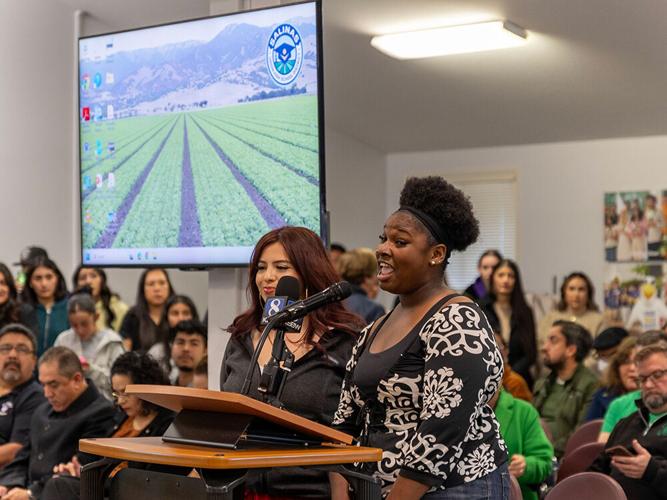
Many students got involved in speaking up during school board deliberations as officials voted on layoffs. On Feb. 24, many students spoke against the proposed layoffs of 14 staff members, including 12 restorative justice facilitators. The board unanimously approved the terminations, effective July 1.
School districts are trying to keep as many services as possible while cutting or restructuring internally to avoid deficit spending after one-time funding expired.
For weeks last winter, parents attended various MPUSD board and town hall meetings where the administration presented a fiscal stabilization plan and three alternatives to address a projected deficit: saving $4.1 million (Option 1), $3.8 million (Option 2) and $8 million (Option 3). During the town hall meeting at Seaside High School on Feb. 11, the atmosphere was tense, and several moms voiced worries about losing positions including mental health professionals and community liaisons.
The board listened to the community concerns and opted for a different alternative, saving staff positions but also saving a little less money, $3.7 million. This plan keeps community liaisons at traditional high schools and middle schools (at the elementary level, they will be reduced to part-time positions, while Central Coast High School won’t have any), as well as mental health professionals at each school.
“Although this wasn’t an easy decision… I just want to thank you, board members, for taking into consideration everybody’s worries,” Norma Aquino, community liaison at Seaside Middle School, told the MPUSD board in March. (The administration’s goal was to slash an $8.7 million deficit for unrestricted funds in half. MPUSD officials say having a healthy reserve – $28 million – helped avoid cutting the entire deficit at once.)
Other districts are also downsizing or restructuring their workforce, including Pajaro Valley Unified, Salinas City Elementary and Salinas Union High School districts.
PVUSD’s board moved forward to eliminate 160 full-time positions in December, of which 51.5 were teachers, 15 counselors and 13 mental health clinicians. In March, SCESD eliminated 61 full-time non-teaching positions, impacting 73 employees. (In April, the district rescinded 33 layoffs and most employees were reassigned. Only three people lost their jobs.) SUHSD eliminated 14 positions, 12 of which are restorative justice facilitators.
The need for counselors among the student population pushed districts to keep positions and services available longer than originally planned.
“While those positions were never meant to be permanent, the district continued to fund them for the past two years because it was clear students were still affected by the pandemic and needed extra support in the classroom,” Mary Duan, SCESD’s director of communication and outreach, says via email.
Before SCESD’s board approved the layoffs on March 10, Susana Mancera-Juárez, assistant superintendent of human resources, told the board that several of the laid-off positions were funded with one-time funds, part of which was Covid-19 relief funding.
“We tried to stretch it as much as possible, but at this point, it’s not doable,” Mancera-Juárez told the board.
In Monterey County, most school districts face a deficit on their balance sheet, ranging from $40.4 million at Alisal Union to just $14,000 at Big Sur Unified School District. Only four districts out of 24 total – Carmel Unified, South Monterey County Joint Unified, Salinas City Elementary and Washington Union (along the Highway 68 corridor) – are without a deficit.
PVUSD, MPUSD and PGUSD approved layoffs to address projected deficits of $29.3 million, $8.7 million and over $2 million, respectively.
MPUSD and PGUSD moved forward with the layoffs, with the likelihood of coming back to request additional cuts next year. (If that happens, it would be the third time in a row PGUSD faces cuts.)
PGUSD’s decision improved the district’s reserves, but Assistant Superintendent Josh Jorn told the board that a deficit is still on the books even if they approved the cuts because expenditures will continue to exceed the district’s revenue.
Most of PGUSD’s expenditures are for salaries and benefits, accounting for 85 percent of its unrestricted general fund. That means any meaningful effort to address a structural deficit necessarily involves personnel considerations.
“Our focus must be on stabilizing the district financially so we can continue serving students not just this year, but for years to come,” PGUSD Superintendent Linda Adamson said.
Jorn added it was important to seek long-term savings. “Why now?” he asked the board. “There is budget uncertainty that’s occurring on the federal side.”
SCHOOLS ARE FUNDED WITH A COMBINATION OF STATE, LOCAL AND FEDERAL RESOURCES. While all school districts receive funding from these three sources, not all pieces of the pie are distributed equally.
The U.S. Department of Education contributes roughly 8 percent of the funding for K-12 education nationwide, supporting various programs such as special education, teacher training, English instruction and low-income students. Other federal agencies, including the Department of Health and Human Services and the Department of Agriculture, fund Head Start, an early childhood education program for kids under 5, and school lunch programs, respectively.
Last year, the federal government invested $78.8 billion in education. The proposed budget for this year, released on April 3, requests $76.5 billion for education, $2.3 billion less than the 2025-2026 allocation. “The budget continues the Department of Education’s path to elimination,” the proposed budget report states.
(In 2025, President Donald Trump officially moved forward with the elimination of the department.)
In California, the state funds up to 60 percent of education for transitional kindergarten-grade 12. The state’s proposed budget for the upcoming year would increase TK-12 education funding by $11.5 billion, from $137.6 billion in 2025-26 to $149.1 billion in 2026-27.
State funds support various programs, such as transitional kindergarten, special education and supplements districts’ budgets when property taxes are insufficient to ensure the minimum funding level.
The funding is calculated using the Local Control Funding Formula, a method the state uses to calculate funding for all school districts; besides supplying base funding, it also provides additional resources for those with high-need students, low-income, foster care and English learners.
School districts in California are divided into two groups. One model is community-funded districts, which are primarily funded via property taxes. The other is state-funded districts, which rely on a mix of state funds and property taxes. School districts can’t choose between one or the other when a district’s property tax revenue exceeds what it would receive under the LCFF formula.
For state-funded districts, students’ daily attendance is a crucial factor to calculate the amount of money they receive from the state. Declining enrollment and chronic absenteeism mean less revenue. (California is one the few states that allocates funding based on average daily attendance). Chronic absenteeism is pervasive among schools with a high number of low-income students and those without permanent housing.
The Local Control Funding Formula provided base and supplemental funding based on each district’s average daily attendance. Schools with high numbers of English learners, foster youth and low-income students receive additional funding.
Monterey County currently has two community-funded districts, Carmel Unified and Pacific Grove Unified, with property taxes that exceed state funding minimums.
In general, community-funded districts spend more money per student and pay teachers higher salaries and might have smaller class sizes.
During the 2024-2025 school year, community-funded districts Carmel and P.G. spent $34,438 and $22,891 per student, while state-funded districts MPUSD and Salinas City Elementary spent $14,351 and $14,382, respectively. In the 2024-2025 school year, entry-level teachers annually; at in 2025-2026.
Next school year, Washington Union will join Carmel and P.G., transitioning to a property tax-based model (and shrinking in student body). Since 2010, WUSD has experienced a sharp decline in enrollment, losing 176 students over the decade, and has faced deficit projections. They will end the practice of accepting transfers from outside the district’s geographic boundaries.
“It’s a very difficult decision. Obviously, it has huge impacts on our school community, but if we’re going to be able to sustain this district financially over the long term, it was a necessary step,” WUSD Superintendent Gina Uccelli says. “We are fortunate in that we have a higher property tax value, so we were able to explore a different option.”
Not all districts can switch from one model to the other.
The LCFF was implemented in 2013 to increase equity among school districts and provide additional resources to high-need students.
While school districts with lower property taxes can benefit from LCFF, obtaining additional funding if they serve high-need students such as those in foster care, who are low-income or English learners, a funding gap persists between the two models.
MPUSD Superintendent PK Diffenbaugh says Proposition 13, which voters passed in 1978 and limits property tax increases in California, was a game-changer for public education – for the worse. California was formerly in the top five when it came to funding per pupil. During the 2022-2023 school year, it ranked 13th nationally. (Prop. 13 keeps property taxes fixed until an ownership transfer takes place.)
“We were the envy of the nation,” Diffenbaugh says. “It has created a very challenging tax system in terms of public schools being able to count on a certain amount of funding every year.”
He’s referring to uncertainty in income and sales taxes compared to property taxes plus the fluctuating revenue districts receive based on attendance. He and many experts would prefer a model based on enrollment, not actual attendance.
Diffenbaugh wishes there were more stable, sustainable funding in general. One-time funding, he says, is frustrating and leaves districts in limbo.
“When there are good times, it’s often given to you with an expiration date and says, ‘Great, build something great in five years and then figure out how to keep it going without the money,’” Diffenbaugh adds.
He’d also like to see more unrestricted funding that districts can spend as needed, rather than for specific purposes dictated by the state, such as after-school programs, transportation or teacher preparation “Giving school districts flexibility to spend funds based on their local context and priorities is the best way to go, because we’re closest to the work and understand our community’s needs,” he says.
Some things are not nice-to-haves, but need-to-haves, and the demand for some of those things, like special education, is continuously growing.
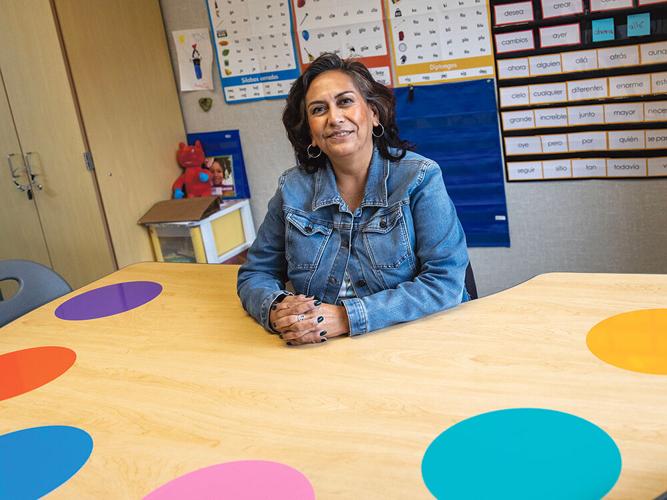
ELOINA TRUJILLO HAS BEEN A TEACHER SINCE 2010, working with kids of all ages. Currently, she’s a multi-tiered system of support acceleration specialist in Salinas City Elementary School District, working with small groups of students or providing one-on-one instruction to kids who need extra help, such as decoding sounds, understanding reading material, or learning multiplication.

Eloina Trujillo teaches students in need of additional intervention in Salinas City Elementary School District. The number of special ed students continues to rise, increasing cost pressures.
“Typically, in about six weeks, we should see some improvement,” Trujillo says. If the plan doesn’t work, she reassesses and changes the strategy. On average, Trujillo says she interacts with about 70 students per day.
Trujillo says teaching today is different than when she started 16 years ago. Now, the use of technology, tablets or Chromebooks, has become a go-to tool. Behavior has also changed. “They want the answer fast… they want immediate feedback,” Trujillo says.
She adds that kids don’t interact with each other as much as they did when she started working. “There’s a real lack of oral language development,” she adds.
Since the Individuals with Disabilities Education Act (IDEA) began in the mid-1970s, the number of students enrolled in special ed has grown; however, federal funding to support it is not enough.
“The state and federal government don’t provide enough funding for special education,” Diffenbaugh says, noting MPUSD only receives 14 percent from the federal government instead of the 40 percent of the costs per student promised by IDEA.
Special ed provides free, tailored education for 3- to 21-year-olds. The number of special ed students enrolled in Monterey County has climbed from 9,628 in 2020-2021 to 11,472 in the 2024-2025 school year.
At Alisal Union, which has a student population of 7,500, roughly 1,100 pupils have an Individualized Education Program, a plan developed for special education students based on their specific needs.
Satwat Rais, director of special education at Alisal Union School District, says awareness and better testing are two contributing factors in the increase of students enrolled in special education.
“More and more parents want their children evaluated, which is slightly different from what happened 20 years ago,” Rais says. “The awareness is there. The support is here.”

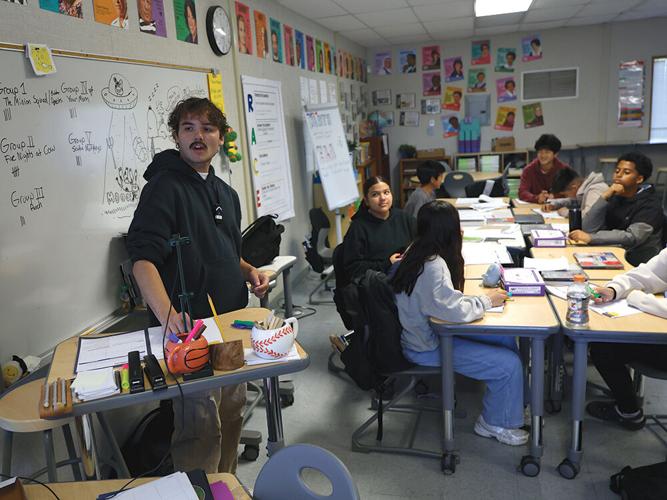
Teacher Samuel Swanson diversifies his lessons to fit the needs of his students, whose skill levels range from kindergarten to college level.
Another variable impacting school districts’ revenue is declining enrollment. While districts can’t reverse this demographic trend – there are aging populations and fewer school-age children – they can take measures to retain more students by being rigorous when approving interdistrict transfers (allowing children to attend schools in other districts).
At SCESD, the administration decided they would only authorize transfers based on four reasons according to California education code, including children of parents in the military; being bullied or expelled; or attending school in the area the parent works.
Esteban Hernandez, SCESD’s executive director of pupil personnel services, says that up to 300 students who live in district boundaries transfer to other school districts every year. “We are hoping to cut that number at least in half,” Hernandez says.
Washington Union is a unique district in Monterey County. Nearly 44 percent, or 327 students, of its current student population are interdistrict transfers. (WUSD has decided to phase out its interdistrict transfer program, shrink its student population and switch from being a state-funded to a community-funded district.)
The new model for Washington Union will mean fewer students, but also more money per child. During the 2024-2025 school year, the district spent $11,364 per pupil, the lowest in the county; with the new funding method, its spending would be similar to districts in South County, about $15,600. Uccelli says it will take the district about three years to fully transition into a property tax-funded district.
District administrators say birth rates, high cost of living (pushing young families to move away) and interdistrict transfers are all impacting their student population. “We’re losing revenue year after year,” Diffenbaugh says, noting the district has 50-70 fewer students every year. (Since a transitional kindergarten expansion that started in the 2022–2023 school year, declining enrollment has slowed down.)
According to the Public Policy Institute of California, California overall has experienced declining enrollment for eight consecutive years. During the 2024-2025 school year, enrollment fell in 57 percent of districts. New data from the state shows that the education system lost 75,000 students in the 2025-26 school year.
According to the National Center for Education Statistics, enrollment will continue to drop in the upcoming years. In recent years in Monterey County, MPUSD closed three schools – Highland and Foothill elementary schools in 2022 and Colton Middle School in 2023 – as a result of its declining enrollment. Pajaro Valley Unified is currently exploring school closures to address declining enrollment and a shrinking budget.
Adamson says school districts are in transition and she expects they will stabilize overtime.
“Districts are recalibrating and working toward more sustainable, long-term planning,” she says. “The focus remains on protecting the core of what matters most – student learning, well-being and strong school communities. This moment is pushing us to think more strategically about how we use resources and how we design systems that are both effective and sustainable.”
(0) comments
Welcome to the discussion.
Log In
Keep it Clean. Please avoid obscene, vulgar, lewd, racist or sexually-oriented language.
PLEASE TURN OFF YOUR CAPS LOCK.
Don't Threaten. Threats of harming another person will not be tolerated.
Be Truthful. Don't knowingly lie about anyone or anything.
Be Nice. No racism, sexism or any sort of -ism that is degrading to another person.
Be Proactive. Use the 'Report' link on each comment to let us know of abusive posts.
Share with Us. We'd love to hear eyewitness accounts, the history behind an article.