

IT’S A BRISK, LATE AFTERNOON ON FEB. 23 when Tim Flanagan, general manager of the Monterey Regional Waste Management District, steps up to a podium to deliver remarks to a smiling crowd at a ribbon-cutting event for the district’s new materials recovery facility in Marina.
It’s a location that, imprecisely, is often referred to as “the dump,” because it’s also the site of the landfill that serves much of Monterey County, including the entire Monterey Peninsula.
“Thank you everybody for coming here tonight,” Flanagan says cheerfully – he’s a cheerful guy – and after introducing himself, he adds, “The card in front of me says to remind everybody that this is big!”
The crowd of about 100 people erupts in cheers and applause.
This is Big.
That is the slogan of the ribbon-cutting event, which is celebrating the opening of the new MRF – in the industry lingo, it’s pronounced “murf” – that has been more than five years in the making, and is affectionately referred to in the agency as the “MRF 2.0,” which is now capable of processing curbside recycling materials, an upgrade from the older MRF that’s been on-site since 1996, and which has exclusively processed construction and demolition debris.

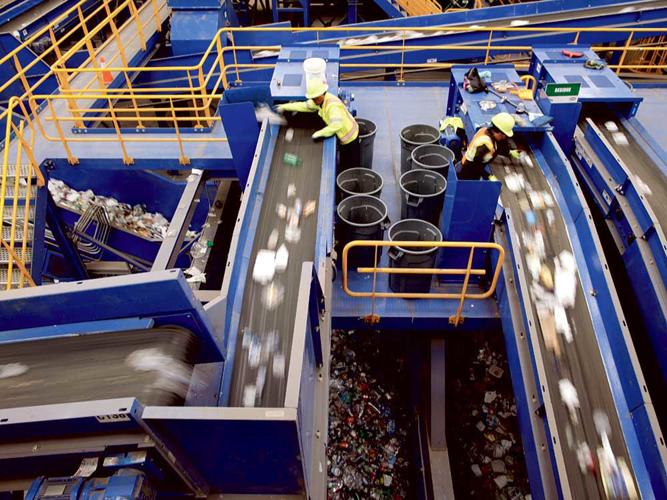
The workers at MRF 2.0 are striving to get their picking speed up to a pick per second.
A few minutes later, Flanagan introduces Marina Mayor Bruce Delgado, chair of the MRWMD board, but before Flanagan cedes the stage, he turns everyone’s attention to the “tsunami of recycling” on the floor of the MRF to his left. “That’s the goal of this district,” he says. “Our mission is to turn waste into resources, and that’s what we hope to provide you with this facility.”
It’s also the perfect cue for Delgado, a member of the Green Party.
“Woohoo!” Delgado says as he takes the stage. “Turning waste into resources! Alright! My heart is all over this place, because I think it’s so important we live responsible lives, and one of the most responsible things we can do is give an Earth, and a planet and a river system, and an air system, to our… generation ahead of us, so they too have access to a wonderful life like we’ve had.”
County Supervisor Luis Alejo follows Delgado, and notes that the supervisors created the district in 1951, at a time when garbage was being burned on the beach in what is now Sand City. “It’s hard to believe,” Alejo says, noting how far the region has come.
Alejo then introduces U.S. Rep. Jimmy Panetta, D-Carmel Valley, who recalls trips to the “dump” in his youth in the 1970s, when he would throw trash off the back of his grandfather’s ’58 Chevy pickup.
“Fortunately, things have changed,” Panetta says, to laughter, before elaborating on more enlightened waste disposal practices that California has helped facilitate through laws that regulate diversion rates to landfills, and seek to lower greenhouse gas emissions to fight climate change.
“The opening of MRF 2.0,” Panetta says, “translates not just throughout our community, not just throughout the state, not just nationally, the opening of MRF 2.0 translates globally.
“We are lowering greenhouse gas emissions. We are ensuring that the materials and resources are recovered, and that our waste streams turn into economic opportunities. And we are fighting for something, and something that is a hard thing to do – I can tell you now in Washington, D.C. – but we are fighting locally against climate change. That’s what this is about.”
Flanagan, who is still smiling, comes on again after Panetta, and says that while the landfill has a capacity to take in waste for more than 120 years, he says the goal is to never exhaust that. Instead, he envisions “a perpetual landfill, because of what we have behind us, and our ability to turn waste into resources.”
It’s a poignant moment, and the culmination of years of work and planning.
But it also comes at the most precarious time in decades for the recycling industry, and how much value those resources will retain remains an open question.
That’s because China – independent of the current trade war that’s brewing due to the recent tariffs proclaimed by President Donald Trump – announced a new policy in July 2017 that the country would be cutting many imports of recyclables into their country because the loads contained too much waste.
In essence, the policy – which is being called “National Sword,” or “Border-gate Sword” – states that China no longer wants the world’s trash.
China’s new policy officially went into effect March 1, just weeks after the conveyor belts at MRF 2.0 started moving, and it has sent the markets for some recyclable commodities – mixed paper and plastics, most notably – into a state of upheaval.

While machinery is key at any MRF, people on the sort lines are essential to eliminating contamination.
IN THE EARLY DECADES OF THE 20TH CENTURY, the Monterey Peninsula’s only three cities at the time – Monterey, Pacific Grove and Carmel – dumped their trash on the beach of what is now Sand City, west of Highway 1 on Playa Avenue. The dump was owned by Dr. John Roberts, founder of the community of Seaside, and the visionary who helped create Highway 1 in Big Sur.
By the early 1940s, as Fort Ord and World War II were ramping up, conditions at the dump ran afoul of state and county regulators.
A Dec. 18, 1940 article in the Monterey Peninsula Herald states that the county’s health inspector said, “The dump has become a thriving breeding ground for rats which are spreading to all parts of the Monterey Peninsula and that because of the development of nearby Fort Ord the place constitutes a steadily increasing health menace.”
State regulators, however, had no problem with the dump carrying on so long as the trash was buried in sand daily.
The region, and the state, have come a long way since. The Monterey Regional Waste Management District was formed in 1951 to find a better way to dispose of our trash, and the current landfill site in Marina opened in 1965.
In 1996, the district’s first MRF went online, and had diverted more than 1 million tons of construction and demolition waste by 2012, when the district’s board moved to upgrade the facility to process mixed waste – i.e. recyclables.
The impetus for the upgrade was in part to comply with AB 341, a 2011 state law mandating that at least 75 percent of solid waste be diverted from landfills by 2020.
At the time, the district’s recyclables were collected and then processed in Watsonville, under a contract with Texas-based Waste Management, and the new MRF, as it was envisioned, would not only help ensure the district was complying with state law, but it would also give the district a chance to earn more revenue, rather than letting Waste Management keep the profits.
In 2013, however, China announced its “Operation Green Fence,” a precursor to National Sword. It increased inspections of imports of recyclables, in an effort to curb an increasing flow of waste that was overly contaminated with food and other trash, and which signaled China’s discontent with taking in so much of the world’s garbage.
The policy, so far as China’s leaders were concerned, didn’t have the desired effect – it wasn’t strict enough – which is why they implemented National Sword. Among other things, the new policy requires the contamination of mixed paper and plastic loads to be less than 0.5 percent.

While there are robust domestic markets for recycling glass and aluminum, MRWMD’s Tim Brownell says the district exports roughly 40 percent of its plastic recyclables and about 60 percent of its paper.
Tim Brownell, MRWMD’s director of operations, is hopeful he can meet that limit, but he’s not certain.
“That’s a very difficult goal to achieve,” he says.
Currently, he says, the MRF’s mixed paper is at about 1.5-percent contamination, but he’s working on bringing that level down – it’s still early days for MRF 2.0.
Which is an important point: Because the MRF is brand-new – Brownell says it’s in the top 10 percent in the nation so far as high-tech machinery goes – it’s better positioned than most to meet that goal.
Yet how things will shake out long-term remains to be seen. National Sword has upended some of the recycling industry’s markets, and in some parts of the state, and country, recyclables are being intentionally buried in landfills because there’s nowhere else for them to go.
That’s because China was the primary importer of the world’s recyclables, particularly mixed paper and mixed plastics, which leads to a key point that is often overlooked, or misunderstood, by the wider public: Recyclables are commodities, and whether or not they get recycled depends on whether or not anybody wants to buy them, and recycle them.
When there’s no buyer, recyclables are just trash.
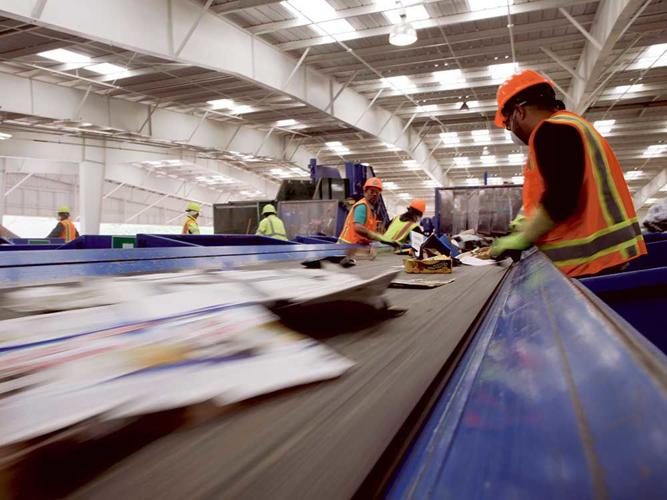
While machinery is key at any MRF, people on the sort lines are essential to eliminating contamination.
RECYCLING IS NOT ROCKET SCIENCE, but from a consumer’s standpoint, it can be complicated.
Some parts are simple – it’s relatively easy to get people to throw their glass and aluminum in a recycling bin – but where it gets most confusing is with plastics.
For one thing, the chasing arrows around a number (1-7) on plastics does not mean the product will get recycled. Those arrows – which suggest recyclability – are what the plastics industry has chosen to put around the numbers, which indicate the type of plastic it is.
In the recycling industry, they call that type of deceptive marketing “greenwashing,” as it can make consumers feel better about using a disposable, single-use product.
In order for plastic to get actually recycled, it has to get sorted into a batch of plastic of the same type – each type has a unique molecular structure – which is one way MRF 2.0 is well-positioned to meet more stringent quality demands on the open market.
The MRF has machinery that sorts plastics optically, and then air jets shoot it off to join plastics of the same type – it’s a remarkable thing to watch.
In the new global order of recycling markets brought on by National Sword, that type of technology is key, because it minimizes contamination due to human error.
Which speaks to the biggest takeaway from MRWMD’s MRF 2.0: The 100,000-square-foot building, outfitted with a $24 million upgrade of equipment, is optimized to deal with consumers’ collective ignorance, or ambivalence, and has state-of-the-art machinery to separate most materials with machines.
Magnets, for example, pull metals. Fiber – i.e., paper – climbs up ladders of rotating wheels, sending three-dimensional items (i.e., not paper) downhill.
Nonetheless, human workers remain key to minimize contamination – machines, like people, aren’t perfect – and sort what the machinery can’t. They also pull plastic bags that get tangled up in gears. (Plastic bags are the bane of every MRF.)
Humans are also necessary to pull things off the line that Brownell calls “wish recycling”: Things that people put in the recycling bin hoping they can be recycled. (The main thing Brownell says the district gets in that regard are garden hoses – “I see them all the time,” he says.)
MRF 2.0 is also optimized for making the ideal end-product for a MRF – a bale of recyclables that’s as dense as possible. That’s made possible by a German-made PAAL baler, the first of its kind in America, that can bale 40-plus tons of material in an hour.
The district got it, Brownell says, for about half-million dollars.
“We got a great deal, being the first,” he says.
And because it can make those bales at high-density, it reduces transportation costs when the district sells them to a domestic or overseas buyer, because it’s less space per-pound on a truck, ship, or train.
That factor is key, because the market for recyclables, and the potential profit margin in selling them, is getting ever tighter.

One city on the Monterey Peninsula that does not send its recyclables to the new MRF.
ON JAN. 23, ZOE HELLER, ASSISTANT DIRECTOR OF POLICY DEVELOPMENT at CalRecycle – the state’s recycling department – delivered a presentation at the department’s monthly meeting about National Sword. It was the first time, on the state level, the subject was brought up in public.
She presented data about the state’s recyclable exports, and how the ban would affect the markets. The data is sobering: In 2016, California exported about one-third of its recyclables, a total of about $4.58 billion. Sixty-two percent of that went to China, most of it being mixed paper.
The good news is, other markets are opening up, though not at the same price.
But the aim for MRF 2.0 is to meet China’s new standard, although it’s so far been tough.
“We’re particularly feeling it on the paper side,” Brownell says. “Those specifications are so tight, it’s very difficult to meet that. We’re having to ship to other markets – Thailand, Vietnam, Indonesia – and the value is much less. Right now, we’re not getting anything for that material dollar-wise.”
One reason why paper’s so tough, Brownell says, is that on top of the strict 0.5-percent contamination restriction, there is also a moisture restriction of less than 12 percent. “Generally, there’s 5 to 10 percent moisture in the air,” Brownell says.
But he also says he understands where China’s coming from: It takes about three months for recyclables to ship back to China, and moisture in paper causes it to decompose, which can turn it into garbage that is destined, at best, to a landfill.
Brownell, who managed a MRF in Minnesota for 15 years – he worked at another in Michigan before that – was hired onto MRWMD to oversee operations, and is making tweaks as the MRF works through its opening weeks. He remains cautiously optimistic.
“It’s going to take us a few months to see what quality we can make, but we anticipate at a minimum the MRF will cover its costs,” he says. “Even in these markets.”
That’s despite the fact, Brownell says, “that paper markets everywhere else are piggybacking, and also asking for higher quality, though not as rigid as China.”
Brownell is a career recycler, and is looking at the upside in it all.
“Our product has to get better. It’s not a bad thing,” he says, adding that he’s continuing to train the workers on the sort lines, and that the district is considering increasing the number of them. This is despite the fact that the MRF is designed to require as little manpower as possible. “We’re trying to get our people to do 60 to 65 picks per-minute,” he says. “It takes people a little while to get up to that speed.”
THERE IS EVERY REASON TO BELIEVE THAT MRWMD’S MRF 2.0 will be a smashing success.
The district’s employees are passionate – one gets the sense that every one of them is a true believer.
But, if there’s to be any real improvement in our recyclable waste stream – especially in light of China’s new policies – many in the industry argue that change needs to happen on the packaging level, and that disposable products that aren’t easily recyclable should be banned from the waste stream altogether. Mostly, that means plastics.
Laura McKaughan, board president of the Northern California Recycling Association, is among those making that argument, but she concedes it will be an uphill battle.
“Manufacturers are putting out increasingly complicated packaging, really unchecked, and it’s resulting in us playing catch-up all the time,” McKaughan says.
“These packaging manufacturers have a lot of money,” she continues, “but it’s the work that has to happen if we’re ever going to have recycling.”
She also believes America has to start taking more responsibility for its trash, and create markets domestically to process our recyclable material into new materials.
If that were to happen, she says, policies like National Sword could be shrugged off.
“China doesn’t want to accept material from us? Big deal. We have our own markets,” she says, imagining an ideal landscape that does not yet exist.
Even in the landscape that does exist, however, Brownell says that the new MRF – while needing some tweaks – has mostly insulated the district from market disruptions: Prices for some things may be down, but the district hasn’t had to send any stockpiled bales to landfill yet, which Brownell attributes to the efficiency of the MRF’s systems.
“It gives us a fighting chance,” Brownell says.
(0) comments
Welcome to the discussion.
Log In
Keep it Clean. Please avoid obscene, vulgar, lewd, racist or sexually-oriented language.
PLEASE TURN OFF YOUR CAPS LOCK.
Don't Threaten. Threats of harming another person will not be tolerated.
Be Truthful. Don't knowingly lie about anyone or anything.
Be Nice. No racism, sexism or any sort of -ism that is degrading to another person.
Be Proactive. Use the 'Report' link on each comment to let us know of abusive posts.
Share with Us. We'd love to hear eyewitness accounts, the history behind an article.