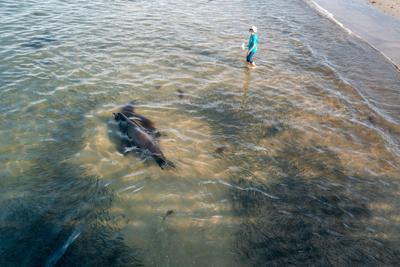

Katie Rodriguez here, still replaying the frenetic feeding fiasco that I witnessed last Friday at Monterey’s Wharf II in my head.
After seeing a post on Reddit that showed thousands of anchovies flopping onto a local boat ramp, my editor Sara Rubin and I went to check it out in person.
We arrived in the afternoon, parking alongside people lined up on the pier looking over the shoreline. It was a noisy scene: phones were out, people were laughing, sea lions were barking and birds were squawking—circling above and plunging into the water.
There are certain wildlife moments that just immediately put you in a trance, drawing your undivided attention to watch similar events unfold again and again, for hours. This was one of those sights, where the scene of one animal going after a fish was just as entertaining as the last.
There were so many anchovies that the local sea lions and seabirds didn’t even appear to be hunting for sustenance, but instead, for fun. Seagulls would lift the fish up into the air, sometimes catching in their mouth and eating, and other times unconcerned with whether the fish ended up in their mouth or on the sand.
There looked to be tens of thousands of anchovies swimming in unison together, cutting through crystal clear blue waters. As waves crashed on shore, hundreds of small silver fish tails fought hard against the water, pushing them to the sand.
Of course, some did not make it, and instead ended up flopping limp on the shore only to be poked and prodded by swarms of seagulls and beachgoers. I was fascinated by these two kids with butterfly nets catching the fish and piling them in a bag.
When I asked what they were going to do with them, they said “eat them.” Zooming out, we humans were just another animal in the equation, staring back at the sea lions barking at us standing up on the pier, having fun in the midst of a fish frenzy.
The question on many minds was: Is this normal? What’s going on?
On the pier, I overheard one man on FaceTime explaining all of his theories for why these fish are here in such great quantities. Another person, who said he was a crab fisher, stopped us on the beach to explain that the anchovies rush close to shore to seek refuge from feeding whales.
Is any of that true? I wondered. What could these large groups of fish be telling us about what’s happening out in the ocean?
So, I talked to a marine biologist at the Monterey Bay Aquarium Research Institute who has been conducting research on anchovies since they started arriving en masse around 2014.


(0) comments
Welcome to the discussion.
Log In
Keep it Clean. Please avoid obscene, vulgar, lewd, racist or sexually-oriented language.
PLEASE TURN OFF YOUR CAPS LOCK.
Don't Threaten. Threats of harming another person will not be tolerated.
Be Truthful. Don't knowingly lie about anyone or anything.
Be Nice. No racism, sexism or any sort of -ism that is degrading to another person.
Be Proactive. Use the 'Report' link on each comment to let us know of abusive posts.
Share with Us. We'd love to hear eyewitness accounts, the history behind an article.