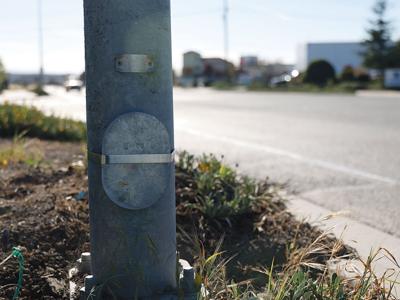

Over the past couple of years, as the price of copper has climbed, so too has a related issue in the Salinas cityscape: streetlight outages.
Thefts of copper wire usually happen at night, with wires ripped out, affecting multiple fixtures. “We’ll lose seven, eight lights when they do that,” says David Jacobs, Salinas’ public works director.
City officials have replaced the wire, and added heavy-duty hand-holds and lids to prevent theft. Public Works doesn’t have a dedicated crew to address street maintenance, but this issue became a need. “The city manager wanted us to increase the rate of fixing lights so he said, ‘Let’s get a contractor on board,’” Jacobs adds.
The uptick began in 2023 in industrial areas, such as the intersection of Work Street and Elvee Drive. Now it is more widespread, impacting major streets including Laurel Drive, Constitution Boulevard and Sanborn Road. “They tend to hit the bigger streets – the collectors and arterials – because they have the bigger wire in it,” Jacobs points out.
Repairs cost $8-$10 per linear foot (to Public Works) and $12-$14 to Francis Electronics LLC, the contractor. They can repair up to 600 linear feet per day; repairing a mile can take up to a week-and-a-half.
“There’s almost no way to make anything theft-proof and we’re spending a lot of money to replace this copper wire,” City Councilmember Andrew Sandoval says.
This fiscal year alone the city has spent $359,203 on streetlight repairs with more on the way, budgeted at a $136,000 price tag.
Copper theft isn’t unique to Salinas; it’s impacting cities across the country including Los Angeles and San Jose. Many affected cities are exploring or transitioning to solar street lights.
While switching to solar seems like a straightforward solution, it comes with a higher up-front cost.
Replacing the wire between two street lights 300 feet apart costs between $1,800-$3,600 per light. A solar light ranges from $5,000 to $9,000 each, and might need additional foundation or a new pole. Salinas has 6,750 streetlights citywide and turning to solar could cost in the range of $120 million to $150 million.
Still, Sandoval says he wants to see a plan to switch solar soon, noting several parks are in the dark.
“We’re looking at some pilot solar options, one to see how they perform, and two, to see if they’re scalable,” Mayor Dennis Donohue says, while noting that meanwhile, repairs of traditional lights are underway.
The city is in the process of preparing to launch a pilot program with 27 solar streetlights at a cost of $515,000. The lights will be on Roosevelt between Kern and Madeira streets, in an area that is experiencing increased prostitution and human trafficking.
Jacobs says one reason they chose this area is because they expect it to be relatively faster to bring lights in that don’t require electrical connections – with the added benefit that it might mitigate criminal activity. “It was the best of both worlds,” he says.


(1) comment
They should consider using overhead power lines before expanding the solar pilot program. Overhead might be a low cost way to deter theft instead of putting heavy batteries and a solar panel sail up top that each require a stronger and more expensive pole. Also remember that current state law restricts private property lights from shining into the public right of way, even though extra light would also be helpful here.
Welcome to the discussion.
Log In
Keep it Clean. Please avoid obscene, vulgar, lewd, racist or sexually-oriented language.
PLEASE TURN OFF YOUR CAPS LOCK.
Don't Threaten. Threats of harming another person will not be tolerated.
Be Truthful. Don't knowingly lie about anyone or anything.
Be Nice. No racism, sexism or any sort of -ism that is degrading to another person.
Be Proactive. Use the 'Report' link on each comment to let us know of abusive posts.
Share with Us. We'd love to hear eyewitness accounts, the history behind an article.