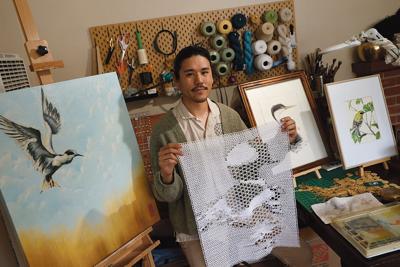

Some people became sourdough bakers, crafters or marathon runners for a spell during the Covid shutdown. J. Kai Maeda became a fiber artist and a painter – and he still is. The 33-year-old was living in his native North Carolina at the time he first picked up crochet. He relocated to Pacific Grove during the pandemic. He joined the Monterey Knitting Social Club which meets every Sunday at East Village Cafe and continued to cultivate his skill, not just in making useful items like towels and sweaters, but also fine art, recently producing two stunning tapestries with filet crochet stitching, both depicting birds.
The smaller tapestry, about 1-and-a-half-by-2 feet, depicts a bufflehead duck that Maeda photographed. The larger piece, about 3-by-4, shows an upside-down ibis. It is inspired by the tragic short story “The Scarlet Ibis” by James Hurst. It follows two brothers, one of whom is ill; the older brother tries to help but actually hurts.
“There are both brothers inside of everyone,” Maeda says. “The one that is hurt, the one trying to help, but in a selfish way. What we need is more of a tenderness, and appreciation of who we are in nature.” He tries to capture that in his art.
Weekly: Tell me about this big, beautiful tapestry, inspired by “The Scarlet Ibis.”
Maeda: It has to do with seeing the beauty in things that are broken, fragile or out of place. In North America we get a lot of white ibises, and the scarlet ibis is a South American bird that is blown off course by a storm to an unfamiliar place.
Do you feel like you have been blown off course?
Life is constantly testing everyone. It’s like the saying, “you can’t control the tides, but you can steer your ship.” There’s only so much that you can control.
I appreciate the beauty in things that are fragile, broken or unfinished because I have felt all those things at one point. Every time I am working on a piece like this, I find elements of that story that I can relate to in my life.
You have two tapestries here that show birds. What is the connection?
I am a birdwatcher – it’s one of my favorite things to do, it feeds my soul. Birdwatching is definitely not guaranteed; it’s like thrifting. Some days you’ll get something really special and other days, you don’t see much.
Is there a particular bird you are excited to hear or see?
A bird that gave me a visceral reaction was this American kestrel [Maeda shows a photo, now the background image on his phone] at Point Lobos. It’s such a charismatic bird, even though it’s small.
You studied marine biology in college, and seem to still be connected to that in your art.
My love for nature is what drove me into the sciences. I wanted to be a Jane Goodall or Steve Irwin when I was a kid; I loved Animal Planet. I have a sciency part of the brain and this whole creative part. I didn’t have that much of a creative outlet before the pandemic.
You seem to have advanced quite quickly as both a painter and a fiber artist. How did you do that?
It’s more dedication than talent. Crochet is two stitches, you just do it over and over and over again. It’s more the commitment to finishing a project, having discipline to work on a piece for months without giving up. I truly think that anyone can pick up crochet in a weekend. Some people get mentally or physically bored.
Can you crochet all day?
I have a little tendon issue in my thumb. I have to remind myself every hour or so to stop and stretch my hands.
If my hands would let me, I truly could crochet for hours. Not only does it keep my hands busy but it calms my mind down as well. I find it to be a really good way of meditating, just being in my body.
You’re also wearing a sweater that you made.
Crochet cannot be made with a machine. That is one of the things I was drawn to with crochet.
Handcrafting is kind of a resistance – it’s slowing down, being mindful, not being so consumed with productivity. If I were to charge money for this, it would be so much money because of the time. I’m not doing this to make money, and that’s the point, it’s kind of like fiber-punk. A way to slow down is what I really appreciate about the craft, especially in a world that is trying to speed things up in a way that is unsustainable.


(1) comment
The article's subject is too modest. To turn a photograph into the crocheted image of a bufflehead shows incredible talent. Bravo on taking crochet into new realms!
Welcome to the discussion.
Log In
Keep it Clean. Please avoid obscene, vulgar, lewd, racist or sexually-oriented language.
PLEASE TURN OFF YOUR CAPS LOCK.
Don't Threaten. Threats of harming another person will not be tolerated.
Be Truthful. Don't knowingly lie about anyone or anything.
Be Nice. No racism, sexism or any sort of -ism that is degrading to another person.
Be Proactive. Use the 'Report' link on each comment to let us know of abusive posts.
Share with Us. We'd love to hear eyewitness accounts, the history behind an article.