
If you think that mochi is Japanese ice cream, it’s time to look beyond the trend.
Even though mochi ice cream is the most popular – and arguably the most delicious – mochi treatment in American culture, those colorful, round ice cream bites are only the tip of the mochi iceberg.
Mochi is a traditional Japanese cake made from glutinous mochigome rice that varies in both shape and filling. It is a popular snack in Hawaii, South Korea, Taiwan, Cambodia and Thailand, as well as the home islands. And in the case of mochi, its tradition is rich.
For Larry Oda, current national president of the Japanese American Citizens League, and his wife, Anne Oda, the favorite presentation of mochi is to toast the cake and serve it with soy sauce and sugar.
“Rice represents wealth,” Anne says. “It’s a symbolic, celebratory food.”
“In the Samurai culture, rice was used as money,” Larry adds.
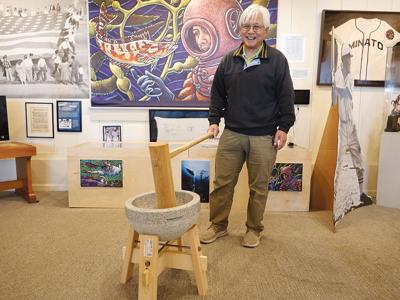
The couple lives in Monterey, and Larry Oda is one of the people in charge of the JACL Hall downtown. There, once a year in early September, he demonstrates how mochi has been traditionally made for the mochitsuki New Year’s ceremony, when members of the community can try pounding out some mochi to the beat of taiko drums.
“It’s a very slow, laborious process and you have to be careful with your hands,” Larry says, presenting the traditional mochi-making equipment: a bowl made of a tree trunk, a wooden mallet and big wooden hammers.
Mochigome is steamed and pounded with a mortar and pestle to begin the process. The rice cakes are then shaped into various forms, most commonly flattened spheres. Typically, three or four people pound and another turns the vessel so the cake is even.
That’s the old method, but the effort is worth it, because mochi symbolizes good fortune, longevity and family. These days, anyone can get a mochi maker machine for less than $100 and have cakes ready in 30 minutes.
“You can freeze them or share them with family and friends,” Anne suggests.
The origins of mochi are not known, though it is believed to have emerged shortly after the introduction of rice cultivation – approximately 2,000 years ago. From the early Heian period (794-1185) onward, mochi has been served as a common ritual offering in both Shinto and Buddhist traditions. For centuries, the preparation of rice cakes for special occasions – such as seasonal festivals – has been an important means of fostering community bonds.
Although mochi are consumed throughout the year, they play a particularly significant role during New Year celebrations, when vast quantities are prepared in a wide variety of forms and flavors. During this period, mochi with vegetables is also served in a special festive soup called zōni. In Japanese homes, to welcome the New Year deities, it is traditional to place a stack of two round rice cakes known as kagami mochi.
“Every New Year’s we would have zōni, a broth with mochi, vegetables and fish cakes,” Anne says.
Familiar forms are easy to find – Ocean Sushi Deli in Monterey and Kim’s Oriental Market in Seaside are among the options. But a new mochi world has emerged. A large mochi ice cream refrigerator stands in such places as East Village Cafe in Monterey. Cong N Go and Lilikoi Boba in Seaside make mochi donuts.
They can be filled with anko – a paste made from red adzuki beans – or with strawberries; alternatively, they may be rolled in black sesame seeds, dusted with roasted soybean flour, or colored green through the addition of powdered yomogi leaves.
The young generation bakes with mochi, eating them sweet as daifuku (stuffed with red bean) or Hawaiian butter mochi. Some recipes play with peanut butter and jelly.
Mochi ice cream was invented in 1981 by South Korean Lotte Corporation, even though no sticky rice nor actual ice cream was used in the process. The idea was picked up by American company Mikawaya that began production in 1993. It comes in many flavors, from mango and chocolate to plum wine or yuzu.
Asked about mochi ice cream, Larry and Anne Oda shrug. They explain that only a tiny bit of this product is actual mochi, a thin pounded rice layer wrapped around ice cream.
(0) comments
Welcome to the discussion.
Log In
Keep it Clean. Please avoid obscene, vulgar, lewd, racist or sexually-oriented language.
PLEASE TURN OFF YOUR CAPS LOCK.
Don't Threaten. Threats of harming another person will not be tolerated.
Be Truthful. Don't knowingly lie about anyone or anything.
Be Nice. No racism, sexism or any sort of -ism that is degrading to another person.
Be Proactive. Use the 'Report' link on each comment to let us know of abusive posts.
Share with Us. We'd love to hear eyewitness accounts, the history behind an article.