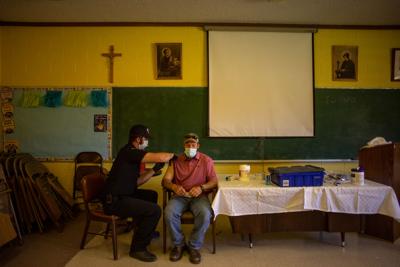

The Monterey County Board of Supervisors voted 4-1 on Tuesday, March 8 to extend the VIDA program, a countywide community health worker initiative that has been instrumental in providing Covid-19 resources across the county.
The request included investing $1.5 million in unspent funds from the American Rescue Act, specifically funds allocated to the Great Plates Delivery Program. The funding will enable VIDA to continue at its current staffing level, the 48 community health workers, until Dec. 31.
Supervisor John Phillips was the only dissenting vote. He disagreed with the nine-month time frame, voicing concerns that it could turn VIDA into a permanent program. (Phillips suggested an alternative of a six-month extension, at a cost of $750,000.)
VIDA started in March of 2021, with 125 community health workers, as a program to help hard to reach populations across the country and lower the spread of Covid-19 in areas highly impacted by the virus using $4.9 million in county funds; since then it has downsized to 48 workers.
The county funds were set to end on March 31 and without these additional $1.5 million, the program would have continued to operate but at a lower capacity, with 18 community health workers instead of 48, for two additional years.
VIDA community health workers have combated misinformation, built trust and provided resources (including outreach on things like rent and utility assistance, administering rapid Covid-19 tests, and offering information on how to shelter and isolate) for thousands of residents.
“Seeing the 93905 zip code [one the most impacted areas] with 100-percent vaccination rate is absolutely amazing to me,” said Supervisor Mary Adams.
From February 2021 to January of 2022, over 25,000 people received assistance. Of those, 90 percent were Latino, 57 percent were women and 70 percent received help in Spanish.
In addition to that, VIDA also administered 21,000 rapid tests and signed up over 7,000 residents for Covid-19 vaccinations.
“Those are not data points but actual families, parents and children that have been helped,” said Michael Castro, community initiatives manager at the Community Foundation for Monterey County, which administers the VIDA program.
The success of the program attracted $5.6 million in addition funds from outside sources including $1.3 million from the Packard Foundation, $400,000 from Together Towards Health, a $3.9 million from a federal health literacy grant.
The program will continue to evolve as needs arise such as being prepared for possible surges or new variants, making testing sites accessible to residents, increasing boosters and vaccination rates among children.
Krista Hanni, program manager for the Monterey County Health Department, said in the near future VIDA workers could become community health workers through Medi-Cal at healthcare facilities providing information not only about Covid-19 but other illnesses such as diabetes or heart diseases, and get reimbursed by insurance.
One example of diversifying the tasks VIDA workers perform, could be signing up people who are 50 and older for Medi-Cal while attending a vaccination clinic. (On May 1, California residents will become eligible for Medi-Cal regardless of immigration status.)
Supervisors inquired if VIDA’s focus could better reach the Indigenous and African American communities, since these groups have lower vaccination rates than other populations within the county.


(0) comments
Welcome to the discussion.
Log In
Keep it Clean. Please avoid obscene, vulgar, lewd, racist or sexually-oriented language.
PLEASE TURN OFF YOUR CAPS LOCK.
Don't Threaten. Threats of harming another person will not be tolerated.
Be Truthful. Don't knowingly lie about anyone or anything.
Be Nice. No racism, sexism or any sort of -ism that is degrading to another person.
Be Proactive. Use the 'Report' link on each comment to let us know of abusive posts.
Share with Us. We'd love to hear eyewitness accounts, the history behind an article.